
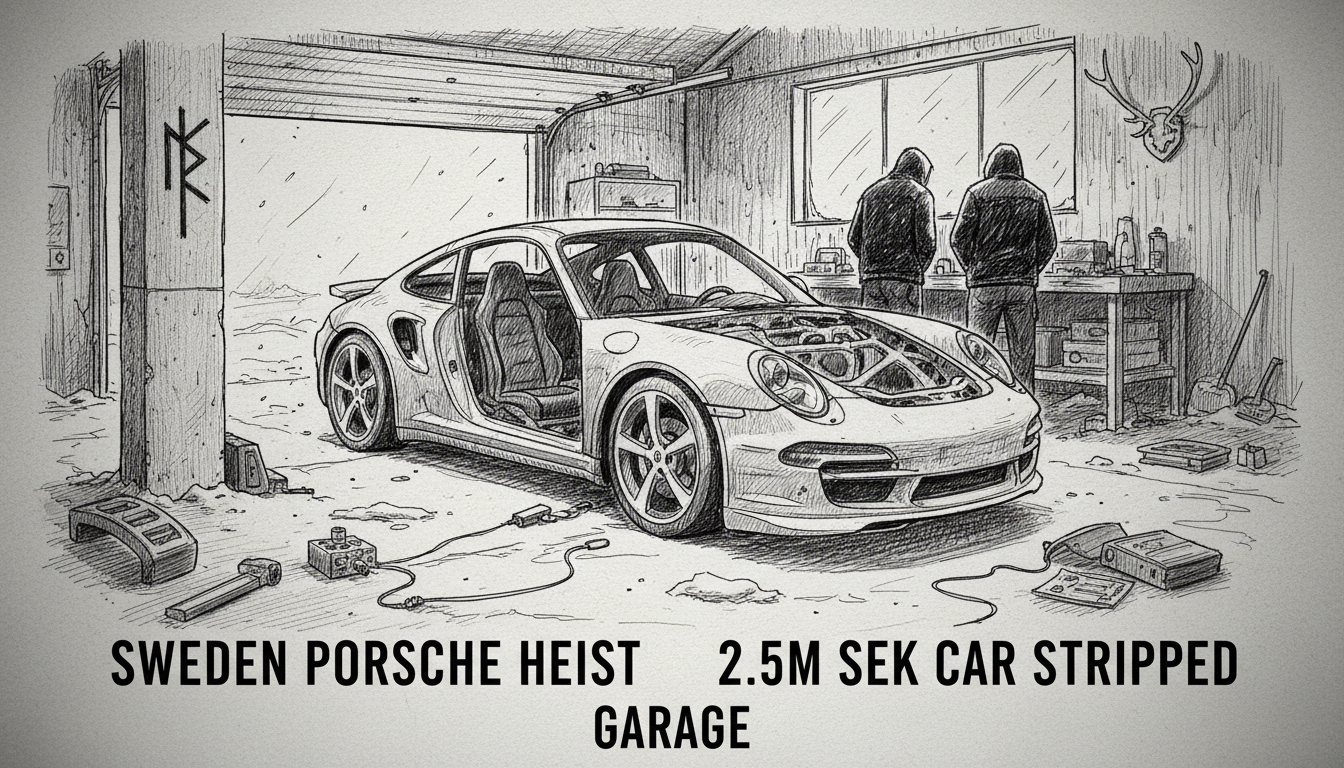
Swedish police arrested two men in the act of dismantling a 2.5 million kronor Porsche in an exclusive Stockholm garage. The owner received a mobile alert at 1:30 AM and found the suspects, who had already removed all four wheels, brakes, and other high-value parts. Officers responding to the call drew their service weapons before detaining the men, who were using a stolen BMW as their getaway and transport vehicle.
This brazen overnight theft in Östermalm, one of Stockholm's wealthiest districts, highlights a persistent trend in Swedish society. Luxury car parts are a prime target for organized crime networks. The incident exposes vulnerabilities in seemingly secure residential garages and raises questions about the market driving these thefts.
A Midnight Alert in Östermalm
The night was quiet in the upscale Östermalm neighborhood. Then, a smartphone buzzed with an urgent alert. A car owner's Porsche, parked in his building's underground garage, was being tampered with. He didn't call the police immediately. Instead, he went downstairs to investigate for himself.
"He sneaked down to the garage," a police report later stated, describing the owner's cautious approach. What he saw was a professional operation in progress. Two men in balaclavas were actively dismantling his high-performance vehicle. The owner retreated and finally made the call to authorities.
Three police officers responded to the scene. As they turned a corner in the garage, they came face-to-face with the thieves. "We see two men in robber hoods moving around and behind the cars," one officer wrote in the report. The officers drew their weapons, shouting commands. The suspects complied immediately, raising their hands and lying down on the garage floor.
The Professional Dismantling of a Dream Car
The scene the police secured was one of methodical stripping. The suspects hadn't just stolen the car; they were harvesting its most valuable components. All four wheels with their high-end tires and alloy rims were gone. The high-performance brake system—including calipers, discs, and pads—had been carefully removed.
These parts were already loaded into a black BMW sedan parked nearby. Police investigations revealed this BMW was itself a stolen vehicle, taken from a garage in the neighboring Vasastan district just days earlier. It served as both the thieves' transport to the scene and their moving van for the stolen goods.
The targeted Porsche, valued at approximately 2.5 million Swedish kronor (about €220,000), represents the peak of automotive luxury. Its parts command high prices on both legitimate and illicit markets. A single carbon-ceramic brake set from such a vehicle can cost over 100,000 SEK to replace.
The Organized Crime Behind Car Part Theft
This is not a crime of opportunity. It is a planned economic operation. "What we see here is professionalization," says Lars Almgren, a security analyst and former police investigator specializing in property crime. "They target specific models for specific parts. There's a supply chain. The garage in Vasastan was scouted for the BMW, which was then used to hit the Porsche in Östermalm. This is logistics."
Almgren explains that organized groups, often with international connections, drive this market. Stolen parts are quickly moved, repackaged, and sold online or shipped abroad where verification is harder. "A wheel set from a Porsche Turbo S can fetch 80,000 SEK on the black market. For these groups, it's a low-risk, high-reward business compared to other crimes."
Statistics from the Swedish National Council for Crime Prevention (Brå) show that while overall vehicle theft fluctuates, the targeting of luxury brands remains consistently high. In Stockholm County, vehicles from brands like Porsche, BMW, Mercedes, and Land Rover are disproportionately represented in theft reports. The trend isn't about stealing the whole car, but efficiently harvesting its most valuable components.
Garage Security: A False Sense of Safety?
The incident challenges the perceived security of residential garages. Many buildings in areas like Östermalm and Vasastan have controlled access, but these measures are often overcome. "A garage door remote signal can be captured and cloned from outside the building," explains security consultant Mira Pettersson. "Or someone simply follows a resident's car inside. Once you're in, you're in. You have time and privacy."
Pettersson advises car owners, especially of high-value models, to use additional physical deterrents like steering wheel locks and wheel clamps, even indoors. "It's about adding layers of time and difficulty. These thieves work quickly. If your car looks harder to strip than the one next to it, they'll move on."
Some newer residential complexes in Stockholm are now installing dedicated garage security, motion-activated lighting, and direct alarm links to security firms. However, in older, prestigious buildings, infrastructure upgrades are slow and costly.
The Human Element: Trust and Fear in the City
Beyond the statistics and security advice, these crimes affect the social fabric. "You feel violated," says Erik, a resident in a nearby building who asked not to use his full name. His own car was targeted last year. "It's not just the money or the insurance hassle. It's that someone was in our space, our private garage. It makes you look at your neighbors differently, at every unfamiliar van."
This erosion of trust is a subtle but significant cost. The Stockholm lifestyle, especially in inner-city districts, relies on a certain level of communal security. Incidents like the Porsche heist remind residents that gates and codes are not impenetrable.
Police have increased patrols around residential garage areas in the inner city following a spate of similar thefts. Their advice is clear: always report suspicious activity immediately, never confront thieves yourself, and invest in a separate GPS tracker for high-value vehicles.
Looking Ahead: A Market-Driven Problem
The fundamental driver remains economic. As long as there is a lucrative global market for high-end automotive parts, thieves will seek to supply it. Law enforcement efforts are increasingly focused on disrupting the online marketplaces and transport channels used by these networks.
"We are working more on the financial trail and the digital footprint," a Stockholm police spokesperson said. "Following the part, not just the thief." This means closer cooperation with customs authorities and online platform regulators.
For the owner of the dismantled Porsche, the process of repair and insurance will be long. The car will likely be out of commission for months as rare parts are sourced. The two arrested men face charges of aggravated theft, receiving stolen goods, and vehicle theft.
Their capture in the act is a victory for police response. But the broader story continues. In the quiet garages of Stockholm's most expensive neighborhoods, the high-stakes trade in luxury car parts shows no signs of slowing down. The next alert could come at any time.