
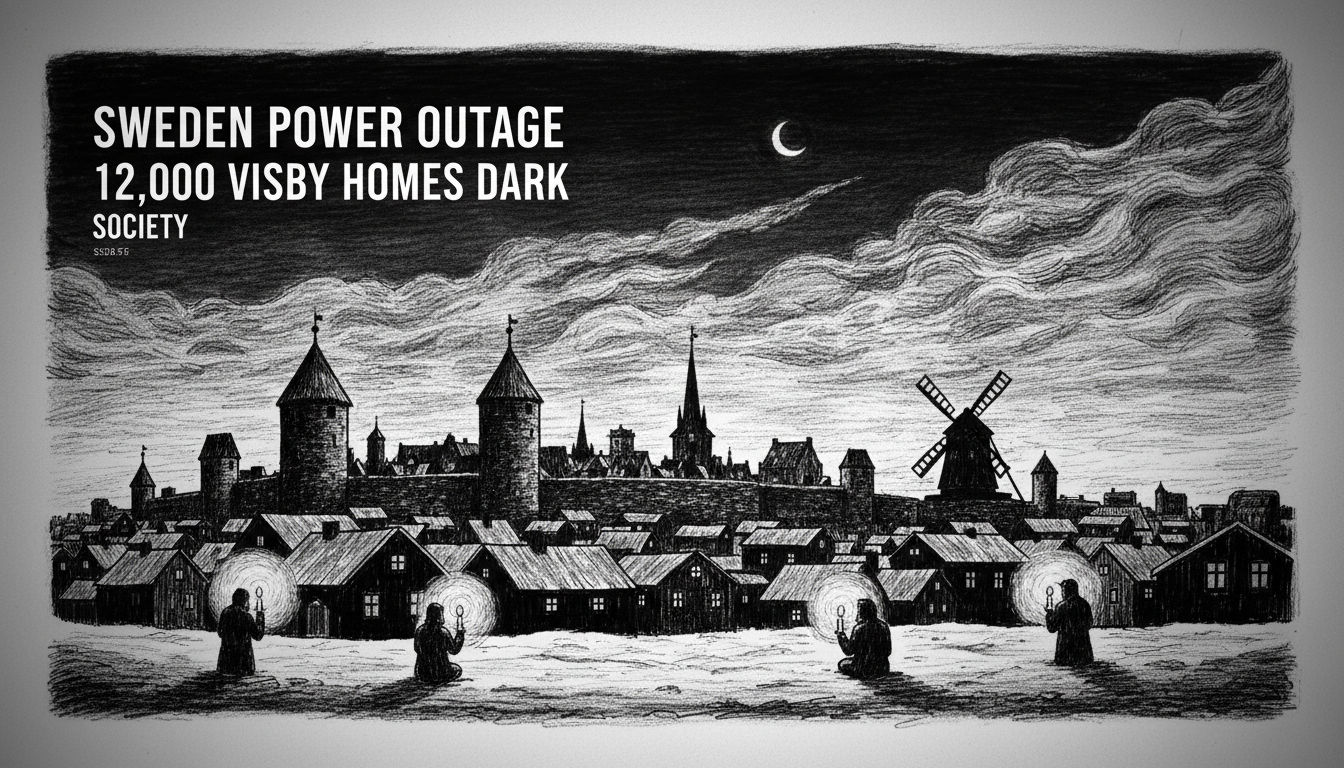
Sweden's medieval gem of Visby was plunged into darkness on Monday evening. Up to 12,000 households on the island of Gotland lost power just before 7 PM, a sudden blackout that disrupted dinner preparations, halted evening routines, and cast the UNESCO World Heritage site into an unexpected silence. For an hour, the modern pulse of the island flickered out.
"We don't know exactly what caused the fault, but we are doing what we can right now to find out," said Johanna Fridh, a representative for the energy company Geab. Her statement, issued as crews scrambled, captured the initial uncertainty. The outage map told a story of rapid response. By approximately 8 PM, the number of affected homes had dropped sharply to around 3,000, a sign of swift repair work in the fading daylight.
An Island in the Dark
The timing, at 18:51, is the heart of the Swedish kväll—the evening. This is when families gather for the evening meal, middag. Students are finishing homework. The gentle hum of refrigerators, internet routers, and televisions forms the backdrop to domestic life. In Visby, that hum stopped. On a spring evening, the outage meant more than just lost light. It meant paused cooking, searching for candles, and a sudden awareness of how deeply modern life is woven into the electrical grid.
Gotland, Sweden's largest island, presents unique challenges for infrastructure. Separated from the mainland, it operates its own energy balance. While connected by submarine cables, local distribution is key. An outage here isn't just a neighborhood problem; it can affect a significant portion of the island's population at once. Visby, with its cobblestone streets and historic wall, is a dense urban center within a rural landscape, making a centralized fault impactful.
The Swift Return to Light
The rapid restoration for most customers—within an hour—points to a localized fault rather than a systemic grid collapse. Energy experts often highlight the Swedish grid's general robustness, a product of continuous investment and cold-climate preparedness. "The priority in any outage is to restore power to the greatest number of customers as quickly as possible," explains Lars Bengtsson, an independent energy analyst based in Stockholm. "The speed of the initial fix in Visby suggests crews identified and isolated a specific problem, perhaps a transformer fault or a cable issue, allowing them to reroute power."
For the 3,000 households that remained without power longer, the experience was more protracted. In a society where digital connectivity is assumed, a prolonged outage cuts off information, work, and entertainment. It also raises practical concerns: the integrity of frozen food, the charging of phones, and heating if the outage had occurred in winter. Sweden's elförsörjningslag (Electricity Supply Act) mandates that distributors like Geab maintain high security of supply, making any significant outage a serious event they are obligated to investigate and report.
Grid Resilience in a Historic Setting
There's a poignant contrast in a power cut in Visby. This is a town defined by its medieval past, where the ring wall has stood for centuries. Yet, its modern life is utterly dependent on invisible, modern infrastructure running beneath and between the ancient stones. The outage underscores a constant, quiet effort: integrating 21st-century reliability into a historic environment. Cable work in a UNESCO site is never simple, requiring coordination with cultural heritage authorities to protect archaeological remains.
"Every outage is a stress test," Bengtsson notes. "For places like Gotland, which is also a leader in wind power, the grid must be smart enough to handle variable renewable input and resilient enough to withstand faults. This event will likely trigger a review of what happened at that specific substation or connection point to prevent a repeat." The goal for energy companies is not just to fix problems, but to build a grid where problems are increasingly rare and localized.
The Human Response: Fika by Candlelight
Beyond the technical analysis, the story is about how people react. In typical Swedish fashion, the response online and in community forums was pragmatic. There were reports of neighbors checking on each other, especially older residents living alone. The concept of trygghet—security and safety—is central to Swedish society, and a blackout momentarily challenges that feeling.
For some, it became an impromptu, analog evening. With Wi-Fi down, conversations and board games emerged. The humble candle, a staple in Swedish homes for creating mys (coziness), suddenly served a practical purpose. A planned television night might have turned into an early bedtime or a walk through the quiet, dark streets of the city center, seeing the famed wall under starlight instead of street lamps. These small adaptations reveal the cultural underpinnings of a society that, while advanced, still values simple preparedness.
Looking Ahead: A Report and Reflections
Geab will now be tasked with determining the root cause. Was it equipment failure, accidental damage from other work, or something else? A detailed report will follow. For residents, the event is a brief disruption. For the energy company, it's data. For planners, it's a case study in grid vulnerability.
The Visby outage, while brief for most, acts as a reminder. As Sweden and the Nordic region push toward electrification of transport and industry, and greater reliance on renewable energy, the demand on the grid grows. The expectation of perfect, uninterrupted power is high. Monday's event shows that even in one of the world's most stable energy nations, that expectation can momentarily falter. The true measure of the system is not that it never fails, but how quickly and effectively it heals itself. In Visby, the healing, for most, took about an hour. Life in the medieval town returned to its modern rhythm, with perhaps a newfound appreciation for the flip of a switch.