
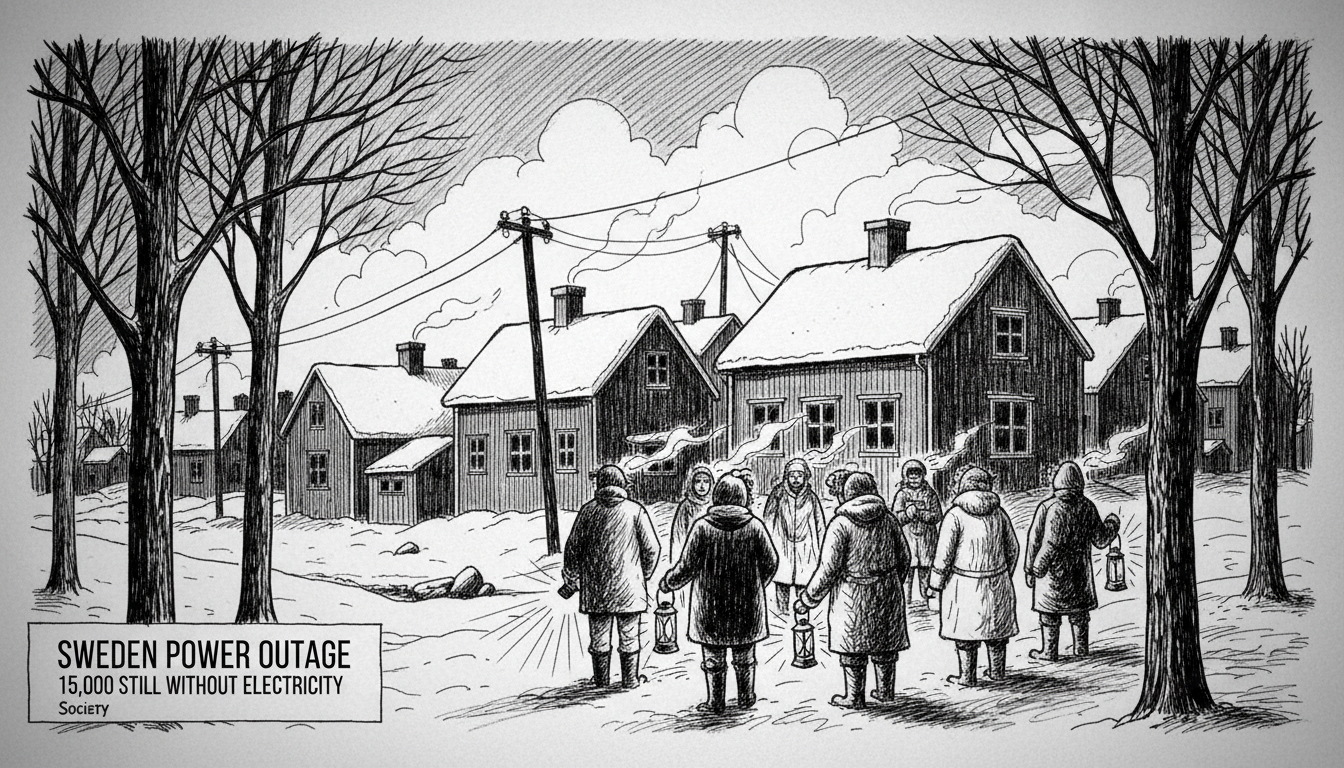
Sweden's Storm Johannes left a trail of destruction and over 15,000 households without power on Monday morning, a full day after the worst winds subsided. The scene across parts of northern and central Sweden has been described by power grid workers as a 'battlefield' of fallen trees and snapped power lines.
Jesper Liveröd from the electricity network company Ellevio used the stark term to describe the widespread damage. "It is a battlefield out there," he said. The storm, which peaked on Saturday night and into Sunday, initially cut power to more than 40,000 subscribers in the hardest-hit regions. While crews from Ellevio, Eon, and Vattenfall have worked non-stop to restore connections, the scale of the damage means many residents face a prolonged wait in the cold and dark.
For families in rural villages and forested areas, the reality is a sudden return to a pre-industrial age. They are firing up wood stoves for heat, cooking on gas camping stoves, and watching phone batteries dwindle as their primary link to the outside world. The outage highlights a persistent vulnerability in the Swedish infrastructure, where a vast network of above-ground power lines snakes through dense forests.
A Long, Cold Wait for Restoration
The restoration effort is a massive logistical operation. Repair crews must first assess damage across vast, often remote areas. Their main enemy is the Swedish forest. Fallen pine and spruce trees have taken down lines and smashed transformers. Each broken pole or severed cable requires individual attention. The work is slow, physical, and dangerous, especially with lingering icy conditions.
"The challenge isn't generating the electricity; it's delivering it," explains Lars Bengtsson, an energy infrastructure analyst based in Stockholm. "Sweden has a very robust production system with hydro, nuclear, and wind. But the final distribution network, particularly in rural areas, is exposed. A single fallen tree on a key line can plunge an entire parish into darkness."
This incident is not an isolated one. Similar scenes play out almost every autumn and winter when storms sweep across the country. Each event reignites a longstanding debate: should Sweden invest billions in burying its power lines?
The Billion-Krona Question: To Bury or Not to Bury?
The debate over underground cabling is a classic Swedish dilemma, balancing cost against resilience. Proponents argue it would virtually eliminate storm-related outages, protect the grid from falling trees, and reduce maintenance costs in the long term. It would also lessen the visual impact on Sweden's famed landscapes.
Opponents, often including the network companies themselves, point to the staggering expense. Burying cables is estimated to be up to ten times more expensive than overhead lines. That cost would ultimately be passed on to consumers through higher electricity network fees. There's also the practical issue of repairing buried lines, which can be more complex and time-consuming than fixing an overhead fault.
"It's a question of what society is willing to pay for security of supply," says Bengtsson. "We accept this risk for road networks—we don't build covered highways to protect against snow. With the grid, we've historically accepted a certain level of storm disruption as a trade-off for affordability."
Community Resilience in the Face of Darkness
While the companies work, a different kind of operation unfolds in the affected communities. The Swedish concept of 'grannsamverkan'—neighborly cooperation—kicks into high gear. In villages across Hälsingland, Medelpad, and Gästrikland, those with wood-fired stoves or generators are checking on elderly neighbors. Community centers, often powered by backup generators, become warming shelters.
Maja Lindgren, a resident of a small village outside Sundsvall, described her Sunday. "We lost power just after midnight. By morning, my husband had fired up our old wood stove. We invited our elderly neighbors over for a hot coffee. Their apartment was getting cold. It’s just what you do."
This self-reliance is a deeply ingrained part of Swedish culture, born from living in a sparsely populated country with a harsh climate. Many households keep emergency supplies, known as 'krishantering,' including candles, canned food, and alternative heat sources. The storm tests these preparations.
Climate Change and the Future of Sweden's Grid
Experts are increasingly connecting these severe weather events to broader climate patterns. While storms have always occurred, there is concern that their intensity and frequency may be changing. This puts additional pressure on aging infrastructure.
"The grid was built for the climate of the past," notes climate adaptation researcher, Karin Edström. "We are now seeing more precipitation and potentially more intense wind events. Our infrastructure needs to be assessed with this new reality in mind. It's not just about burying cables; it's about smarter grid management, better forestry practices near power lines, and local energy solutions like microgrids."
Some municipalities are exploring these hybrid solutions. Investing in local renewable sources, like solar panels with battery storage for critical public buildings, can create pockets of resilience even when the main grid fails.
A Glimpse of a Broader Swedish Challenge
The prolonged outage from Storm Johannes is more than a news story about bad weather. It is a snapshot of a challenge facing modern Sweden: maintaining a high-tech, electrified society dependent on a vulnerable physical network. The country aims for 100% renewable electricity production, but that green power still needs to travel to people's homes.
For the 15,000 households still waiting, the focus is understandably short-term. They want the lights and the heat back on. Utility companies predict most will be reconnected within the next 24-48 hours, but some isolated properties may face a longer wait.
As night falls again over the affected regions, the glow of candles and the hum of a few generators will punctuate the darkness. The storm has passed, but its lesson about the delicate balance between nature, technology, and community in Sweden remains, waiting to be addressed until the next wind blows.
Will the cost of future-proofing Sweden's grid remain too high, or will the repeated sight of thousands sitting in the cold finally tip the scales toward major investment?