
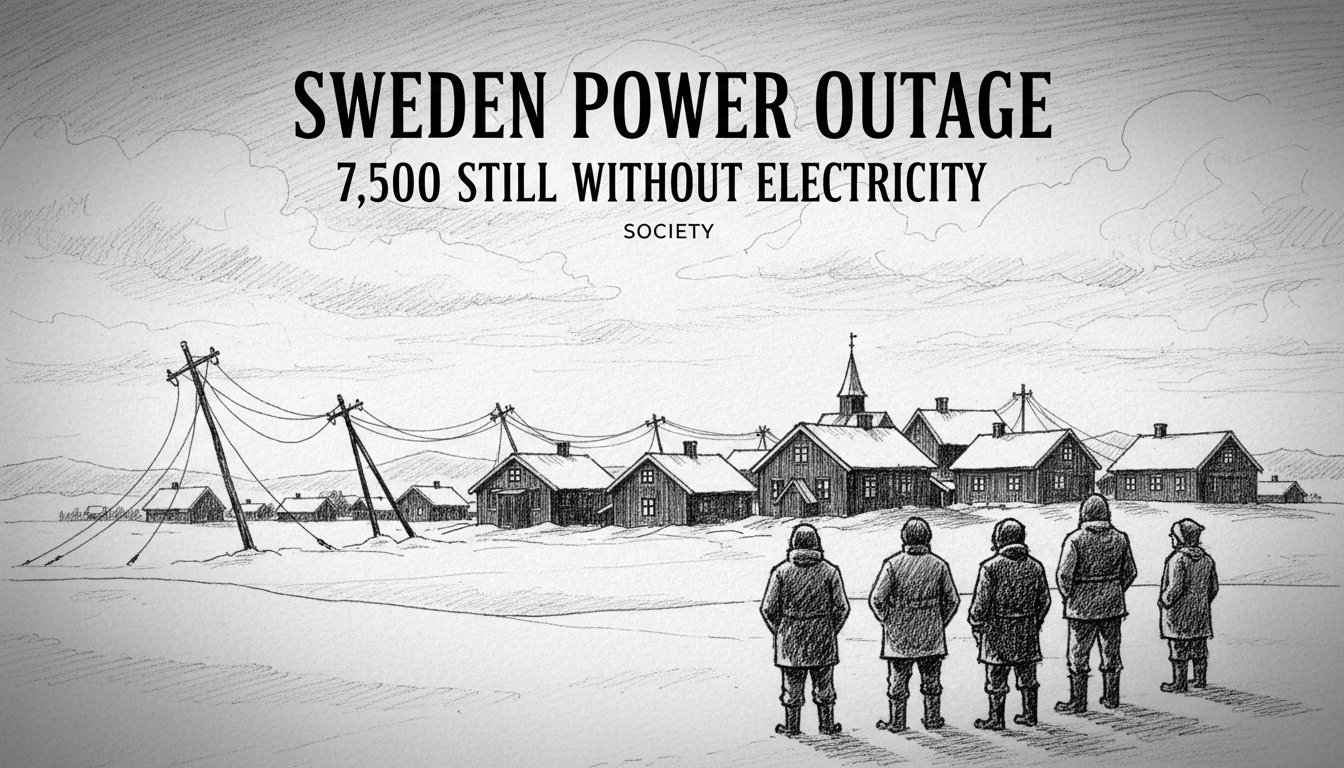
Sweden's Storm Johannes power outage has left thousands in the dark for days. Over 7,500 customers remained without electricity on Tuesday morning, three days after the storm first hit. The worst affected region is Gävleborg County, where more than 6,000 households and businesses are still waiting for the lights to come back on.
For families like the Karlssons in rural Hälsingland, the reality is cold dinners and candlelit evenings. "We lost everything in the freezer on Sunday," says Anna Karlsson, a mother of two young children. "Now we're heating water on our wood stove for baths. The kids think it's an adventure, but we're just counting the hours." This human impact, repeated across central Sweden, highlights the vulnerability of modern life to nature's whims.
The Storm's Widespread Impact
Storm Johannes swept across central Sweden with surprising force late Saturday. Initial reports focused on fallen trees and blocked roads. By Sunday morning, the true scale of the damage became clear. Over 40,000 customers were without power in the hardest-hit areas. While repair crews from major grid operators Vattenfall, Eon, and Ellevio worked through the weekend, progress has been slow in remote regions.
The geographical spread of the outage tells a story of rural vulnerability. Gävleborg County, with its vast forests and dispersed population, accounts for 80% of the remaining affected customers. Villages and isolated farms have been cut off, relying on generators if they have them. In contrast, urban centers like Gävle city had power restored much faster. This urban-rural divide in infrastructure resilience is a recurring theme in Swedish storm aftermaths.
A Test of Grid Resilience
This is not Sweden's first major storm outage, and it likely won't be the last. Autumn and winter regularly bring powerful weather systems across the Nordic region. Each event tests the national electricity grid and the protocols of the network companies. Experts point to systemic issues that these crises reveal.
"The fundamental challenge is an aging overhead grid in forested areas," explains Lars Bengtsson, an energy infrastructure researcher at Uppsala University. "When a major storm hits, trees fall on lines. The solution isn't just faster repairs—it's proactive investment. Burying lines is expensive, but so are repeated multi-day outages for thousands of people."
Bengtsson emphasizes that vegetation management is a critical, ongoing cost. "Keeping a clear corridor around power lines in dense Swedish forests is a constant battle. Budgets for this maintenance are often the first to be squeezed, which increases risk." The financial calculus for grid companies involves balancing infrastructure investment against the statistical likelihood of major storms.
Life on Hold in the Darkness
Beyond the statistics, the outage has frozen daily life. Small businesses are particularly vulnerable. Mikael Öberg runs a dairy farm outside Bollnäs. "Without power, the milking machines don't work," he says, frustration evident in his voice. "We have a backup generator for the cooling tanks, but it's costly to run. This isn't just an inconvenience—it threatens our livelihood."
Local municipalities have opened emergency warming centers in community halls and schools. These provide hot meals, device charging stations, and a warm space for the elderly and families with young children. The Swedish Civil Contingencies Agency (MSB) has been coordinating with regional authorities, a well-rehearsed dance for a nation accustomed to harsh winters.
Yet, the social strain is palpable. Community solidarity shines, with neighbors checking on each other and sharing generator power. But patience wears thin as the third night without electricity approaches. The constant hum of generators has become the background noise in affected villages, a temporary and expensive fix.
The Road to Restoration
Grid operators face a monumental task. Repair crews are assessing damage in difficult terrain, often needing specialized equipment to remove fallen trees and repair downed lines. A spokesperson for Ellevio stated that crews are working "around the clock" but acknowledged the complexity of repairs in forested areas. Safety protocols for workers also slow the process in dangerous conditions.
The restoration strategy follows a clear priority list. First, repairs that restore power to the largest number of customers. Second, critical infrastructure like hospitals and water treatment plants. Finally, the most remote individual connections. This triage approach means some households could face a longer wait.
Weather forecasts complicate the efforts. While no new major storms are imminent, freezing temperatures at night are a concern. Prolonged cold without heating pushes the situation from an inconvenience to a public health risk, especially for vulnerable populations.
A Recurring Swedish Dilemma
This outage forces a familiar national conversation. Sweden prides itself on reliability and a high-tech society. Yet its vast landscape and climate make its infrastructure uniquely vulnerable. The debate centers on cost versus resilience. Should consumers and taxpayers fund a massive program to bury power lines? Or accept that occasional multi-day outages are the price of living in a beautiful, forested country?
Comparisons with neighboring Norway are inevitable. Its mountainous terrain faces similar challenges, but investment in grid hardening has been a higher political priority in recent years. The Swedish model, with privatized grid operators regulated by the state, creates a different set of incentives and responsibilities.
For now, the focus remains on restoring power. But when the lights come back on in Gävleborg, the discussion shouldn't end. Each storm provides data on weak points in the network. The question is whether that data leads to investment or is simply filed away until the next crisis. As climate patterns shift, the frequency and intensity of such storms may increase, making this more than a theoretical debate.
In the dark, quiet houses of central Sweden, residents aren't thinking about grid policy. They're thinking about warmth, food, and normalcy. Their resilience is being tested not by a single storm, but by the systems meant to protect them from it. The true measure of this event will be how Sweden responds when the sun finally shines and the last generator is switched off.