
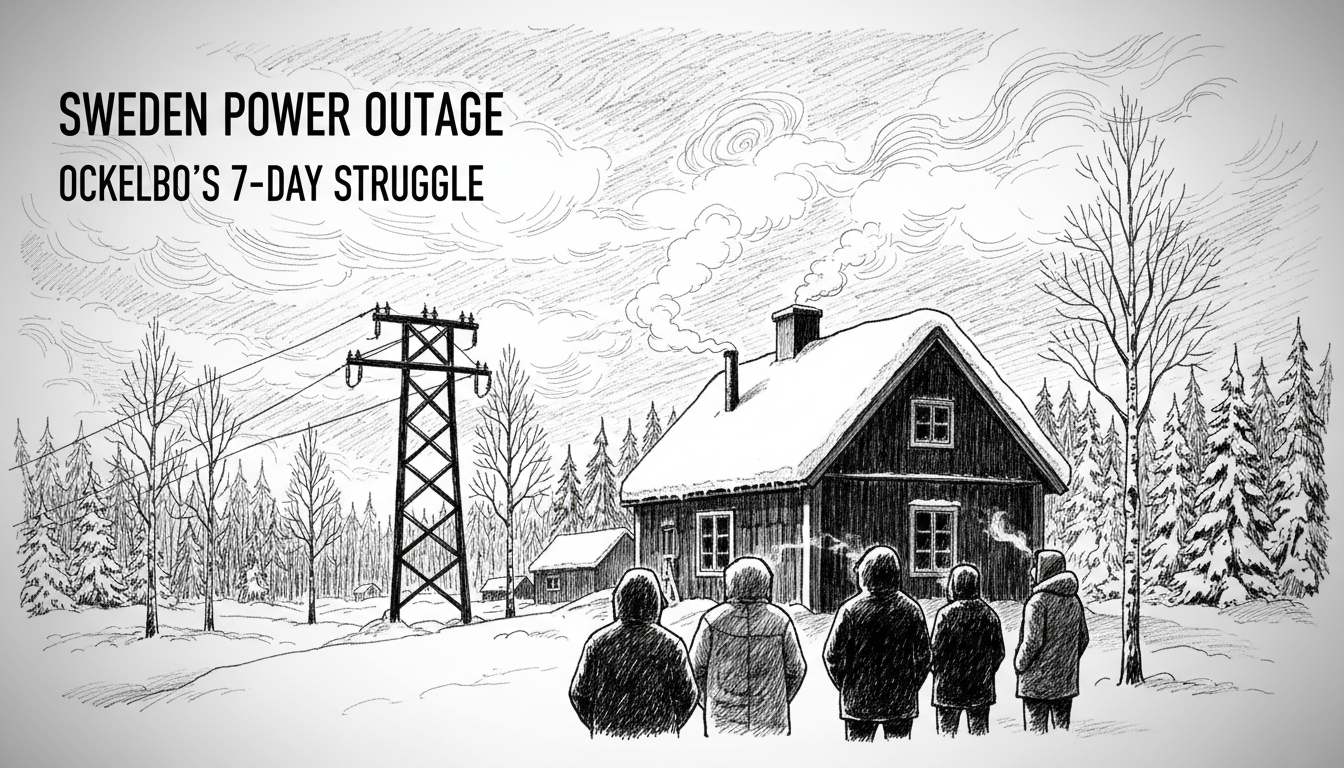
Sweden's reliable power grid has failed residents in Ockelbo, Gävleborg County, for seven days. A loud crash was the only warning before the lights went out. For a week, life has been reduced to basics: finding heat, preserving food, and relying on neighbors. This prolonged outage in a rural Swedish community reveals the hidden vulnerabilities in a nation proud of its energy security.
Markku Kalliokoski considers himself lucky. Two of the three electrical phases in his house still work. "We have power here and there," he says, his voice a mix of fatigue and resilience. "And we have a wood-burning stove we can fire up to get the heat going." His story is one of minor adaptation in a major crisis. Across Ockelbo, a locality of forests and scattered homes, the reality is harsher for many. The social contract of modern Sweden—constant electricity for heating, communication, and daily life—has been broken. "We neighbors are trying to help each other as best we can," Kalliokoski adds, highlighting the community spirit that has become essential for survival.
A Week in the Dark
The outage began with that single, ominous sound. In a region defined by its vast woodlands and low population density, the failure of an overhead power line can isolate hundreds. Gävleborg County's population density is far below the national average, making infrastructure repairs a logistical challenge, especially after severe weather. While Sweden boasts a low average number of power outage minutes per customer annually, this statistic offers little comfort to those experiencing a week-long blackout. The average is skewed by these intense, localized crises that push rural resilience to its limit.
Life without electricity in a Swedish winter, even a mild one, is a serious matter. Homes dependent on electric heat pumps grow cold. Water systems relying on electric pumps can fail. Freezers thaw, and refrigerated food spoils. Internet and phone networks become unstable, cutting people off from emergency updates, work, and family. The disruption goes beyond inconvenience; it strikes at the core of safety and well-being. For the elderly or those with medical needs, the situation can quickly become dangerous.
The Infrastructure Paradox
Sweden is a global leader in energy transition, with a robust mix of nuclear, hydro, wind, and biomass. The national grid is modern and highly efficient. Yet, this story from Ockelbo exposes a critical weak point: the final distribution network, especially in the countryside. Extensive overhead lines, strung through miles of forest, are susceptible to wind, heavy snow, and falling trees. Investing in burying these lines is astronomically expensive in such terrain, creating a financial paradox. How does a society balance the cost of ultra-resilience in remote areas with the practical reality of serving a scattered population?
Energy experts often point to this need for increased grid investment. Diversifying local energy sources, such as encouraging more household solar with battery storage, could provide crucial backup. Community microgrids are another discussed solution. But these are long-term projects. For Ockelbo this week, the solutions have been decidedly analog: firewood, generators shared between neighbors, and cool boxes placed outside in the winter air.
The Human Network: Fika in the Freezing Dark
This is where Swedish culture itself becomes part of the response. The concept of "grannhjälp"—neighborly help—is deeply ingrained. The practice of "fika," the cherished coffee break, persists even without power. People check on each other. Those with working fireplaces or generators open their doors. The local community center, if it has a generator, often becomes a warming shelter and information hub. This social cohesion is an unofficial but critical part of Sweden's disaster response. It's a resilience that doesn't appear on grid maps.
"It's gone to hell," one resident summarized bluntly to a local reporter, capturing the collective frustration. The sentiment isn't just about the lost comfort. It's about a broken expectation. Swedes pay considerable taxes and electricity bills for a standard of reliability that has, in this instance, vanished. The trust in the system is what feels damaged.
Looking Beyond Ockelbo
The Ockelbo outage is not an isolated event. Similar prolonged blackouts have occurred in other rural parts of Sweden and across the Nordic region after major storms. Each event prompts the same debates: Should consumers in vulnerable areas be better prepared with their own backup systems? Should the state invest billions to fortify the grid against what seem to be increasingly common extreme weather events? There are no easy answers.
For now, the focus in Gävleborg County remains on restoring power. Repair crews work long hours in difficult conditions. Municipalities activate their crisis plans. But for the residents of Ockelbo, this week will be remembered. It's a story of cold nights, spoiled food, and shared hardship. It's also a story of a community leaning on its own strength when the national infrastructure faltered. As Sweden continues its ambitious energy transition, the experience of Ockelbo serves as a stark reminder: a green and efficient grid must also be a resilient one, for every citizen, from the heart of Stockholm to the quiet forests of Gävleborg. The true test of a modern society isn't just how it powers its cities, but how it refuses to leave its smallest communities in the dark.
Will this event drive a new focus on rural grid resilience, or will it be forgotten once the lights come back on? The answer will determine how Sweden weathers the next storm.