
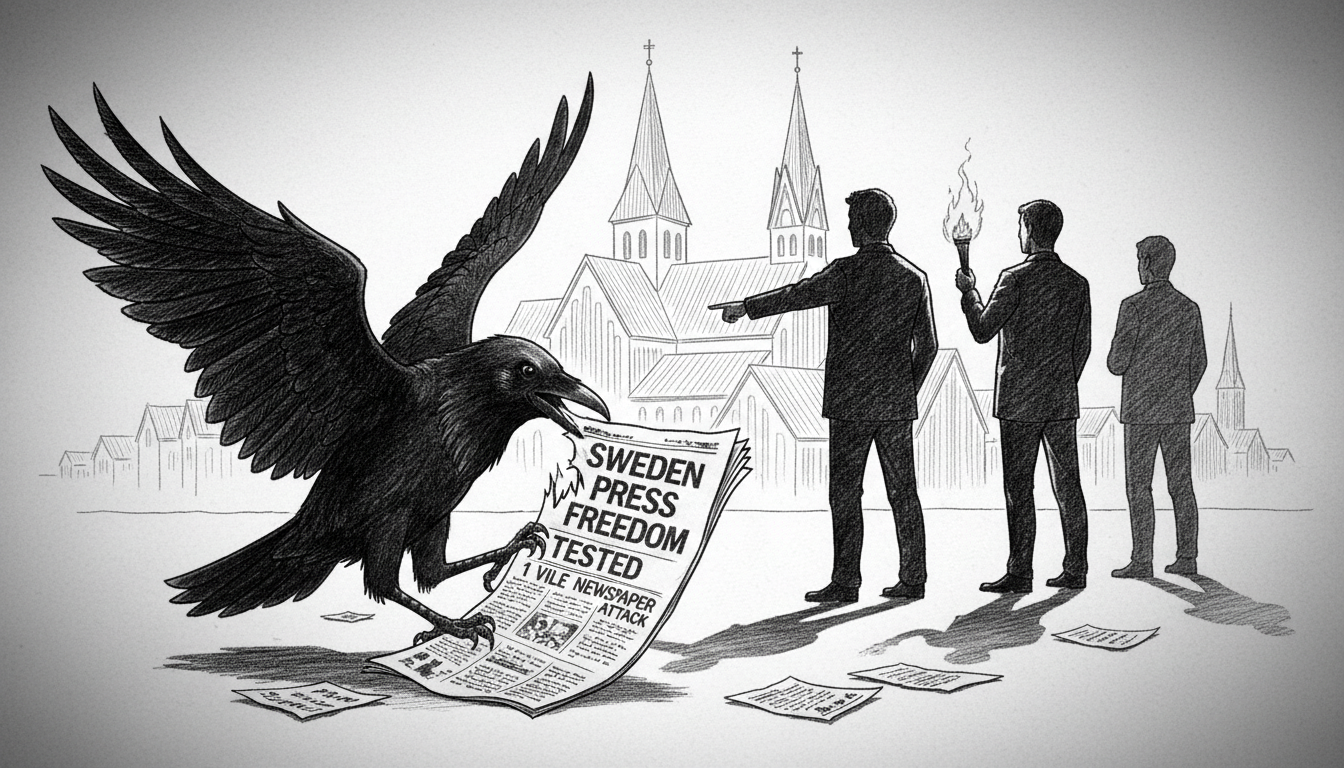
Swedish press freedom faced a crude and shocking test this week in Västerås. Employees arriving at their local newspaper office on Friday morning discovered the premises had been vandalized with human feces. The attack, which police are investigating as harassment, has sent ripples of disgust and concern through Sweden's journalistic community.
"It is a strange event," said editor-in-chief Daniel Nordström in a radio interview. His voice conveyed the mix of emotions felt by his team. "A great many people are upset, sad, and disgusted." The violation was both physical and symbolic, striking at the heart of a trusted local institution. For a country that consistently ranks among the world's best for press freedom, the incident felt profoundly alien.
Police spokesperson Pelle Vamstad confirmed an investigation for 'ofredande'—a charge covering harassment or molestation. Officers were on the scene collecting evidence. While the motive remains unclear, the act's intent to intimidate and degrade is unmistakable. In response, the newspaper is immediately bolstering security. Security guards will be stationed at the office, starting over the weekend, to protect staff.
A Stain on Swedish Media Tradition
This attack feels particularly jarring against the backdrop of Swedish media culture. Sweden has a centuries-old tradition of strong, independent journalism protected by constitutional law. The Principle of Public Access allows citizens to scrutinize official documents. Newsrooms, especially local ones like the targeted Västerås paper, are seen as pillars of the community. They report on council meetings, local sports, and school events. They are not typically fortresses.
"We have fairly strong security," Nordström noted, acknowledging the unsettling breach. "But obviously, this happened anyway, so we will have to review that too." His statement highlights a painful new reality. Even in a safe society, the tools of hatred and intimidation can find a way in. The move to hire guards transforms a newsroom from an open public service into a secured zone. It is a practical step that carries heavy symbolic weight.
The Global Context of Local Intimidation
Media analysts are watching this case closely. While they stress it appears isolated in the Swedish context, it connects to a worrying global pattern. Reporters Without Borders and other watchdogs document rising threats against journalists worldwide. These threats are often fueled by online vitriol and deepening political polarization. The attack in Västerås is a low-tech, high-impact version of this trend.
"Any act intended to silence or frighten journalists is an attack on democracy itself," says Lena Pettersson, a media ethics researcher at Uppsala University. I spoke to her for perspective on the incident. "In Sweden, we have been somewhat insulated from the physical threats seen elsewhere. This event is a stark reminder that no democracy is immune. The response must be unequivocal condemnation and a rigorous police investigation to ensure it does not inspire copycats."
Pettersson emphasizes that the strength of Swedish press freedom will be measured by the response. A thorough investigation and potential prosecution are crucial to deter future acts. The goal is to prevent a climate where journalists, especially at the local level, feel vulnerable for doing their jobs.
The Human Cost Beyond the Cleanup
The immediate revulsion of the vandalism is one thing. The lingering psychological impact on the staff is another. Coming to work to find your workplace defiled in such a personal, degrading manner creates a deep sense of violation. It is not just an attack on a building; it is an attack on the people who work there. Their sense of safety and professional purpose has been challenged.
Local journalists in cities like Västerås, Gothenburg, or Malmö are deeply embedded in their communities. They live where they work. This connection makes them accountable but can also make them more visible targets if someone holds a grievance. The newspaper has not speculated on a motive, and police have not identified any suspects. The possibility of it being a random act seems remote given the specific target. The choice of method—feces—is universally understood as an attempt to humiliate and express utter contempt.
Security and Openness: A New Balancing Act
The newspaper's decision to hire security guards is a pragmatic, short-term solution. It addresses the immediate fear among employees. However, it opens a broader discussion about the balance between security and accessibility. Swedish media outlets, particularly local papers, pride themselves on being approachable. Readers can call, email, or even visit to share a story tip or voice a concern.
Will heightened security create a barrier between the public and the press? It is a question newsrooms across the Nordic region may now ponder. The attack forces a recalculation of risk in an environment traditionally considered low-risk. Other editors, seeing this, might review their own protocols. The incident serves as an alarming case study.
A Test for Västerås and Sweden
The true test now lies with the community and the authorities. Västerås, a historic city on the shores of Lake Mälaren, is known for its industry and its cathedral. It is not known for attacks on its press. How the city rallies around its local newspaper will be telling. Public support for the journalists, in the form of letters, messages, or continued engagement with their work, can be a powerful counterweight to the vandal's message of hate.
Similarly, the police investigation's speed and transparency will be closely watched. A swift resolution would reinforce the societal norm that such acts are unacceptable and will be punished. A prolonged, unsolved case might leave a shadow of unease. The Swedish Union of Journalists will likely monitor the situation, offering support to the affected staff and advocating for their safety.
This is more than a crime scene cleanup. It is about cleaning up a stain on the idea of civil discourse. Sweden's democratic conversation relies on a free and secure press. When one newsroom feels threatened, the entire structure feels a tremor. The response must be firm, clear, and collective. The people of Västerås, and Sweden as a whole, must show that the best answer to an act of disgusting intimidation is a renewed commitment to clean, fearless journalism.
The coming days will reveal whether this was a grotesque one-off or a sign of a more troubling shift. For now, the staff in Västerås are trying to move forward, their work underscored by an unwelcome new reality. Their continued reporting, despite this intimidation, will be the most powerful rebuttal of all.