
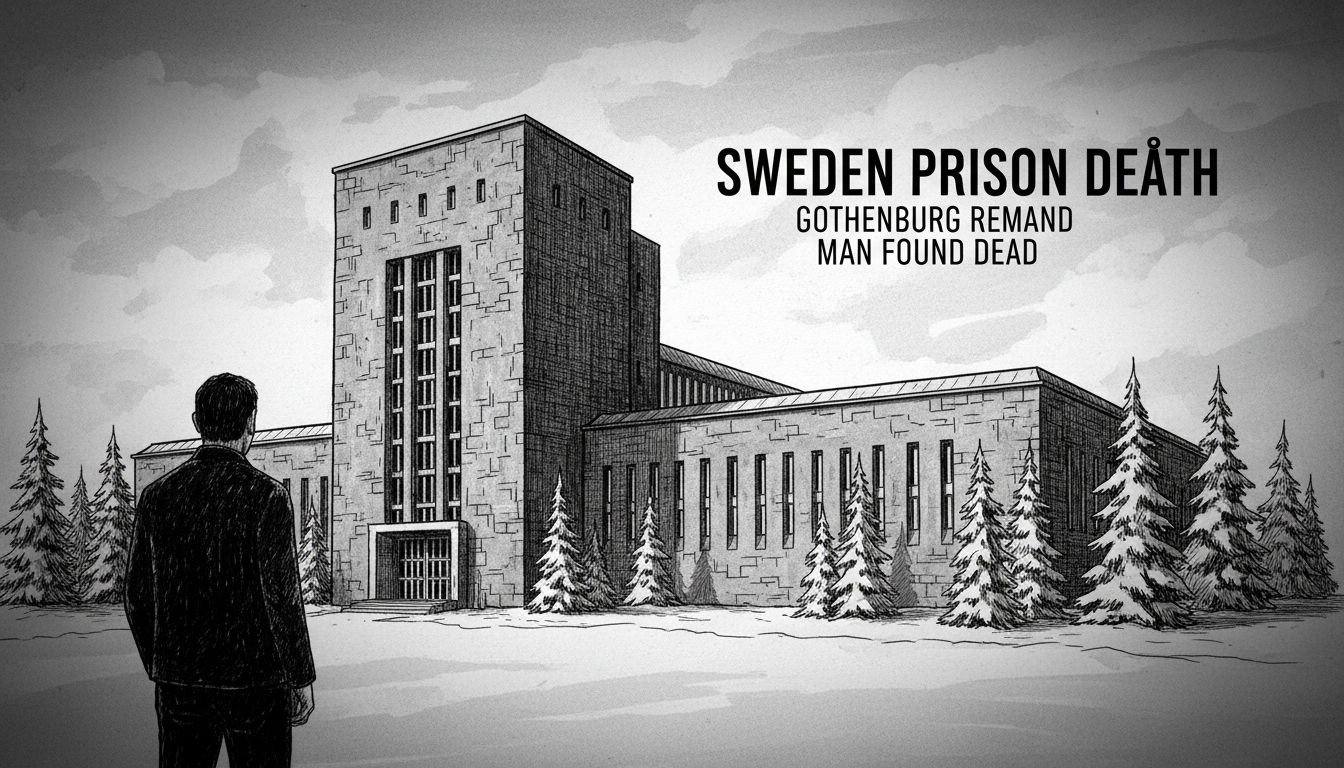
Sweden's prison service is investigating after a man was found dead in a remand cell in Gothenburg on Tuesday morning. The discovery was made during the morning unlock at the remand prison, known locally as a häkte. The Swedish Prison and Probation Service, Kriminalvården, confirmed the death but has not released the man's age or the cause. A report of misconduct in office has been filed, a standard procedure in such cases, though officials currently state there is no suspicion of a crime. Our thoughts are with the person's family and friends, said Mikael Ringberg of Kriminalvården. The man's next of kin have been notified.
A Standard Procedure in a Tragic Event
When a life ends behind the locked doors of a Swedish remand prison, a specific protocol swings into action. This week's event in Gothenburg follows that script. An ambulance and police attended the scene to formally confirm the death. Authorities then filed two separate reports: one for a death without initial criminal suspicion, and another for potential misconduct in office, known as tjänstefel. This dual-track approach is automatic. It aims to balance compassion with rigorous accountability. The misconduct report does not imply guilt. It is a legal mechanism to ensure every action, or inaction, by staff is scrutinized. The investigation will look at cell checks, medical care, and overall procedures. It is a sad reality, but these investigations are crucial for transparency, says a source familiar with prison oversight. They protect the rights of the deceased and maintain public trust in the system.
The Reality of Life on Remand
To understand the gravity of this event, one must understand the Swedish häkte. It is not a prison for serving a sentence. It is a pre-trial detention facility, a place of waiting. Inmates here are awaiting trial or deportation. The uncertainty can be crushing. The environment is often more restrictive than a regular prison, with less access to activities and programs. Mental health challenges are prevalent. A 2022 report by the Swedish National Board of Health and Welfare highlighted the high prevalence of psychiatric disorders among detainees. Suicide is a leading cause of death in custody globally, and Sweden is not immune. While official 2022 statistics show 17 deaths across all Kriminalvården institutions, each number represents a profound human tragedy. Each case prompts questions about societal responsibility for those in its care, even when they are accused of crimes.
A System Under Constant Scrutiny
The Swedish prison and probation service operates under the principle of normalization. The idea is that life inside should resemble life outside as much as possible, a concept deeply rooted in Swedish societal values. Yet remand prisons exist in a tense space between security and humanity. Human rights organizations like the Swedish Helsinki Committee and Amnesty International Sweden periodically review conditions. Their focus is on isolation, access to healthcare, and the treatment of vulnerable groups. The filing of a tjänstefel report in Gothenburg will trigger an internal review by Kriminalvården's own inspection unit. Simultaneously, the police may conduct a preliminary investigation if any crime is suspected. This layered oversight is designed to leave no stone unturned. It is a system that tries to learn from every loss, says a criminology researcher at Stockholm University. But the ultimate measure is prevention. How do we better support people in the most vulnerable point of their encounter with the justice system?
The Human Cost Behind the Headline
Beyond the official statements and procedural jargon lies a simple, devastating truth: a man has died alone in a cell. His family in Sweden or abroad is now grieving a sudden, shocking loss. For the staff at the Gothenburg remand prison, it is also a traumatic event. Correctional officers in Sweden are not just guards; they are trained in conflict management and basic welfare support. Finding a deceased inmate is a deeply affecting experience that requires its own psychological support. The incident ripples outwards, touching lawyers, social workers, and others connected to the man's case. In neighborhoods like Majorna or Hisingen, where news of local remand incidents often travels, it sparks quiet conversations about justice, safety, and second chances. It reminds us that the prison wall separates, but does not isolate, human fate from the community.
Looking Ahead: Questions of Care and Accountability
The coming weeks will see a slow release of information. A cause of death will be determined. The internal and police investigations will conclude, though their full findings may not be public. The key question will be: could this death have been prevented? Experts point to several ongoing challenges. Overcrowding in some remand centers strains resources. Recruiting and retaining qualified staff is difficult. The complex needs of the inmate population, from addiction to severe mental illness, require specialized responses that prisons are not always equipped to provide. Sweden prides itself on a humane justice system. Incidents like the one in Gothenburg test that self-image. They force a societal reckoning with how we treat those we have decided to lock away. The true measure of the system's humanity is not in its modern facilities, but in how it protects the life and dignity of the most vulnerable within its walls. As the investigation proceeds quietly in Gothenburg, the fundamental issue remains. How does a society committed to welfare and equality ensure those values extend behind the locked door of a remand cell? The answer defines not just the system, but the society itself.