
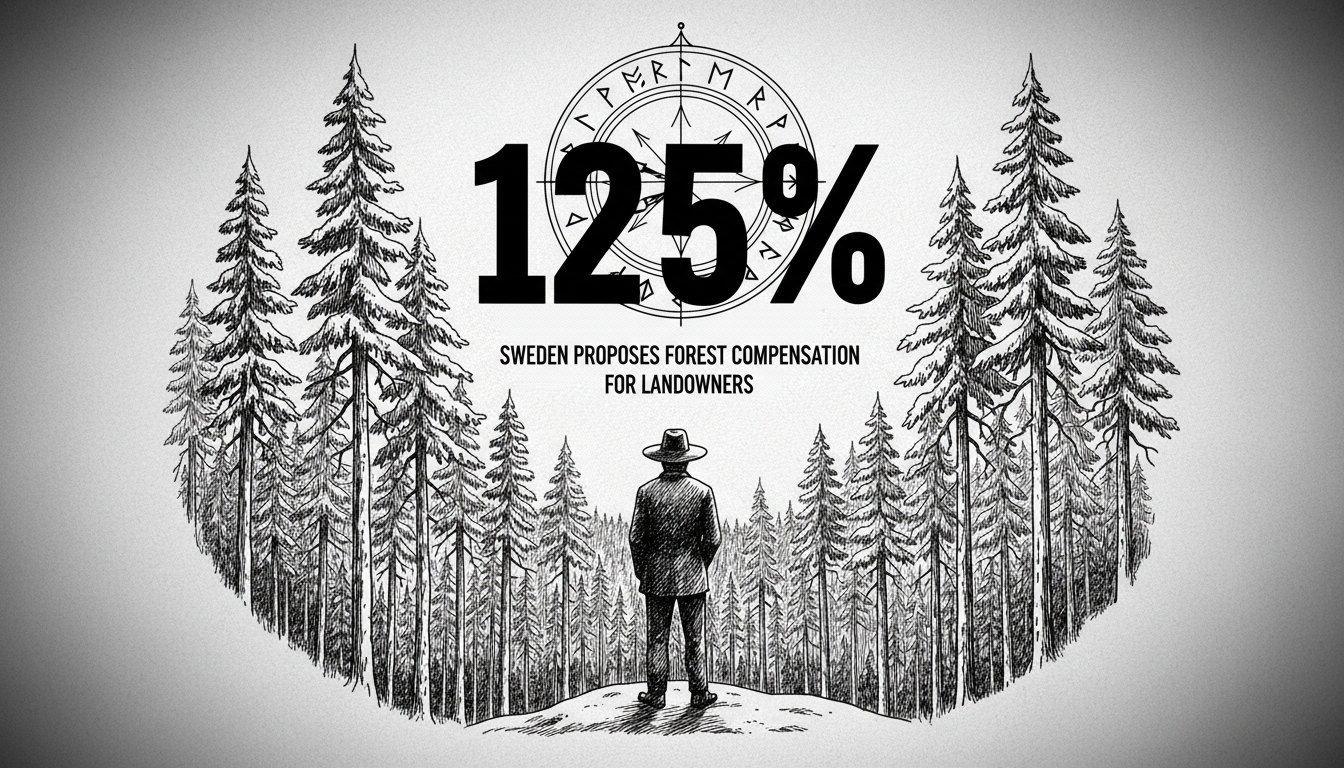
Sweden's government has proposed a landmark policy to compensate forest owners when species protection laws restrict their logging rights. Climate and Environment Minister Romina Pourmokhtari announced the plan at a press conference in Stockholm, aiming to resolve a persistent conflict between economic forestry and biodiversity goals. The proposal mandates compensation at 125% of the calculated property value loss when protection measures 'significantly hinder' ongoing land use.
Minister Pourmokhtari framed the initiative as correcting a fundamental imbalance. 'Today there is a clear imbalance. Responsible landowners who practice sustainable forestry risk having their logging stopped completely without compensation,' she stated. The Swedish Forest Agency (Skogsstyrelsen) will be tasked with negotiating and administering these compensation agreements directly with landowners. This move directly addresses what the government calls uncertainty and legal disputes stemming from current species protection ordinances.
A Decades-Old Conflict Reaches a Turning Point
The tension between Sweden's powerful forestry sector and its environmental commitments is deeply rooted. Forests blanket roughly 70% of the country's land area, and the industry contributes about 10% of Sweden's total export value. The 'artskyddsförordningen' (Species Protection Ordinance) has long been a flashpoint, allowing authorities to halt logging to protect endangered species like lichens, beetles, and birds that depend on old-growth forests. Landowners have argued this constitutes a disproportionate financial burden, effectively imposing conservation costs on private individuals without state support.
The new compensation framework, emerging from the government offices at Rosenbad, represents a significant philosophical shift. It acknowledges a form of 'regulatory taking,' where public environmental benefit creates a private economic loss. By assigning the Forest Agency as the broker, the policy seeks to move conflicts from the courtroom to the negotiation table. This procedural change aims to reduce the number of appeals against logging decisions, which Pourmokhtari identified as a primary source of sector instability.
Mechanics of the Market-Based Model
Under the proposed system, compensation triggers when species protection measures 'substantially impede' ongoing forestry operations. The key metric is the reduction in the property's market value caused by the logging restriction. A valuer will assess this diminution, and the state will pay the landowner 125% of that calculated amount. The extra 25% is designed to cover ancillary costs and transaction fees associated with the valuation and negotiation process.
This model places significant responsibility and discretion on the Swedish Forest Agency. Its officials must determine what constitutes a 'substantial' impediment and negotiate fair valuations. The policy does not create a blanket compensation right for any species-related restriction; the hurdle of significant hindrance must be met. This approach attempts to filter out minor inconveniences while addressing cases where conservation mandates cause genuine economic hardship. The Riksdag will debate the specific legal thresholds and definitions in the coming months.
Balancing Economic and Environmental Ledgers
Initial reactions suggest the proposal walks a political tightrope. Landowner associations have historically demanded compensation, arguing that society-wide biodiversity goals should be funded publicly, not privately. From their perspective, the 125% figure is a starting point for negotiations, with details on valuation methodology being critical. 'The devil will be in the details of how 'substantial hindrance' is defined and how property devaluation is calculated,' said a representative from a major forest owners' federation, speaking on background.
Environmental organizations are scrutinizing the plan for potential loopholes. A core concern is whether the compensation model might inadvertently pressure authorities to avoid issuing protection orders due to budget constraints. If the Forest Agency must pay from its own budget, will it become reluctant to enforce the Species Protection Ordinance? Others question if the policy sufficiently incentivizes proactive conservation beyond mere compensation for enforced restrictions. The government has not yet detailed the total projected fiscal impact or the specific budgetary source for the compensation funds.
A Broader Trend in Nordic Environmental Policy
Sweden's move reflects a broader European and Nordic trend of integrating market mechanisms into environmental governance. The policy aligns with principles of 'just transition,' seeking to ensure the costs of green policies are not borne unevenly by specific groups. It also represents a pragmatic attempt to reduce legal friction and accelerate conservation outcomes by making them more economically palatable for landowners.
However, experts point to unresolved questions. Will compensation valuations accurately reflect long-term ecological values, which are notoriously difficult to price? Does the model adequately consider non-timber forest values, such as recreation and carbon sequestration? The success of the policy may hinge on the Forest Agency's capacity as an honest broker and valuer. Furthermore, the Riksdag must ensure the final legislation strengthens, rather than inadvertently weakens, the underlying protection for threatened species.
The Road Through the Riksdag
The proposal now enters Sweden's legislative process. Government bills will be prepared for review by the Riksdag's Committee on Environment and Agriculture. This committee will solicit feedback from agencies, industry groups, NGOs, and academic experts in written reports and public hearings. The multi-party nature of the Swedish Parliament means the minority government must build a coalition to pass the law. Key points of negotiation will likely include the precise compensation percentage, the definition of triggering restrictions, and safeguards against the dilution of species protection.
Minister Pourmokhtari's Liberal Party, part of the governing coalition with the Moderates and Christian Democrats, has staked political capital on this reform. The outcome will test the government's ability to deliver on promises to both support rural economies and meet national and EU biodiversity targets. The debate will also reveal the political appetite for using state funds to subsidize private landowners for public environmental goods—a concept that could set a precedent for other policy areas.
A New Chapter for Swedish Forests?
If enacted, this policy could fundamentally alter the social contract between Swedish forest owners and the state. It moves from a punitive or restrictive model to a compensatory one, recognizing landownership rights while affirming public conservation interests. The 125% compensation figure is a bold opening bid, signaling the government's desire to settle the issue decisively.
The final measure of success will be on the ground. Will it lead to fewer legal battles and more cooperative habitat management? Will it genuinely protect species while maintaining a vibrant forestry sector? As the proposal winds its way from Rosenbad to the Riksdag building, it carries the weight of reconciling two pillars of Swedish identity: its deep connection to the forest landscape and its ambition to be a global leader in environmental stewardship. The coming parliamentary session will determine if this financial formula can buy peace in the woods.