
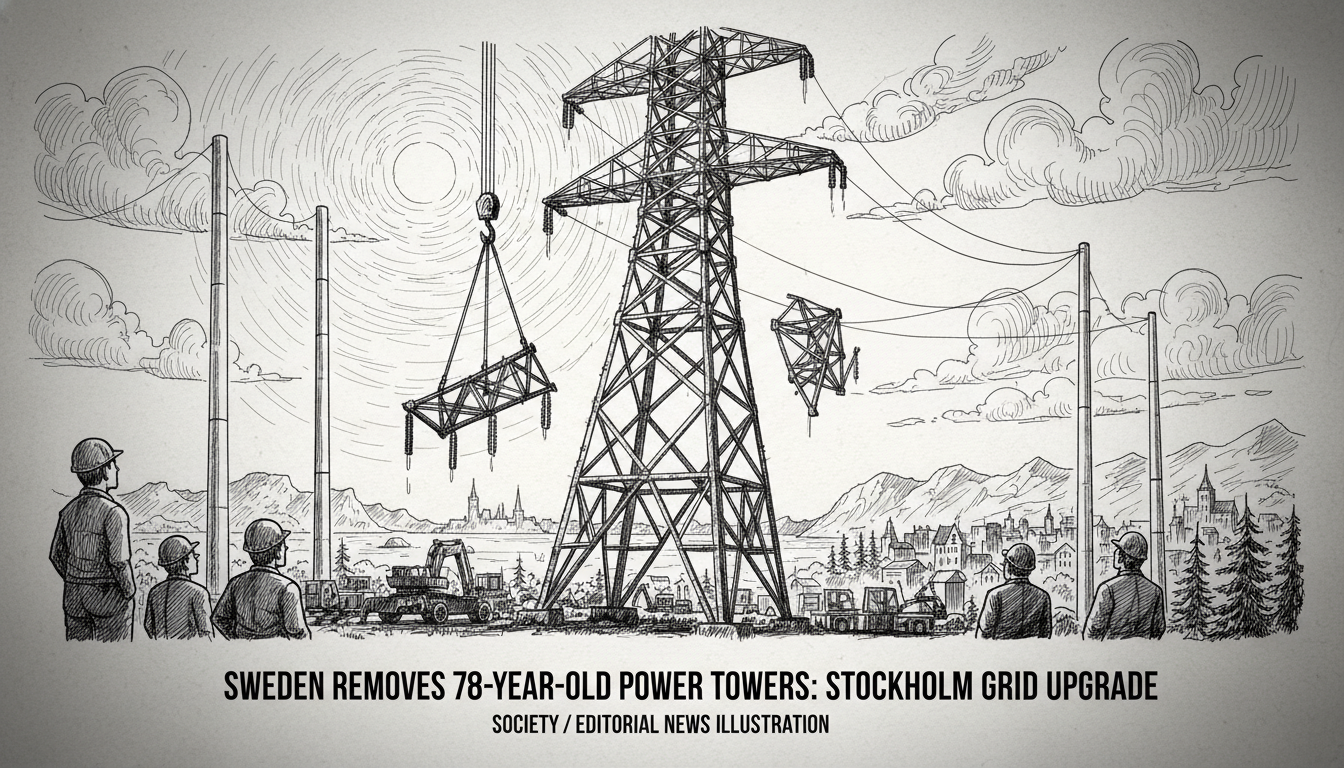
Stockholm's power grid is demolishing 78-year-old transmission towers on Norra Djurgården to eliminate a critical bottleneck. This move signals a shift from visible infrastructure to hidden, high-capacity cables buried underground. For decades, these 20-meter steel structures have been a fixture in the Royal National City Park, but they now make way for a system designed to power a growing, electrified metropolis.
Ann Bjurström, head of programs and projects at grid owner Ellevio, stated the urgency. 'Capacity shortage has long been a brake on Stockholm's development. Now we are loosening one of the knots so that more homes, businesses, and electrified transport can become reality,' she said in a statement. The upgrade directly supports business districts like Östermalm and Södermalm, where tech startups and fintech firms demand reliable, ample electricity.
The End of an Industrial Era
The towers were erected in 1947, part of Sweden's post-war reconstruction. They have carried power across northern Stockholm for 78 years, becoming an unintended landmark. Their removal this year marks the end of an era where overhead lines were the standard. The new underground cable, stretching several kilometers, represents a modern approach. It prioritizes aesthetics, environmental protection, and reliability. This change reflects broader trends in urban infrastructure, where utilities are hidden to preserve scenic values and reduce vulnerability.
Work on the underground project began in 2021, not 2020 as initially planned, due to logistical and legal hurdles. Ellevio invested significantly, though exact figures are undisclosed. The project's scale is substantial, aiming to future-proof the network for coming decades. Stockholm's population growth, estimated at over 1.5% annually, pressures all city systems. Power demand is rising sharply from new housing, commercial spaces, and electric vehicle charging stations.
Solving Stockholm's Capacity Crunch
Ellevio identified this stretch on Norra Djurgården as one of Stockholm's most critical bottlenecks. Capacity constraints have limited development in nearby areas, including emerging innovation hubs. For startups in the Swedish tech scene, consistent power is non-negotiable. Data centers, research labs, and office spaces in the Stockholm business district cannot afford interruptions. This upgrade unlocks potential for more construction projects and economic activity.
The underground cable increases transmission capacity dramatically. It uses advanced technology to minimize energy loss and enhance grid resilience. This is crucial for supporting Sweden's green transition, including widespread adoption of electric vehicles and renewable energy integration. Analysts note that robust infrastructure is a backbone for innovation. Without it, ambitions in Nordic fintech and cleantech could stall.
Community Resistance and Legal Resolution
Residents in the Ekhagen area protested the project, appealing for the complete removal of all power poles. Their concerns included visual impact and environmental disruption in the protected parkland. The case went to the Land and Environment Court, causing delays. In fall 2024, work resumed after the court process concluded. Ellevio reached a compromise: most towers were removed, but two poles near Roslagsvägen remain above ground for economic reasons.
This outcome highlights the tension between infrastructure needs and community preferences. Urban development in Stockholm often faces such challenges. Balancing growth with quality of life is a constant negotiation. The resolution allowed the project to proceed while addressing some resident concerns. It sets a precedent for future infrastructure upgrades in sensitive areas.
Powering a Modern Innovation Hub
The upgraded grid has immediate implications for Stockholm's business landscape. Reliable electricity is a key factor for companies choosing locations. In districts like Hagastaden and Norra Djurgårdsstaden, new developments can now proceed with confidence. Venture capital firms funding Swedish startups consider infrastructure quality when investing. A stable power supply supports everything from cloud computing to manufacturing prototypes.
Experts emphasize that cities competing globally must invest in hidden infrastructure. 'Stockholm's move underground is smart,' said Karl Lindström, an infrastructure analyst at a Nordic consulting firm. 'It reduces visual clutter, minimizes outage risks from storms, and supports denser urban growth. For tech companies, this is as important as broadband speed.' The project aligns with Sweden's goals to become a leader in sustainable urban living.
Ellevio's investment also reflects private sector responsiveness to public needs. As a major grid operator, they navigate regulatory, environmental, and economic factors. The successful cable installation demonstrates that large-scale projects can adapt to feedback. This agility is essential in a fast-changing energy market.
Looking Ahead: Infrastructure as an Innovation Enabler
With the towers gone, Norra Djurgården will regain a more natural skyline. The park, part of the Royal National City Park, benefits from reduced industrial presence. However, the real story is beneath the surface. The new cable quietly powers Stockholm's next phase of growth. It enables more housing projects, crucial in a city facing a shortage. It supports electric public transport and charging networks for private vehicles.
For the Nordic innovation hub, this upgrade is a foundational step. Swedish startups in fintech, gaming, and biotech often cluster in Stockholm. Their success depends on seamless urban services. The power grid upgrade, though less glamorous than a new app launch, is critical infrastructure. It allows entrepreneurs to focus on building businesses without worrying about energy limits.
The demolition of the old towers is a symbolic moment. It shows that even long-standing infrastructure must evolve to meet new demands. Stockholm's blend of historical preservation and modern advancement is on display. As the city continues to attract talent and investment, reliable power will be a silent partner in that success. The question now is how other European cities will follow suit in upgrading their grids for a digital, electrified future.