
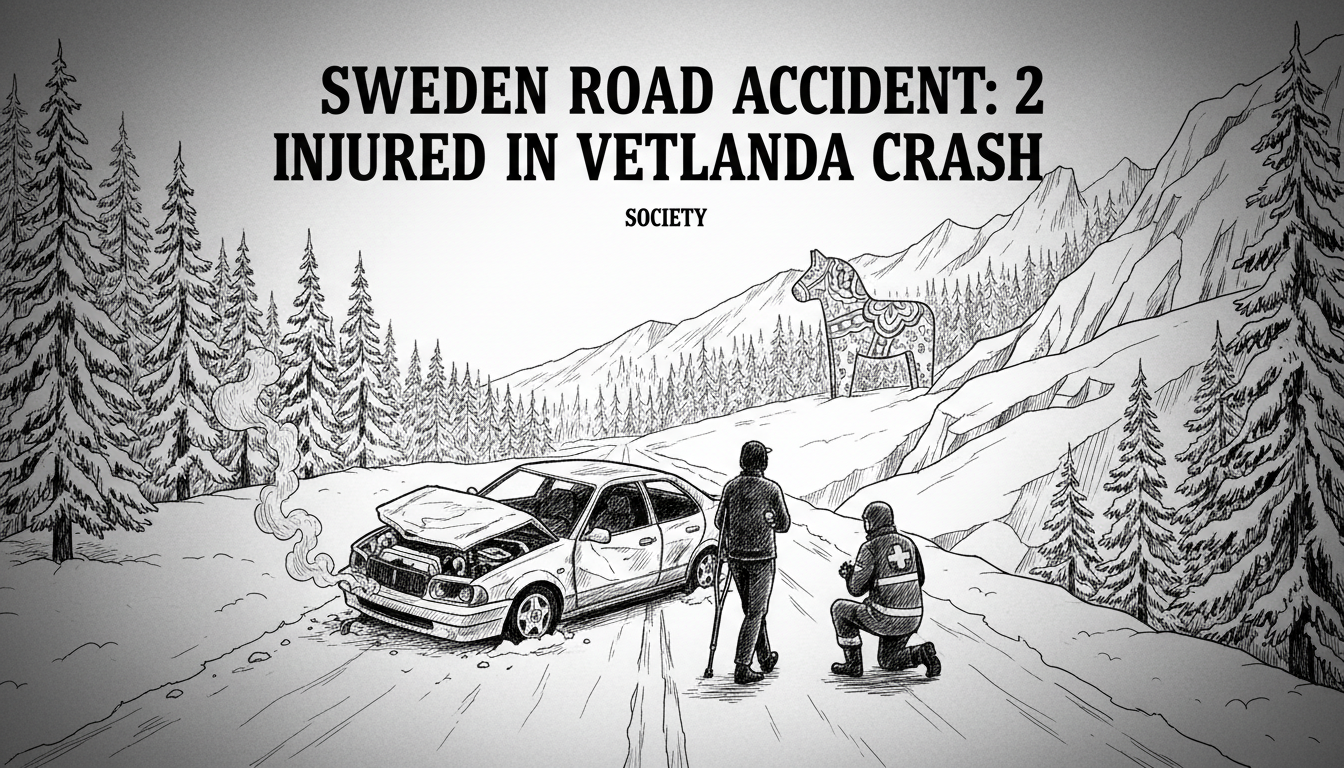
Sweden's Route 31 near Vetlanda was the scene of a serious head-on collision between two passenger cars on Thursday. The crash occurred near Ekenässjön, bringing traffic to a complete standstill. Two people were injured and transported to hospital by ambulance, according to rescue services. The incident highlights ongoing road safety challenges on Sweden's regional highways.
Emergency services responded quickly to the scene. A recovery vehicle was called to clear the wreckage. Traffic has since resumed flow, but the shockwaves of such an event linger long after the road is cleared. For the local community in Vetlanda municipality, it is a stark reminder of the fragility of daily travel.
A Quiet Road Turned Crisis Point
Riksväg 31 is a vital artery through southern Sweden's countryside. It connects communities, farms, and businesses. The stretch near Ekenässjön is typical of many Swedish regional routes—a two-lane road winding through forests and past lakes. It is scenic but can be deceptively dangerous. Speed limits and clear markings are present, yet the margin for error is slim. When two vehicles meet head-on, the consequences are often severe.
This type of collision is one of the most feared on the road. The combined force of impact at speed is devastating. Modern car safety features like crumple zones and airbags are tested to their limits. The fact that both individuals were taken to hospital, rather than declared dead at the scene, speaks to both the severity and the potential for survival thanks to Sweden's strong vehicle safety standards.
The Human Cost Behind the Statistics
While the specific conditions of the injured are unknown, their transport to hospital indicates significant trauma. In Sweden, the chain of care from accident scene to hospital is highly coordinated. Ambulance crews work alongside police and rescue services. The priority is always life-saving intervention and rapid transport to advanced care.
For families waiting for news, these hours are agonizing. A single phone call or a knock on the door can change everything. In small communities like those around Vetlanda, news travels fast. There is a collective holding of breath, a hope that the injured are not neighbors or friends. This human impact is the true cost of any traffic accident, far beyond the twisted metal and traffic delays.
Sweden's Road Safety Paradox
Sweden is globally renowned for its Vision Zero traffic safety policy. The goal is to eliminate all traffic fatalities and serious injuries. The country has made remarkable progress. In 2022, there were 273 fatal road accidents in Sweden, resulting in 283 deaths. This is a low number per capita compared to many nations. Yet, each number represents a profound personal tragedy. Head-on collisions on two-lane roads like Route 31 remain a persistent and deadly problem within this generally safe system.
Vision Zero's approach is systemic. It argues that humans make mistakes, and the road system must be forgiving. This has led to widespread median barriers on highways, lower urban speed limits, and safer car designs. However, covering every kilometer of regional road with physical separation is a monumental and costly task. On routes like the one near Ekenässjön, safety relies heavily on driver behavior, clear signage, and road maintenance.
What Causes a Head-On Collision?
Road safety experts point to a common set of factors. Driver fatigue is a major risk, especially on long, monotonous rural routes. A momentary lapse in concentration can have catastrophic results. Distracted driving, whether by a mobile phone or something inside the car, is another critical factor. Speeding, of course, reduces reaction time and increases impact force exponentially.
External conditions also play a role. Was the road wet or icy? Was the sun low, creating glare? Did an animal run into the road, causing a sudden swerve? The police investigation will seek to answer these questions. Their findings are crucial not just for potential legal proceedings, but for understanding how to prevent the next crash. This data feeds back into the Vision Zero framework, informing future road upgrades and safety campaigns.
The Aftermath and the Road Ahead
After the ambulances leave and the wreckage is cleared, a process of recovery begins. For the injured, it is a physical and emotional journey. For the authorities, it is an investigative one. The section of Route 31 will be examined. Skid marks, vehicle positions, and debris fields tell a story. Event data recorders from the cars, if available, will provide digital evidence of speed and braking.
For the Swedish Transport Administration, each serious accident is a data point in a relentless push for improvement. Could a median cable barrier have prevented this? Would more frequent passing lanes reduce risky overtaking maneuvers? Is better lighting or road surface needed? These are the practical, engineering-focused questions that follow the human drama.
Local residents who use Route 31 daily will drive past the spot with renewed caution. They might notice the scarred guardrail or a patch of new asphalt. The memory of the total traffic stoppage, the flashing blue lights, will fade. But the underlying awareness of vulnerability on the road is reinforced. Sweden's safety culture is built on this collective awareness, not just on regulations.
A Community Reflects
Vetlanda is a municipality built on forestry, agriculture, and small industry. Its people depend on roads like Route 31. It is not just a route for commuters, but for timber trucks, delivery vans, and families going to school or sports. An accident like this disrupts the rhythm of an entire region. It forces a conversation about the infrastructure that binds communities together and the risks inherent in connecting them.
Sweden continues to invest in its road network, balancing safety, cost, and environmental impact. The conversation around Vision Zero is evolving. How fast should we be able to travel on rural roads? What level of risk is acceptable when the cost of eliminating it entirely is so high? There are no easy answers. Each accident, like the one near Ekenässjön, sharpens these difficult questions.
The hope is that from this incident, lessons are learned that make Route 31 safer for everyone. That the injured make full recoveries. And that all who get behind the wheel in Sweden remember that the safest journey is not the fastest one, but the one that ends uneventfully at its destination. The ultimate goal remains clear: zero. Every journey should end safely.