
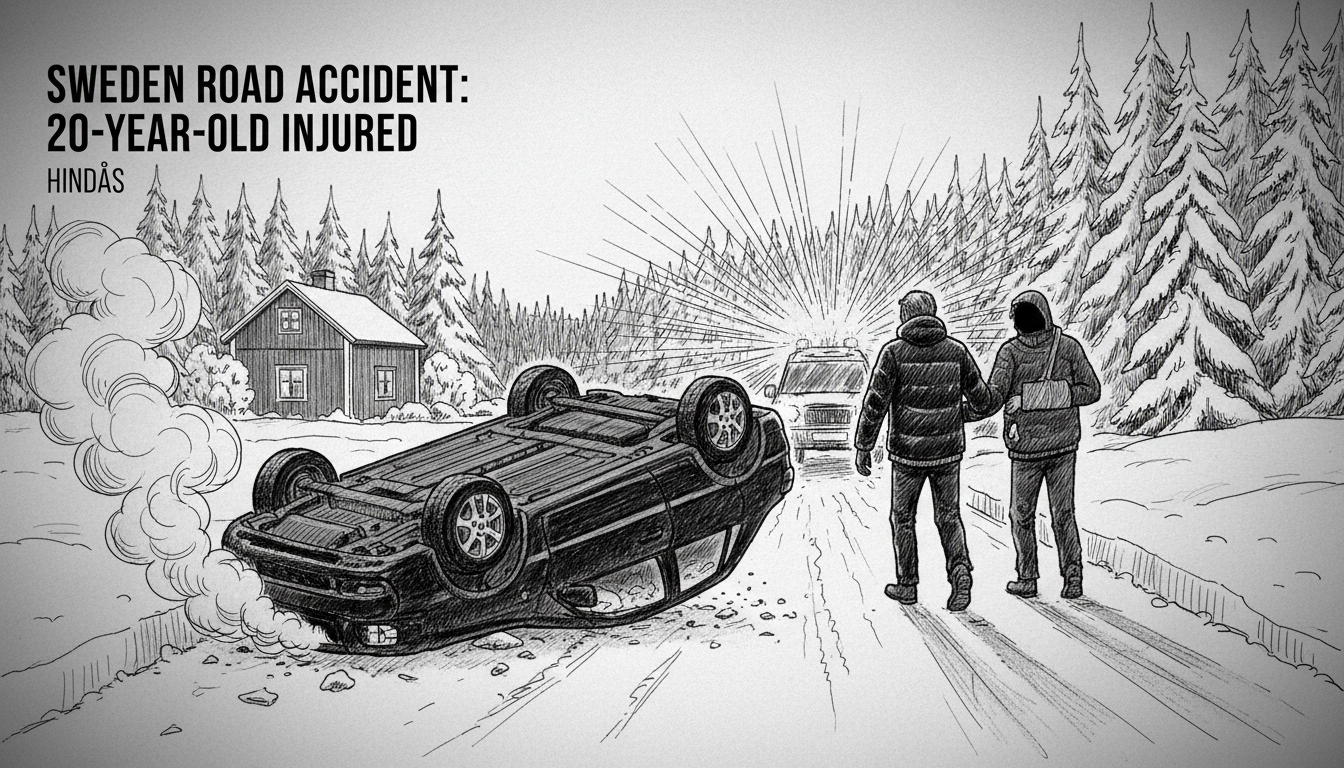
Sweden road safety faces another test after a pedestrian was struck by a car on regional highway 156 in Hindås. The accident occurred at 6:41 PM on a stretch of road connecting communities east of Gothenburg. Police, rescue services, and an ambulance rushed to the scene where a private car and a young man on foot had collided. For nearly an hour, the extent of the pedestrian's injuries remained unclear, casting a shadow over the quiet locality known for its outdoor trails. "The pedestrian is being assessed by ambulance personnel at this moment," police press spokesperson Adam Samara said in an initial statement. Just before 7:30 PM, an update brought a measure of relief: the man, in his twenties, was transported to hospital awake and able to speak.
A Quiet Evening Interrupted
The call to emergency services shattered the early evening calm in Hindås, a locality within Härryda municipality. This area, part of the Västra Götaland region, blends residential areas with the scenic landscapes that attract hikers and cyclists. Road 156 serves as a vital artery for these communities, carrying local traffic through environments that shift from built-up to rural. Accidents here prompt immediate questions about visibility, speed, and the mix of vehicles and people. Local resident Elin Mårtensson, who lives near the road, described hearing the sudden sound of sirens. "It's always a chilling sound, especially here," she said. "You know it's serious, and you hope everyone is okay. This road can be quite busy, and when it gets dark, it's not always well-lit in certain sections."
The Long Shadow of Road Statistics
While this incident appears to have avoided the worst outcome, it feeds into ongoing national concerns. Sweden recorded 324 deaths from road traffic accidents in 2022 across 308 fatal incidents. The number of people seriously injured that same year was approximately 1,500. These figures represent real people, families, and communities affected. Each accident triggers a standard response protocol but also a quieter, more profound reckoning with the nation's ambitious safety goals. The 'Vision Zero' policy, adopted in the late 1990s, aims to eliminate all traffic fatalities and serious injuries. It represents a foundational element of modern Swedish society, shifting responsibility from individual road users to the system designers—planners, automakers, and policymakers. "Every accident is a failure of the system," explains traffic safety analyst Lars Bengtsson. "The investigation will look at everything: the road design at that specific point, the lighting conditions at 6:41 PM, the speeds involved, and the actions of both the driver and the pedestrian. The goal is never to assign blame, but to learn and prevent the next one."
The Human Cost Beyond the Headline
The clinical language of police reports—"private car," "pedestrian," "awake and talkative"—belies the human trauma. A young man's evening walk turns into a hospital visit. A driver faces the shock and aftermath of a collision. Families receive phone calls they dread. In the cozy wooden houses and apartment blocks of Hindås, news of the accident spreads quickly through word of mouth and local social media groups. There is a collective sigh of relief that the injuries were not life-threatening, but also a shared unease. These events remind everyone of their own vulnerability, whether they are walking to a friend's house, cycling to a lake, or driving to the supermarket. The cultural importance of outdoor life, or 'friluftsliv,' in places like Hindås means people are constantly interacting with infrastructure built for cars.
Vision Zero in a Mixed-Traffic Reality
Sweden's approach to road safety is admired globally, but its implementation faces daily challenges on roads like the 156. The policy mandates physical separation between vehicles and vulnerable road users where speeds are high. On lower-speed community roads, the design must ensure speeds are kept low enough to prevent serious injury. The accident site in Hindås will now be scrutinized through this lens. Was the road design appropriate for the volume and mix of traffic? Were there adequate pedestrian crossings or lighting? The investigation seeks systemic fixes, not just individual culpability. This philosophy is deeply ingrained in Swedish administrative culture but can feel abstract to those directly involved. For the injured man, the immediate reality is physical pain and recovery. For the community, it's a renewed debate about local traffic calming measures, sidewalk availability, and speed limits.
A Community's Response and Reflection
In the days following the accident, the conversation in Hindås is likely to turn practical. Local municipal officials in Härryda may face questions about road safety investments. Community Facebook groups often become forums for sharing concerns about specific dangerous corners or requests for better street lighting. This grassroots engagement is part of how Swedish society works to improve public safety. It aligns with the Vision Zero principle that everyone shares responsibility. The accident serves as a grim reminder that safety gains are not permanent; they require constant vigilance, investment, and adaptation as traffic patterns and communities evolve. The fact that the pedestrian was a young man also touches on another sensitive topic: road safety among younger demographics, who are often overrepresented in accident statistics.
Looking Ahead: The Road to Prevention
The young man's recovery is now the primary concern. His condition, described as being "awake and talkable" when transported, suggests a hopeful prognosis. Yet, the psychological impact on all involved can be long-lasting. Meanwhile, the official wheels turn. Data from this incident will be logged, analyzed, and added to the vast datasets used by the Swedish Transport Administration. It might contribute to a future decision to install a new crosswalk, lower the speed limit on a segment, or improve lighting. This is the unglamorous, systematic work behind Sweden's world-leading road safety record. It's a process built on the understanding that human error is inevitable, so the system must be forgiving. As dusk falls again over Road 156 in Hindås, pedestrians might be more cautious, drivers more alert. The incident becomes a shared memory, a marker in the community's history, and another data point in Sweden's relentless, sobering pursuit of zero. How many more data points will be needed before the goal is finally reached?