
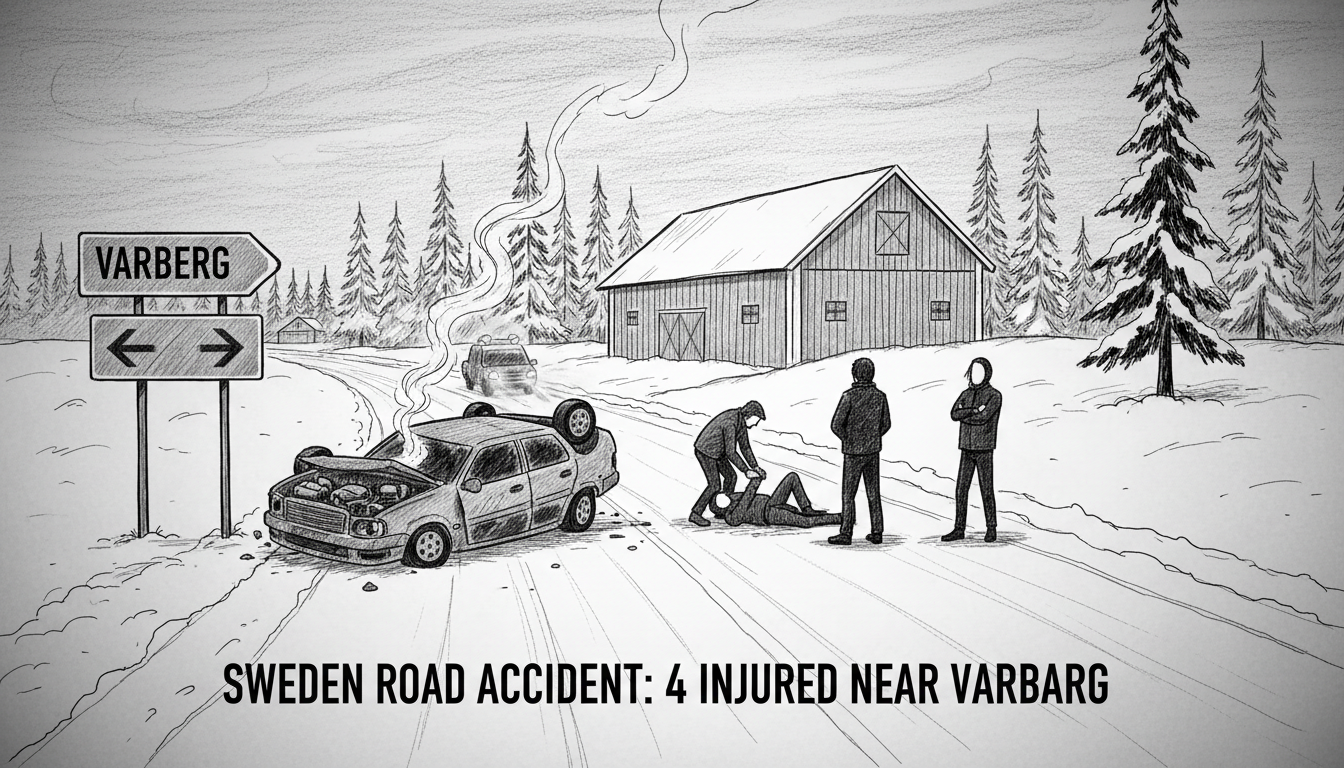
Sweden road accident news today centers on a serious head-on collision on a slippery regional road. Two cars collided head-on on Road 752 outside Varberg in Halland County. At least two of the four people involved were injured in the crash, which occurred under treacherous winter conditions. Emergency services, including police, rescue teams, and ambulances, responded with multiple units to the scene.
"We are there with several units, as well as the rescue service and ambulance," police press spokesperson Johan Håkansson said in a statement. He confirmed the road was "very slippery" at the site. The incident highlights the persistent dangers of winter driving in Sweden, even on roads connecting smaller communities. For the people involved, a routine journey turned into a crisis in moments.
A Slippery Stretch of Road
Road 752 is a vital artery for the local communities around Varberg, a coastal town known for its fortress and surfing. Unlike major highways, these regional routes often wind through countryside and villages. They are essential for daily life but can be unforgiving in winter. The conditions described by police—"very slippery"—are a common and dreaded phrase in Swedish weather reports from November through March.
This accident did not happen in isolation. Halland County has experienced fluctuating traffic accident rates over the past decade. Winter conditions consistently contribute to a spike in incidents. Black ice, sudden snow squalls, and slush can transform a familiar road into a hazard. Drivers must constantly adapt, a reality deeply embedded in Swedish culture. The collective memory of dark, icy commutes is a shared experience across the country.
The Human Cost of Winter Roads
Behind the brief police report are four individuals whose day was violently interrupted. While the extent of their injuries is not yet public, any head-on collision carries significant risk. The psychological impact, the shock, and the disruption to families ripple out from the crash site. In small communities, news of such an accident travels fast, with neighbors often wondering if they know those involved.
Swedish society places a high value on traffic safety, known as "trafiksäkerhet." It's a common topic of conversation, public service announcements, and personal vigilance. Yet, the statistics remind us of the ongoing challenge. In 2022, Sweden recorded 308 fatal road accidents, resulting in 324 deaths. Each number represents a story that ended too soon, a family changed forever. While Sweden has one of the world's lowest traffic fatality rates per capita, the goal is always zero. Accidents like the one near Varberg show how far there is to go.
Expert Advice for Slippery Conditions
Traffic safety experts repeatedly emphasize a core set of winter driving rules. The first is proper winter tires, which are a legal requirement in Sweden from December 1st to March 31st. But tires alone are not enough. Adjusting speed to the conditions is critical. The posted limit is for ideal weather, not for an icy Road 752 on a cold morning. Maintaining a safe following distance—dramatically increased on ice—is another non-negotiable practice.
"The margin for error disappears on slippery roads," says a veteran driving instructor from Gothenburg, echoing a common sentiment in the field. "It's about anticipation, not just reaction. You must read the road ahead, the tree lines for wind, the bridges that freeze first." Police investigations into this collision will likely examine all these factors: speed adaptation, tire condition, and potential driver distraction or impairment. The goal is not just to assign blame but to understand and prevent the next accident.
A Cultural Ritual of Preparedness
Preparing for winter driving is a cultural ritual in Sweden. It involves the seasonal tire change, checking the emergency kit in the trunk, and listening to weather warnings. There's a shared understanding that nature dictates the terms of travel for several months each year. This mindset is crucial for survival on roads far from city centers, where help may take time to arrive.
In Stockholm, Gothenburg, or Malmö, winter driving challenges often involve congestion and slush. On regional roads like 752, the challenges are different. They can be longer stretches between streetlights, more exposed areas prone to drifting snow, and fewer witnesses if something goes wrong. The response from emergency services, as seen in Varberg, is typically swift and coordinated, a testament to Sweden's robust civil preparedness. But the best rescue is the one that isn't needed.
Looking Beyond the Crash Barrier
This accident on Road 752 will be logged, investigated, and added to annual statistics. For the rest of us, it serves as a stark reminder. As the days slowly grow longer, the threat of ice remains. It asks every driver a simple question: are your habits adapted to the reality outside your windshield? The Swedish Transport Administration tirelessly campaigns for safe driving, but the final responsibility rests with the individual behind the wheel.
The road to zero fatalities is long and requires constant vigilance. It's built on cultural attitudes, smart engineering, and personal responsibility. As the people involved in the Varberg collision recover, their experience underscores a fundamental truth of Nordic life. Respect for winter is not optional; it's essential for safe passage through the beautiful, demanding landscape we call home. Will this season's reminder lead to more cautious journeys tomorrow?