
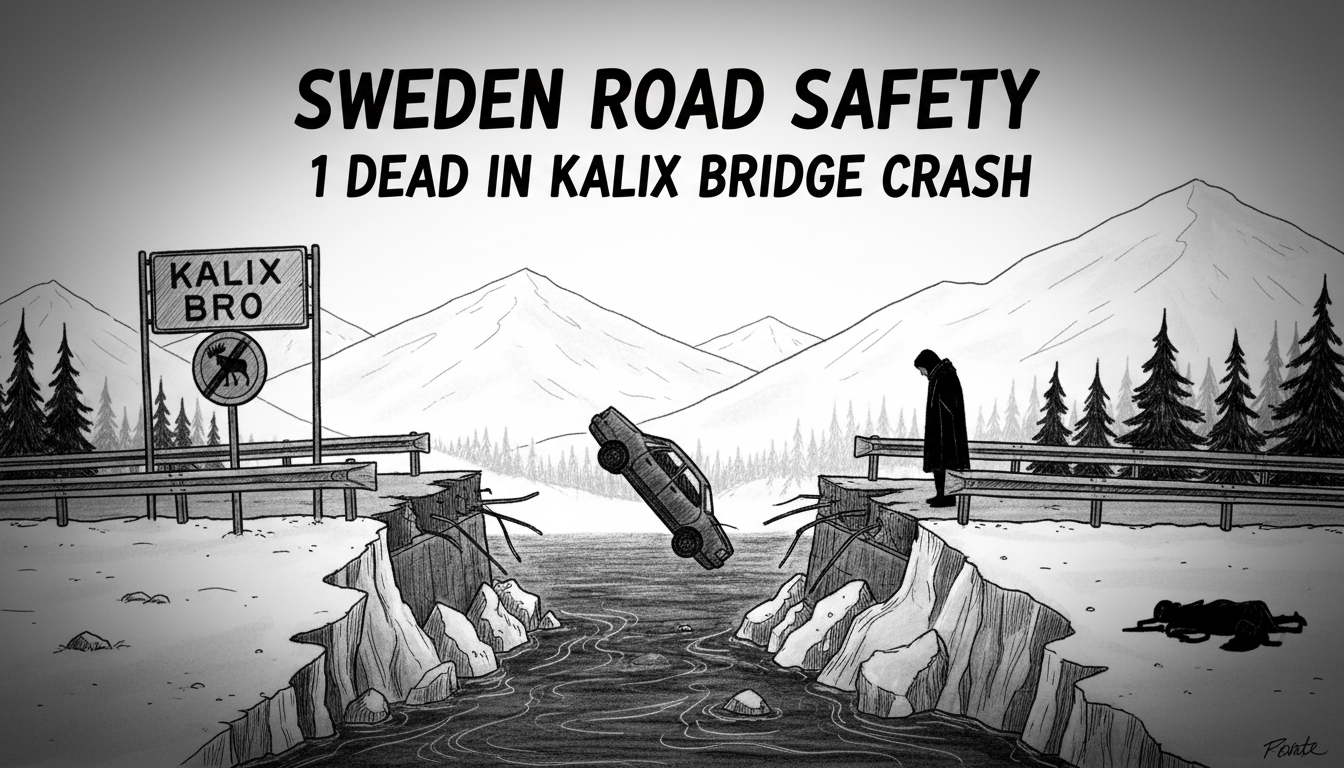
Sweden road safety is under scrutiny after a man died when his car plunged into water near a bridge in Kalix on Sunday evening. Emergency services rushed to the scene, but the driver could not be saved. This tragic incident in Norrbotten County highlights the quiet dangers of Sweden's northern roads.
A Sunday Evening Turned Tragic
The call came in on a quiet Sunday evening. Rescue services, police, and ambulance crews were dispatched to a bridge in Kalix, a municipality known for its river and peaceful landscapes. A car had left the road and entered the water. The response was swift, a testament to Sweden's integrated emergency system where different agencies coordinate closely. The man was extracted and transported by ambulance across the border to a hospital in Finland, a common practice for specialized care in the northern regions. Despite these efforts, his life could not be saved. Police have notified his next of kin. Initial reports suggest he was alone in the vehicle.
"Our thoughts are with the family and loved ones during this incredibly difficult time," a police spokesperson said in a statement. The investigation is now focused on determining why the car left the roadway. Was it a moment of distraction? A mechanical failure? Or the challenging conditions of a northern Swedish road at night? These are the questions investigators will seek to answer in the coming days and weeks.
The Cold, Hard Reality of Water Rescue
Accidents where vehicles enter water present unique and severe challenges for rescue teams. Expert context reveals that factors like water temperature in northern Sweden, even in late summer, can be brutally cold, leading to rapid onset of hypothermia. Depth, current, and visibility further complicate rescue efforts. A vehicle can sink quickly, and escape becomes exponentially harder as water pressure builds.
"Time is the critical enemy in these scenarios," explains Lars Strömberg, a former rescue diver with over twenty years of experience, who now consults on water safety. "The window for a successful rescue, especially in cold water, is often measured in minutes, not hours. It requires not only speed from emergency services but also specific equipment and training." This incident underscores the bravery and difficulty of the work performed by Sweden's rescue services, who train for such high-pressure, low-visibility situations.
Kalix: A Community in Mourning
Kalix, with a population of around 17,000, is the type of close-knit community where news of a tragedy spreads quickly and hits hard. It's a place defined by the Kalix River, forests, and a strong sense of local identity, famous for its Kalix löjrom (caviar). The bridge where the accident occurred is now a site of sorrow, a stark contrast to the usual tranquility of the area. Locals may now look at that stretch of road differently, a reminder of how quickly normal life can be shattered.
In Swedish society, there is a deep cultural reliance on the car, especially in rural and northern areas where distances are vast and public transport options can be limited. This makes road safety a perennial topic of public concern and policy discussion. Every fatality is felt not just by a family, but ripples through a community, prompting silent reflections on our own journeys.
The Investigation and Road Safety Culture
The police investigation will be meticulous. Accident reconstruction specialists will examine skid marks, vehicle damage, and the roadway itself. The vehicle will be inspected for any signs of brake failure, tire blowouts, or other mechanical issues. They will also look at environmental factors—was the road icy? Was there heavy rain or fog? The goal is always twofold: to provide answers to the grieving family and to gather data that might prevent a similar accident in the future.
Sweden has long been a global leader in road safety, pioneering the Vision Zero approach which aims to eliminate all traffic fatalities and serious injuries. This philosophy has shaped everything from road design and speed limits to vehicle safety standards. Yet, this tragedy in Kalix is a somber reminder that the goal of zero is a constant pursuit. It highlights the specific challenges of maintaining that standard across the entire country, from the busy streets of Stockholm to the remote bridges of Norrbotten.
Each accident forces a re-evaluation. Are certain rural roads adequately lit? Are guardrails sufficient? Is driver education about specific hazards, like water edges, robust enough? These are the complex, ongoing discussions that follow a single, heartbreaking headline.
A Life Remembered, A Safety Legacy
Behind the official reports and the expert analysis is a profound human loss. A man set out on a Sunday evening drive and never returned. His family's world has changed forever. In the Swedish way, there will likely be a quiet gathering, a funeral notice in the local paper, and a collective moment of respect from the community.
This incident, while a specific and localized tragedy, connects to the broader narrative of Swedish society and its relationship with risk, safety, and community responsibility. It tests the systems put in place to protect citizens and mourns the individual they could not save. As the investigation continues in Kalix, the ultimate hope is that its findings contribute to the safety of others, turning a moment of profound loss into a catalyst for saving future lives on Sweden's roads. How many more quiet bridges must witness tragedy before every journey is a safe one?