
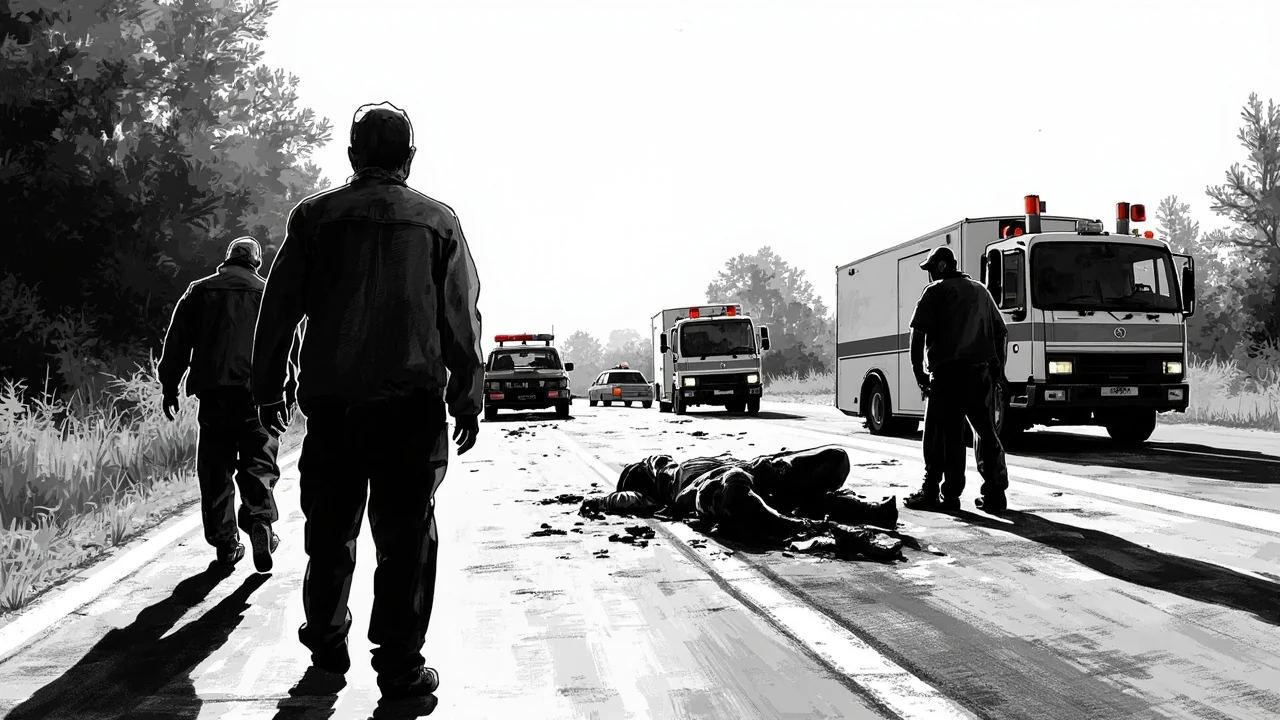
Sweden's treacherous winter roads claimed another life Tuesday night. A serious multi-vehicle collision on the E6 motorway near Vellinge, south of Malmö, has left one person dead and three others hospitalized, two with serious injuries. The crash, involving a van and three passenger cars, forced a complete closure of the northbound lanes, snarling traffic and sending emergency crews scrambling in difficult conditions.
"It's slippery, snowy, and slushy, and it's windy," said police press spokesperson Leif Fransson, describing the scene. "Right now, traffic is a bit messy heading south as well." The alarm came in at 7:40 PM. Initial reports from rescue services indicated two people were seriously hurt. Police later confirmed one of those injured had succumbed to their wounds. Next of kin have been notified.
The accident near Vellinge was not an isolated event. Earlier in the evening, another multi-vehicle incident involving four cars occurred outside Ystad, roughly 50 kilometers east. Police again pointed to challenging road conditions as a factor. These back-to-back crashes on a single evening in Skåne county highlight a recurring, grim seasonal pattern. They force a conversation Swedes know well but can never afford to ignore: the annual battle against winter's grip on mobility and safety.
A Community Reacts to Sudden Loss
While police have not released the identities of those involved, the impact of such an event radiates through a small community like Vellinge. The E6 is the main arterial road connecting Malmö to Trelleborg and the ferries to Germany. For locals, it's a daily commute route. For travelers, it's a transit corridor. A sudden closure and tragedy disrupts the rhythm of an entire region.
"You hear the sirens, and you know it's bad when they close the whole motorway," said Anna Lundgren, a resident of Vellinge who often uses the E6. "It makes you pause. You think about your own drives home in the dark, on those exact stretches. It's a shock, but also a fearful reminder." This sentiment is common in Swedish towns bisected by major highways. The road is a lifeline, but on nights like Tuesday, it becomes a site of profound vulnerability.
The Relentless Challenge of Swedish Winter Roads
Police descriptions of the conditions—"halt, snöigt och moddigt" (slippery, snowy, and slushy)—are the soundtrack to a Swedish winter. Despite having one of the world's most sophisticated winter road maintenance systems, Sweden cannot fully conquer the physics of ice, snow, and wind. The country invests billions of kronor annually in plowing, salting, and sanding. Authorities issue constant warnings via media and apps like Trafikverket's.
Yet, accidents happen. The transition periods between autumn and full winter, and between winter and spring, are particularly hazardous. Black ice forms invisibly. Wet snow compacts into treacherous grooves. Strong winds, like those reported Tuesday, can create sudden white-out conditions or drifts across cleared lanes. Driver adaptation is the critical, human variable. "We have the technology and the infrastructure to manage winter," notes traffic safety analyst Mats Berg. "But the final layer of safety is driver behavior—speed adapted to conditions, proper tires, and heightened awareness. On a bad night, the margin for error shrinks to zero."
Beyond the Crash Barrier: A National Conversation
Every serious accident prompts a ritual of public examination in Sweden. News reports detail the event. Experts are interviewed. Officials remind drivers to use winter tires (a legal requirement from December 1 to March 31 in much of Sweden). The Swedish Transport Administration (Trafikverket) might reiterate its safety campaigns. There is a collective, societal effort to learn from the tragedy.
This crash near Vellinge touches on several ongoing themes in Swedish society news. It involves the critical infrastructure that connects Sweden to continental Europe. It highlights the regional challenges faced in Skåne, where maritime climates can create wetter, icier conditions than the dry cold of the north. It also underscores a cultural relationship with cars and distance; in a sprawling country, the car is often essential, making road safety a deeply personal issue for millions.
The Long Night for Emergency Services
The human impact of the crash extends to the first responders. Police, ambulance crews, and firefighters worked in the dark, cold, and wind to extricate the injured, manage traffic, and investigate the scene. Theirs is a difficult, vital role that often goes unseen after the headlines fade. "Our teams train extensively for these scenarios," said a regional rescue service coordinator, who asked not to be named as they were not the official spokesperson. "But facing the reality, with people seriously hurt, is always tough. The conditions make it physically demanding and technically challenging."
The closure of a major motorway also creates a logistical puzzle. Traffic must be diverted through smaller local roads, which may themselves be in poor winter condition, creating secondary risks. Clearing the wreckage and conducting a thorough investigation to understand the crash sequence can take many hours, prolonging the disruption.
A Look at the Broader Safety Picture
Statistically, Sweden's roads are among the safest in the world, a achievement of the long-term "Vision Zero" policy which aims to eliminate traffic fatalities and serious injuries. Fatalities have trended downward for decades. Yet, winter remains a persistent spike in the data. Single-vehicle accidents involving cars sliding off the road and multi-vehicle pile-ups on motorways are hallmark winter tragedies.
Analysts point to several factors. The increased use of studded winter tires has improved grip but can create a false sense of security on ice. The maintenance of tire grooves is crucial. Speed, always a primary factor, becomes even more deadly on surfaces with reduced friction. Fatigue from driving in stressful, low-visibility conditions also plays a role. For new immigrants adjusting to Swedish society, experiencing a first full winter on these roads can be a particularly steep learning curve, a point often discussed in integration and driver education programs.
From Tragedy to Vigilance
As the sun rose on Wednesday, the E6 near Vellinge was likely reopened. The physical scars on the asphalt would be temporary. The emotional scars for the families and friends of the victim, and for the injured, will last much longer. This is the true cost, repeated in variations across Sweden every winter.
The accident serves as the starkest possible reminder. Swedish winter is not just about cozy fika by candlelight or the beauty of a snow-covered Stockholm Old Town. It is a powerful natural force that demands respect from every person who gets behind the wheel. The conversation that follows this crash is part of Sweden's cultural contract with its environment—a continuous effort to balance modern mobility with ancient, seasonal dangers. The ultimate tribute to the life lost on the E6 is for every driver who hears this story to slow down, check their tires, and give the road the caution it demands on a dark, snowy night. The responsibility, as ever, is shared.