
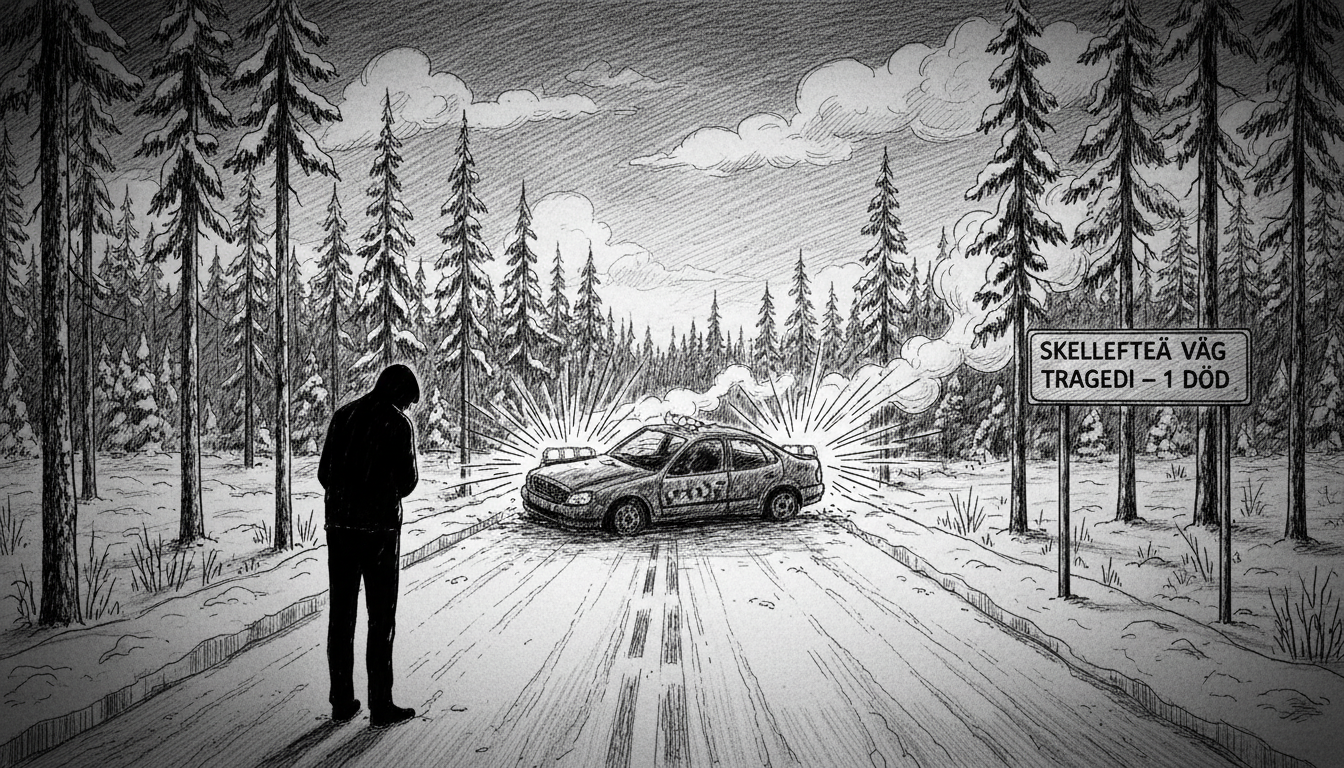
Sweden's Riksväg 95 outside Skellefteå is the scene of a fatal accident that claimed one life on Sunday. A car overturned on the major northern route, and in connection with the crash, a pedestrian walking nearby was struck and killed. The incident has sent shockwaves through the local community and prompted a police investigation.
"We went there to check what had happened, and it turned out that a person had been hit and died in connection with the accident," said Marie Andersson, press spokesperson for the police in the North region. The driver, described as a young man, was taken to the hospital and has been arrested. Authorities have seized the vehicle for a technical examination and are investigating the sequence of events, including through interviews.
For the family of the victim, notified by police, a life has been irrevocably changed. For the small communities dotting the Silver Road, it is a grim reminder of the fragility of life on these quiet, yet sometimes dangerous, stretches of asphalt. The road, officially Riksväg 95 but known historically as Silvervägen (the Silver Road), is a vital artery. It connects the coastal city of Skellefteå, a hub for tech and green industry, with the mountainous interior and the Norwegian border. Its path winds through vast forests and past mirror-still lakes, a landscape of breathtaking beauty that can belie the risks of high-speed travel.
A Quiet Road Shattered by Sudden Loss
The accident did not happen in a crowded city center but on a road where encounters are less frequent. This makes the death of a pedestrian particularly jarring. Local residents often use these routes for walking, cycling, or simply enjoying the pristine nature. The specifics of what the victim was doing at that moment, and why their path intersected so tragically with the crashing vehicle, are central to the police inquiry. The fact that the driver was arrested immediately indicates police are treating the incident with utmost seriousness, likely exploring all angles from speed and distraction to potential impairment.
Swedish roads are among the safest in the world, a point of national pride built on decades of Vision Zero policy. This philosophy aims to eliminate all traffic fatalities and serious injuries. Yet, when a single death occurs, especially in a seemingly random circumstance, it challenges that vision profoundly. It forces a community to ask silent questions about road design, driver behavior, and sheer misfortune.
The Legal and Investigative Path Forward
Under Swedish law, causing another person's death through negligent or reckless driving is a serious crime. The penalties can be severe, reflecting the societal value placed on life. The ongoing investigation will be meticulous. Forensic experts will examine the seized vehicle for mechanical faults. Police will map skid marks, assess road conditions at the time, and reconstruct the vehicle's trajectory. The driver's medical status and any potential contributing factors will be scrutinized.
"Accidents like this are complex puzzles," says a Stockholm-based traffic safety analyst who wished to remain anonymous as the investigation is active. "The police aren't just looking for who to blame. They are piecing together a chain of events—weather, visibility, vehicle state, driver action, pedestrian placement. Each piece helps understand how to prevent the next tragedy. In rural areas, factors like animal crossings or long, straight stretches leading to driver fatigue can also play a role."
The human cost, however, transcends legal codes and technical reports. A family is in mourning. A young driver's life is also altered forever, facing not only potential legal consequences but a lifelong burden of guilt. These are the raw, human stories behind the brief police bulletins.
Life Along the Silver Road
To understand the impact, one must understand the context of Riksväg 95. This is not a faceless highway. It passes through villages like Byske and Bastuträsk, where everyone knows their neighbors. News travels fast, and a tragedy like this touches everyone. The region is a mix of traditional industries—forestry, mining—and the new, symbolized by Skellefteå's massive Northvolt battery factory. It's an area of contrast, where deep-rooted local culture meets rapid technological change. The road binds these communities together, used by logging trucks, commuters to new tech jobs, tourists heading to the mountains, and locals going for an evening stroll.
This accident disrupts the rhythm of that life. It creates a specific point of sadness on a map—a curve in the road, a particular stand of pine trees—that will forever be marked in local memory. There will be flowers placed at a roadside, a quiet testament to a life lost.
The Broader Conversation on Road Safety
While Sweden's traffic safety record is stellar, no system is perfect. Every fatal accident triggers internal evaluation. Could something have been done differently? Are there specific risks on certain road types that need addressing? For roads like the Silver Road, discussions often center on improving visibility for pedestrians and cyclists, adding more lighting or separated pathways in key sections, and managing speed effectively on long, open stretches.
The investigation's findings will feed into these ongoing safety efforts. They may lead to a new traffic sign, a lowered speed limit on a specific segment, or increased police patrols. The goal is always to learn, to adapt, and to inch closer to the ultimate goal of zero deaths.
For now, the community of Skellefteå and the villages along Riksväg 95 are left to grapple with a sudden void. The majestic silence of the northern forests feels a little heavier. The Silver Road, a route built for connection and commerce, has become a site of profound disconnection. As the police continue their quiet, methodical work in interview rooms and garages, the rest of us are reminded to drive with a little more care, to walk with a little more awareness, and to hold our loved ones a little closer. The road waits for no one, but how we travel it is always a choice.