
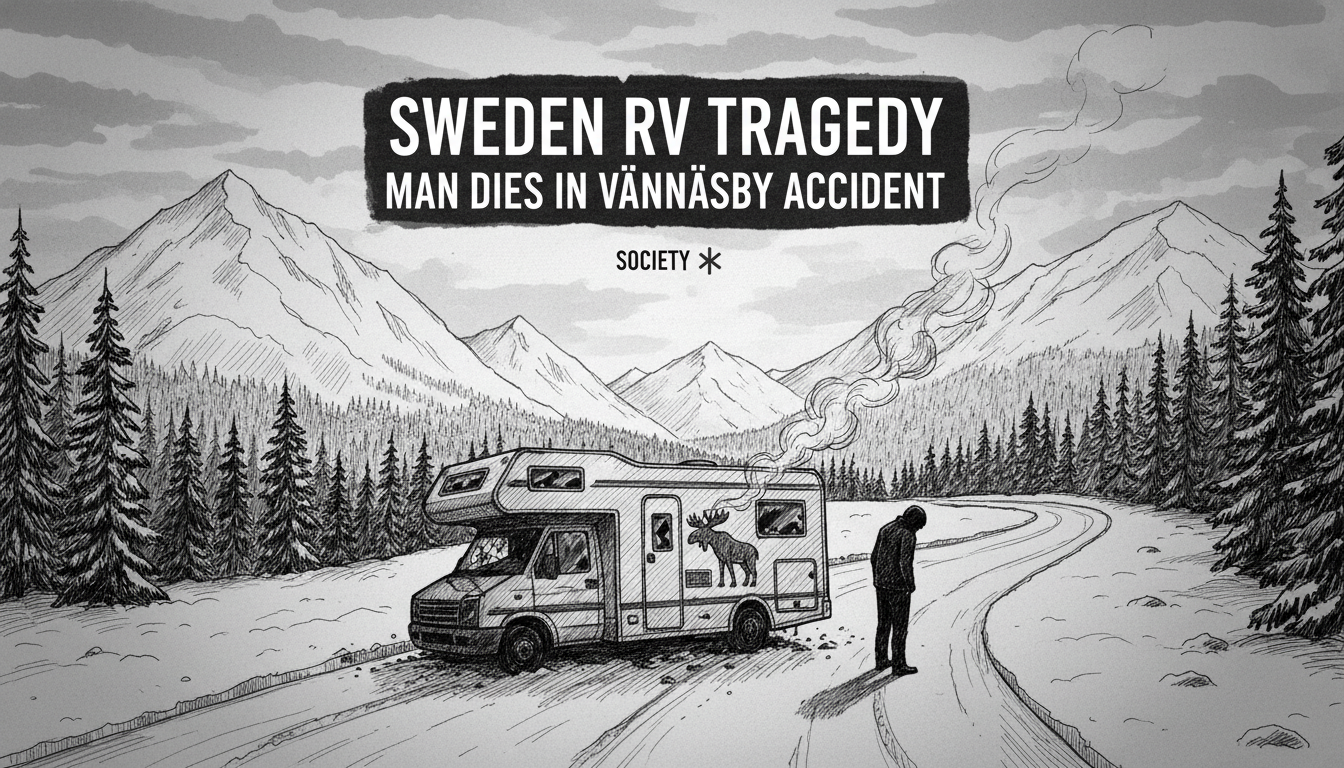
Sweden's road safety record, one of the world's best, is shadowed by a quiet tragedy in the north. A man in his 40s has died after being crushed under an RV in Vännäsby, Västerbotten, on Christmas Day. The incident, which occurred as he reportedly worked on the vehicle, ended with his death in hospital on Boxing Day. His family has been notified. This single, devastating event in a small locality cuts through national statistics, reminding us that safety is personal, not just a policy.
A Christmas Day Emergency in Västerbotten
The call came in just after noon on December 25th. A passerby in Vännäsby saw the overturned recreational vehicle and immediately alerted emergency services. The scene they discovered was serious. The man was freed and rushed to hospital with critical injuries. He was treated in intensive care, but the injuries proved fatal. Police confirmed the man was performing some kind of work on the RV when it overturned, pinning him beneath it. Vännäsby, a community of a few thousand residents, is the kind of place where such news travels fast and hits hard. The holiday season, a time for family and mys, has been irrevocably altered for one household.
“What I understand is that this person was performing some work on the car when it tipped over,” the police press communicator said in a statement. The brief official comment underscores the sudden, brutal mechanics of the accident. It moves the focus from the ‘where’ and ‘when’ to the ‘how’—a question that now occupies investigators and haunts anyone who has ever jacked up a car in their driveway.
The Unseen Risks of Vehicle Maintenance
While Sweden famously innovated the Vision Zero road safety policy, aiming to eliminate traffic fatalities and serious injuries, this accident occurred not on a highway, but privately. It highlights a different category of risk: the domestic maintenance of large vehicles. RVs, or husbilar, have grown in popularity as Swedes embrace domestic travel and outdoor life, or friluftsliv. Their size and weight, however, present unique dangers when they are off the road and up on jacks.
“Every vehicle, especially a top-heavy one like an RV, is a significant mass,” says Lars Bengtsson, a veteran automotive safety instructor based in Umeå, not far from Vännäsby. “When working underneath, you are trusting mechanical supports with your life. The ground must be perfectly level and solid. The supports must be rated for the weight and used correctly. There is zero room for improvisation.” Bengtsson notes that while Swedish workplaces have strict protocols, the same rigorous mindset doesn’t always translate to the home garage or driveway. “A moment of haste, a piece of wood used as a block instead of a proper stand, can have the worst possible outcome.”
Sweden's Safety Paradox: Public Success, Private Peril
Sweden recorded 270 road traffic fatalities in 2022, a low number per capita that is the result of decades of investment in safer roads, vehicles, and driver education. This national success story makes individual tragedies like the one in Vännäsby feel even more shocking. The accident likely falls outside official road traffic statistics, belonging instead to occupational or domestic accident data. This distinction is cold comfort. It represents a safety paradox: a society excellent at managing systemic risk on public roads must also confront scattered, private moments of vulnerability.
The investigation by police and possibly the Swedish Work Environment Authority will look at the specific circumstances. Was the RV properly supported? Was the ground on the property stable, or could frozen or soft earth have given way? Were any safety measures in place? The answers aim not to assign blame, but to understand and potentially prevent similar incidents. In communities across Norrland, where self-reliance and practical skills are highly valued, the lessons from this investigation could resonate deeply.
A Community's Quiet Reflection
In Vännäsby, the rhythm of the holidays was interrupted by the sound of sirens and the slow spread of difficult news. The locality, part of Vännäs Municipality, is a typical northern Swedish community where people know their neighbors. Such an event is not just a news item; it is a personal loss that ripples through the föreningsliv (club life), the workplace, and the local school. The Swedish tradition of dagsverke—the historical concept of a day’s work for the community—finds a sad, modern echo in the collective mourning for a life lost during a task.
“It’s a terrible thing to happen at any time, but on Christmas Day it feels especially cruel,” says Anna-Karin, a local resident who asked not to use her full name. “It makes you think about your own family, your own husband tinkering in the yard. We all do it. You never think it could end like this.” Her reflection touches on a universal truth about risk: it often feels most distant when it is actually near.
Looking Beyond the Statistics
The man who died was in his 40s. He was someone’s partner, possibly a father, a friend, a colleague. His story is now part of a broader narrative about safety culture in Sweden. While the country leads in public safety, this incident prompts a necessary conversation about private vigilance. Do safety campaigns from Trafikverket (the Swedish Transport Administration) and Arbetsmiljöverket (the Work Environment Authority) penetrate the domestic sphere with enough force? As RV ownership grows, driven by a desire for freedom and nature, does the knowledge of how to safely maintain them grow at the same pace?
Experts suggest that the same principled, systematic thinking that made Vision Zero a success must be applied to home workshops and driveways. It’s about cultivating an attitude where checking the rating on a jack stand is as instinctive as buckling a seatbelt. For the many Swedes who prize self-sufficiency and the ability to fix things themselves—a common trait from Malmö to Kiruna—this is a challenging but vital evolution.
The tragedy in Vännäsby is a stark, singular event. It is not an indicator of failing systems, but a heartbreaking reminder of a moment where everything went wrong. As the investigation continues quietly in the winter dark of Västerbotten, its ultimate value may lie in making every Swede pause, just for a second, before crawling under a car. That pause, that extra check, is where the very Swedish concept of trygghet—security and peace of mind—is personally built and maintained. The memory of a man lost on Christmas Day might just inspire that caution in others, turning private grief into a powerful, silent lesson in survival.