
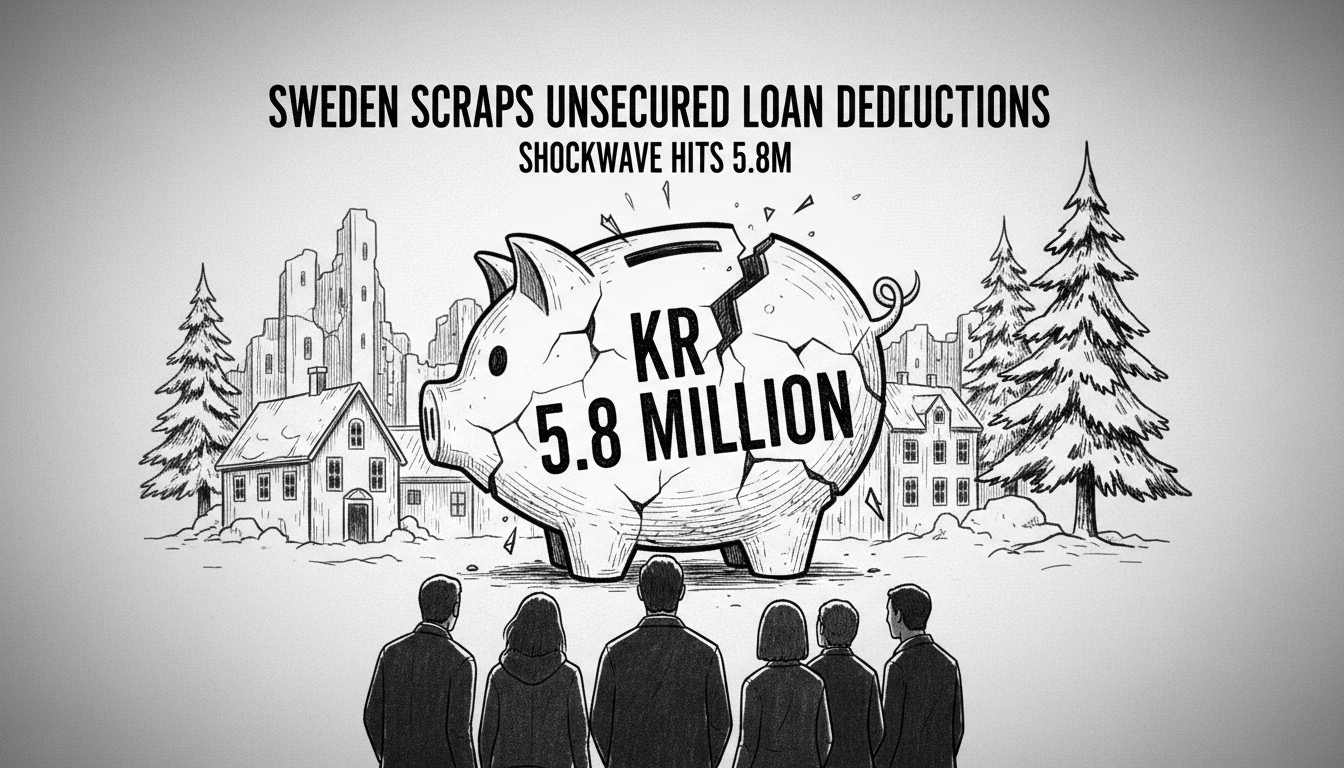
Sweden's looming removal of tax deductions for unsecured personal loans will directly impact 5.8 million people from January 2026, forcing a nationwide financial reckoning. The Swedish Tax Agency (Skatteverket) confirms the figure, representing over half of the adult population. This policy shift turns a common financial tool into a significantly more expensive burden overnight. For many, the annual cost of holding a 'blanco' or unsecured loan will rise by thousands of kronor. Financial advisors report a surge in client inquiries as Swedes scramble to adjust their personal balance sheets before the deadline.
The Coming Cost Crunch
Currently, Swedes can deduct 30% of interest paid on unsecured loans up to 100,000 SEK, and 21% on amounts above that threshold. This deduction is claimed against capital income for tax purposes. From 2026, this benefit disappears entirely for loans without collateral. A person paying 20,000 SEK annually in interest on a consumer loan could lose a deduction worth 6,000 SEK. For those with larger debts, the financial hit is more severe. "It's a significant policy change that many still haven't grasped," says Christina Sahlberg, an economist at price comparison service Compricer. "The assumption that these loans are only for those with poor finances is incorrect. They are widespread."
Household debt in Sweden stands at approximately 4,600 billion SEK. While mortgages dominate, unsecured consumer credit is a substantial slice. These loans often carry interest rates several times higher than a typical mortgage. The removal of the deduction effectively increases the real interest rate paid by the borrower. This move by policymakers aims to discourage debt accumulation that isn't tied to asset creation, like a home. The unintended consequence is a immediate squeeze on disposable income for millions.
A Catalyst for Fintech Innovation
This regulatory shift is creating urgent demand for financial solutions. Stockholm's fintech scene, a global leader, is mobilizing. Startups specializing in debt consolidation, personal finance management (PFM), and alternative credit assessment are seeing a strategic opportunity. "Policy shocks create markets," says Felix Nilsson, founder of a Stockholm-based debt refinancing app. "We're developing tools specifically for the '26 transition. This isn't just about refinancing; it's about holistic financial health."
Venture capital firms with a focus on financial technology are actively scouting for related startups. "We see this as a structural change in the Swedish credit market," notes an investment partner at a major Nordic VC. "Software that helps consumers navigate this, or lenders adjust their products, will be crucial." Accelerators in the Stockholm business district and Södermalm are hosting thematic rounds focused on 'personal debt tech.' The government's policy is inadvertently fueling innovation in the very sector it aims to regulate.
Strategic Moves for Borrowers
Financial experts are clear: passive waiting is the worst strategy. The key is to act before 2026. The first step is a full audit of all liabilities, prioritizing loans by their interest rate and the impending loss of deductibility. High-interest unsecured debt should be targeted for aggressive repayment. For those unable to pay off loans immediately, exploring refinancing options is critical. This could mean negotiating a lower rate with the current lender, consolidating multiple high-interest loans into a single, lower-cost product, or, where possible, securing debt against an asset.
"This is a moment for serious budgeting," advises Sahlberg. "Review your monthly expenses. Can you redirect funds to pay down this costly debt faster? Even small increases in monthly payments can have a major impact over time." For homeowners, one option may be to increase a mortgage—where interest remains deductible for the portion under the income threshold—to pay off an unsecured loan. This swaps expensive, non-deductible interest for cheaper, deductible interest. However, this extends the debt period and uses one's home as collateral, a serious consideration.
The Broader Economic Ripple
The macroeconomic implications are substantial. Economists at major banks project a dampening effect on consumer spending as more household income is diverted to service debt. Retail sectors, particularly those reliant on discretionary spending, could feel a chill. The policy may achieve its goal of reducing unsecured borrowing, but at the cost of reduced economic activity in the short term. It also raises questions about financial inequality. The deduction's removal is regressive, impacting middle and lower-income earners who rely on consumer credit more heavily.
Meanwhile, traditional banks and niche lenders are quietly revising their product portfolios. New loan structures that blend secured and unsecured elements, or that offer fixed, low rates for shorter terms, are in development. The competitive landscape for consumer credit is shifting from just price to price-plus-fiscal-efficiency. Lenders who clearly communicate the post-2026 net cost to borrowers will gain trust. This transparency is becoming a unique selling proposition in a suddenly complex market.
Navigating the New Normal
The countdown to January 2026 is a stark deadline. It transforms a slow-burning personal finance issue into an urgent action item. For Sweden's digitally-savvy population, this will likely accelerate the adoption of fintech tools for debt management and financial planning. The policy may ultimately lead to a more deliberate and less debt-reliant consumer culture. Yet the transition will be painful for many. The responsibility now lies with individuals to assess their situation, with advisors to provide clear guidance, and with innovators to build the bridges to a more sustainable financial future. Will this tax change force a healthier relationship with debt, or simply squeeze households already under pressure? The answer will define Sweden's economic mood for years to come.