
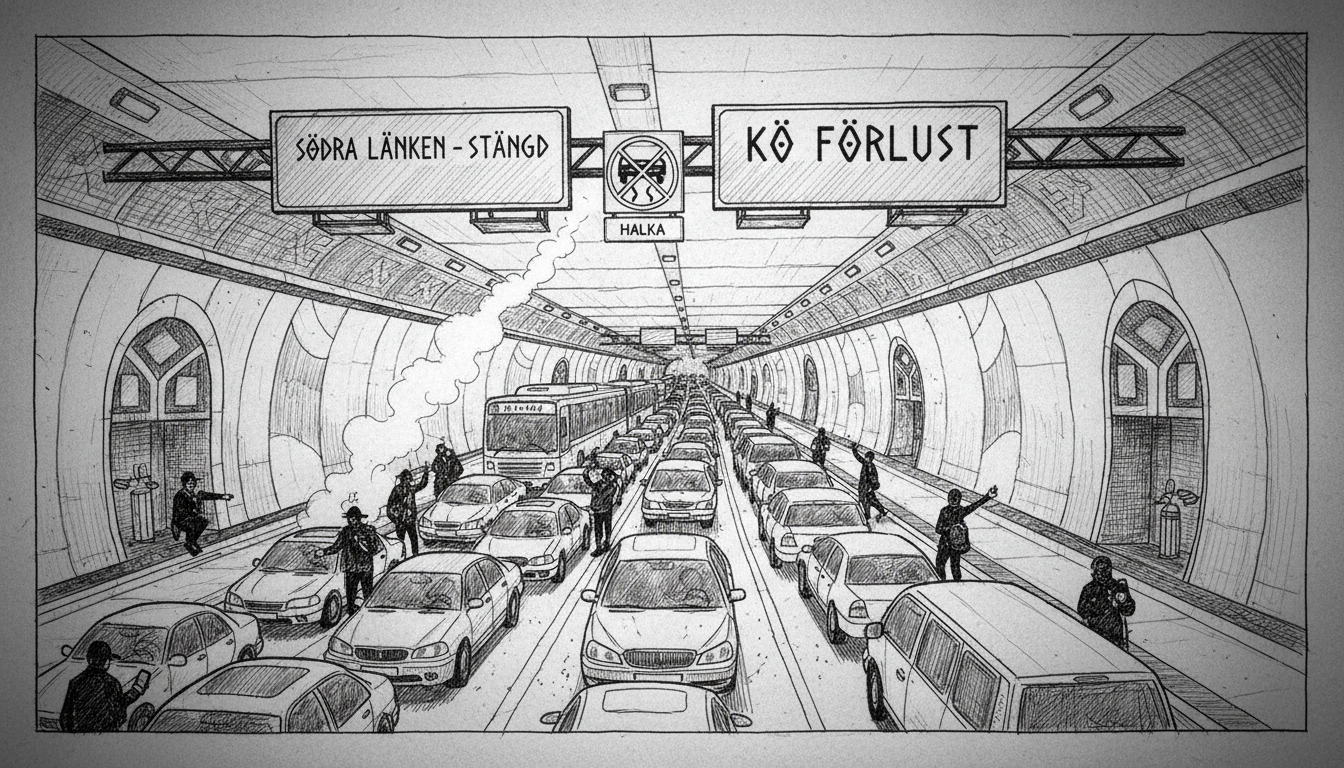
Sweden’s crucial Södra Länken tunnel, a motorway handling hundreds of thousands of vehicles daily, became a bottleneck of gridlock after an afternoon crash. The collision occurred around 2 pm on Wednesday, blocking the left lane of the tunnel's southern tube heading towards Södertälje, just past the Gullmarsplan entrance. Emergency services rushed to the scene, closing access ramps from Sickla and Gullmarsplan as they worked. For the thousands of commuters and truck drivers caught in the ensuing chaos, the afternoon turned into a long, frustrating crawl under the city.
A Vital Artery Grinds to a Halt
The Södra Länken is not just any road. This 6-kilometer engineering feat, with 4.5 kilometers running underground, is a cornerstone of Stockholm’s traffic system. It connects the E4 and E20 European routes, funneling traffic between the city’s western and eastern halves. When it sneezes, as locals say, the entire region catches a cold. “It’s our lifeline for getting goods from the ports and moving across town,” said Erik Lundström, a delivery van driver we spoke to while he was stuck in the queue. “An accident here doesn’t just cause a delay. It unravels the schedule for the whole day.”
The advanced traffic management systems inside the tunnel—surveillance cameras, sensors, and variable message signs—swung into action. But technology can only do so much when physical space is blocked. With the left lane closed, the capacity of the three-lane tube was drastically reduced. Traffic quickly backed up, with reports indicating queues stretching for miles on the approach roads. The ripple effect began immediately, clogging alternate routes through adjacent neighborhoods like Årsta and Hammarby Sjöstad.
The Human Cost of Gridlock
Beyond the statistics are the stories of interrupted lives. We met Anna Bergman, a teacher trying to get from her job in Södermalm to pick up her children from daycare in Högdalen. “I left what I thought was plenty of time,” she said, checking her watch nervously from her stationary car. “Now I’m just hoping the staff can stay late. It’s this anxiety, this helplessness, that’s the worst part.” For many, the tunnel is a daily necessity, not a choice. Public transport alternatives in these corridors are often overwhelmed when the road network fails.
The incident highlights a stark reality of modern urban infrastructure: our reliance on complex, concentrated systems. A single crash in a key location can have disproportionate effects. “Tunnels are particularly vulnerable nodes,” explains traffic analyst Mats Jansson, who we contacted for comment. “There are no easy detours, no shoulders to clear to. An incident that might cause a 20-minute delay on an open highway can paralyze a tunnel for hours. The emergency response is fantastic, but the physics of the space create a major challenge.”
Jansson points to the tunnel’s design—two separate tubes, each with three lanes—as both its strength and its weakness. The separation prevents head-on collisions and allows for maintenance, but when one tube is impaired, the other cannot absorb the full load. The system’s efficiency is also its fragility.
Analysis: Resilience in a Wired City
This afternoon’s disruption forces a question Stockholm, and cities like it, must continually ask: How do we build resilience into our vital arteries? The Södra Länken is equipped with world-class safety and monitoring tech. Yet, as seen today, technology cannot prevent all human error or mechanical failure. The economic cost of such stoppages is immense, calculated in lost productivity, wasted fuel, and delayed logistics.
From a societal perspective, these events also test the social contract of commuting. The famed Swedish value of ‘lagom’—moderation, balance—feels distant in a five-kilometer tailback. Yet, there’s also a collective patience often observed. “What can you do? You wait, you listen to the radio. You get home when you get home,” said Lars, a commuter we spoke with, echoing a common, if weary, sentiment. It reflects a pragmatic acceptance of the vulnerabilities that come with dense urban living.
Looking ahead, analysts like Jansson suggest the conversation is shifting from pure capacity to smarter management and redundancy. “Can we better incentivize off-peak travel? Is our real-time information for drivers good enough to allow for earlier rerouting? And how do we speed up clearance protocols without compromising safety?” he asks. These are the policy and operational puzzles that follow an incident like today’s.
The Road Ahead
As the cleanup continued into the evening rush, the focus turned to recovery. The reopening of the closed lane would provide relief, but the backlog of traffic would take hours to dissipate. For Stockholm’s commuters, the event is a reminder of the intricate, often invisible web that keeps a city moving—and how quickly it can fray.
The Södra Länken will flow freely again, as it always does. But the memory of today’s long queues will linger, a brief snapshot of urban vulnerability. It prompts a final thought: In our pursuit of faster connections and smarter cities, are we designing systems that can truly withstand the unpredictable nature of daily life? The answer, much like the traffic today, moves slowly, with careful consideration required at every turn.