
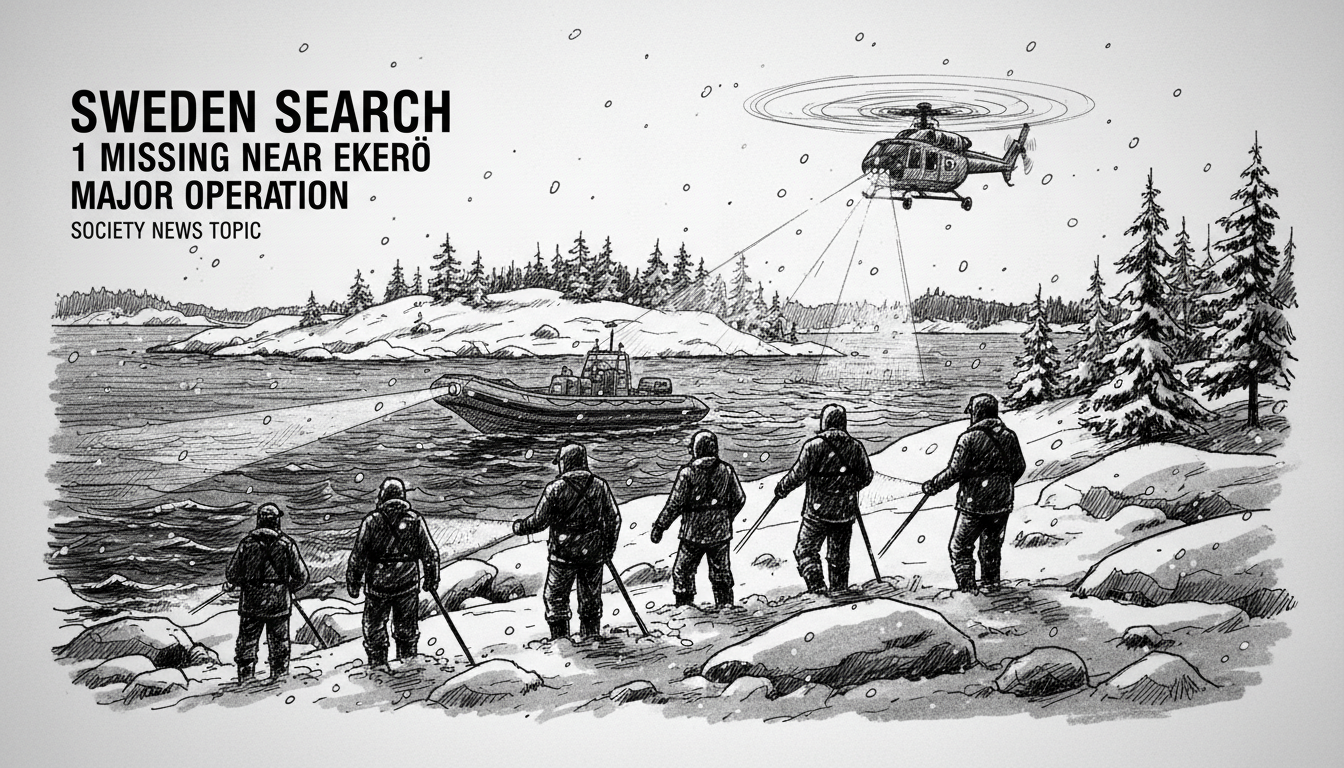
Swedish authorities are searching for one missing person after a boat was found adrift on Lake Mälaren near Ekerö. The alarm came in at 8:10 AM on Thursday morning. A vessel was discovered floating in the reeds near Brostugan on the island of Helgö. This triggered a large-scale rescue operation across the waters of Kyrkfjärden.
“There are signs that someone was on board. It could be that someone has fallen overboard,” said Sara Eriksson, press officer for the Swedish Maritime Administration (Sjöfartsverket). Her statement framed the morning's urgent efforts. Multiple agencies scrambled to the scene. The Maritime Administration's rescue helicopters circled overhead. Crews from the Swedish Sea Rescue Society (Sjöräddningssällskapet), the Rescue Services (Räddningstjänsten), and the Coast Guard (Kustbevakningen) combed the water with boats and aircraft.
By lunchtime, the focus shifted. The Maritime Administration concluded its sea rescue mission and handed the case over to the police. The search transformed from a water-based rescue to a land-based investigation. “Right now, we are mainly searching on land. Some finds have been made that can be interpreted as the person being on land,” said police press spokesperson Daniel Wikdahl. This pivot suggests clues point away from the open water. It deepens the mystery on the quiet, historically rich islands west of Stockholm.
A Morning Alarm on Historic Waters
The call that disrupted a calm Thursday morning led responders to a specific point: Brostugan on Helgö. For locals, Helgö is not just any island. It is a place steeped in profound history, known internationally as a major Viking Age trading center. From roughly 400 to 1000 AD, it was a bustling hub where artifacts from as far as Ireland and the Byzantine Empire have been unearthed. Today, it is largely a place of summer homes, serene forests, and archaeological sites. The contrast between its ancient past and a modern missing person case is stark.
Kyrkfjärden, the body of water where the search concentrated, is a typical part of the Mälaren archipelago. The lake is dotted with islands, inlets, and dense reed beds. This complex geography makes search operations particularly challenging. A person in the water could be concealed by shoreline vegetation. Alternatively, they could have made it to any one of dozens of small, wooded islets. The multi-agency response reflects standard protocol for such a landscape. It requires coordination between air, sea, and land units to cover all possibilities.
“The shift from a maritime rescue to a police-led land search is significant,” explains Lars Bengtsson, a former search and rescue coordinator with experience in the Stockholm archipelago. “It usually means they have found personal items—a jacket, a phone, a bag—on shore. Or there’s witness information suggesting the person left the boat intentionally. The priority changes from saving a life in the water to finding a person, who may be disoriented or injured, in a large terrestrial area.”
The Community of Ekerö Waits and Wonders
Ekerö municipality is a collection of islands like Helgö, known for a quieter, suburban pace of life compared to central Stockholm. Many residents are commuters who cherish the natural setting. News of the search spread quickly through community forums and word of mouth. The sight of helicopters and patrol boats in the usually tranquil Kyrkfjärden was unsettling.
Mikael, a year-round resident of Ekerö who asked not to use his full name, was walking his dog along the shore. “You see the Coast Guard boat going slowly back and forth, and the helicopter making low passes,” he said. “It’s a worrying sight. This is a tight-knit area. People are asking each other if they’ve seen anything, if they know whose boat it might be. Everyone hopes for a good outcome.” This sense of communal anxiety is palpable in small, island-based communities where everyone feels connected to the water and the land.
The police have not released details about the missing individual or the “finds” made on land. This lack of information is standard procedure to protect the investigation and the privacy of the individual’s family. It does, however, fuel local speculation and concern. Is it a local fisherman? A summer resident preparing their cabin? A lone sailor? The unanswered questions hang over the community as the search continues.
The Complex Mechanics of a Search
The initial response showcased Sweden’s integrated rescue system. The Swedish Maritime Administration handles coordination at sea. The voluntary Swedish Sea Rescue Society provides crucial boat crews. The Coast Guard offers additional maritime resources and authority. The Rescue Services handle complex operations often linked to the shoreline. Finally, the police take over for criminal investigations or, as in this case, missing person searches on land.
This handover is a critical juncture. It involves briefing, sharing all gathered data—like helicopter thermal imaging or boat search patterns—and defining a new search perimeter. The police likely mobilized dog units, foot patrols, and possibly drones to scan the dense forests and rocky shores of Helgö and adjacent islands. They would also be conducting door-to-door checks at the scattered homes and cottages.
“Searching these island environments is a massive logistical task,” says Bengtsson. “You have limited road access, dense forest, and often difficult terrain. It’s not like searching a city grid. You’re relying on technology, dogs, and the methodical work of officers walking through difficult ground. The fact that they are focusing on land is a major clue, but it also means they are looking for a needle in a very large, green haystack.”
Between Ancient Echoes and Modern Anxiety
There is an eerie resonance to a disappearance on Helgö. This island was abandoned by the end of the Viking Age, its role as a central place fading into history. The people who lived, traded, and vanished there over a millennium ago are known only through the artifacts they left behind. A modern disappearance forces us to confront a similar, chilling silence—the absence of a person, the story cut short.
Yet, this is not an archaeological mystery. It is a pressing, modern incident involving real-time technology and human worry. The helicopters in the sky are a world away from the Viking longships that once plied these same waters. But the fundamental human elements—concern for a missing member of the community, the mobilization of collective resources to find them—transcend time. The community’s hope is for a swift, safe conclusion that the ancient residents of Helgö rarely enjoyed.
As dusk fell on Thursday, the police search on land continued. The boats had largely left Kyrkfjärden. The helicopters returned to base. The active, noisy urgency of the morning was replaced by a more deliberate, quiet investigation among the trees and rocks. For the family and friends of the missing person, the wait is agonizing. For the community of Ekerö, the event is a reminder of the vulnerability that exists even in the most peaceful settings.
Will the search on land provide the answers the sea did not? The coming hours are critical. In the vast, beautiful, and sometimes unforgiving landscape of Lake Mälaren, the work to bring one person home continues, step by careful step.