
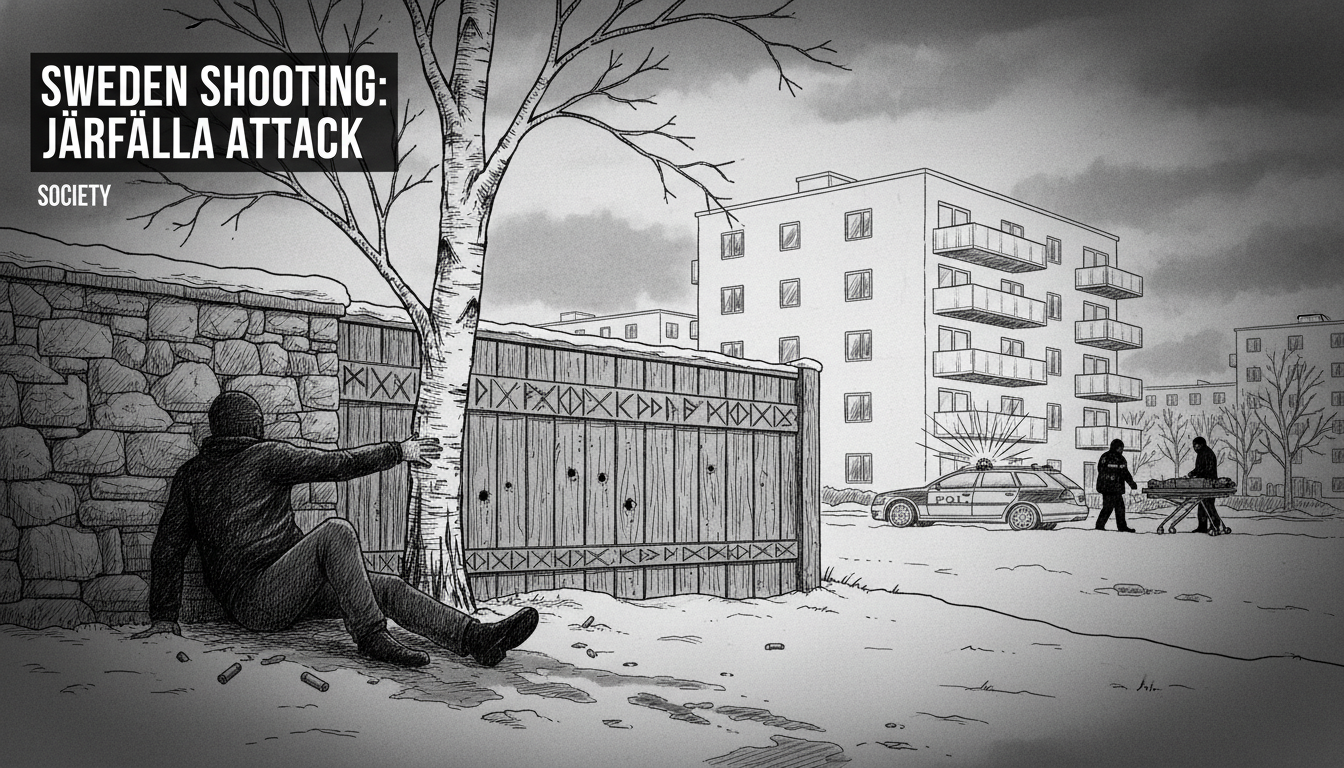
Sweden's recurring problem with gang violence struck again Wednesday evening in the Stockholm suburb of Järfälla. A man was shot and wounded in the district of Kallhäll, northwest of the capital. Police were alerted to the shooting and found the injured victim at the scene. He was taken to hospital by ambulance. Authorities have launched a preliminary investigation into attempted murder and serious weapons offences. No suspect has been arrested.
"When patrols arrived, an injured person was found," police press spokesperson Nadya Norton said. She confirmed the man had been shot. While his exact condition is unknown, Norton stated it had been possible to speak with him. The incident adds to a growing list of shootings that have shaken communities across Sweden, particularly in the urban areas around Stockholm, Gothenburg, and Malmö.
A Quiet Suburb Disrupted
Järfälla is typically a quiet municipality, a mix of residential areas, nature reserves, and business parks. Kallhäll, where the shooting occurred, is known for its commuter train station and family-friendly neighborhoods. Events like this rupture the everyday calm. They send ripples of fear through communities where children play and people walk their dogs. For residents, the sound of sirens replacing the evening quiet is a jarring reminder that no area is entirely insulated from the violence linked to criminal conflicts.
This shooting follows a pattern seen in recent years. Gang-related violence, often tied to drug trafficking and territorial disputes, has escalated. The weapons of choice are frequently illegal firearms, circulating within criminal networks. While overall crime rates in Sweden are comparable to other European nations, the frequency of shootings and explosions has become a distinct and troubling trend.
The Human Cost Beyond the Headline
Behind the police report is a human story. A man is in hospital. A family is waiting for news. Neighbors are locking their doors with a new sense of unease. "You hear about these things in other places, but when it's your own station, your own street, it feels different," says Anna, a Kallhäll resident who asked not to use her full name. She was returning from work when she saw the police tape. "It's the feeling of safety that's damaged. That's what they take."
This erosion of public safety is a primary concern for both citizens and policymakers. Shootings often occur in public spaces—outside convenience stores, near subway stations, in residential courtyards. The risk of bystanders being caught in the crossfire is a constant, grim possibility. Each incident fuels a debate about integration, social exclusion, and the tools available to police.
A Complex Web of Causes
Criminologists point to a confluence of factors driving the violence. Social and economic segregation in some suburban areas can create fertile ground for recruitment into criminal gangs. Young people facing limited opportunities may see few alternatives. The lucrative illegal drug market provides both motive and financial fuel for conflicts. The availability of illegal weapons, often smuggled into the country, turns these conflicts deadly.
Law enforcement has responded with increased focus on organized crime. Strategies include targeted surveillance, tougher sentencing for gun crimes, and task forces aimed at disrupting gang finances. The police work is often described as a constant battle against fluid and adaptable networks. "We are focusing on the perpetrators, the organizers, and the weapons," a Stockholm police representative recently stated. "Every weapon we seize is a potential life saved."
The Stockholm County Context
Stockholm County is the epicenter of this type of violence in Sweden. A significant percentage of the nation's shootings occur within its borders, though precise annual figures fluctuate. The geography of the violence is telling. It frequently plays out in the suburbs surrounding the affluent city center, highlighting the socioeconomic divides within the region. Areas like Järfälla, Botkyrka, and Södertälje have all seen similar incidents, putting local police under sustained pressure.
The response is not solely punitive. Many municipalities and community groups run prevention programs. These initiatives aim to provide young people with positive alternatives through sports, mentorship, and job training. The goal is to address the root causes before a young person ever picks up a weapon. Success is hard to measure, but those involved argue it is a critical piece of the puzzle alongside policing.
Searching for Solutions in a Polarized Debate
The political debate surrounding gang violence is highly charged. It touches on deep questions about immigration, integration, and the role of the welfare state. Some argue for significantly harsher penalties and expanded police powers. Others advocate for massive investment in social programs, schools, and youth outreach in vulnerable areas. The reality is that most experts see a need for both: a strong, effective judicial system to handle immediate threats, and long-term, inclusive social policies to prevent future recruitment.
For the residents of Kallhäll, these national debates feel abstract. Their immediate concern is the yellow police tape on their street. It is the hope that the injured man recovers. It is the desire for a single night without the echo of sirens. The shooting in Järfälla is another data point in a worrying national trend. But for the community living it, it is a personal violation of their peace and a challenge to their sense of security. As the investigation continues with no suspect in custody, that sense of vulnerability lingers. The question hanging over Kallhäll, and over many Swedish suburbs, remains: When will the next shot be fired?