
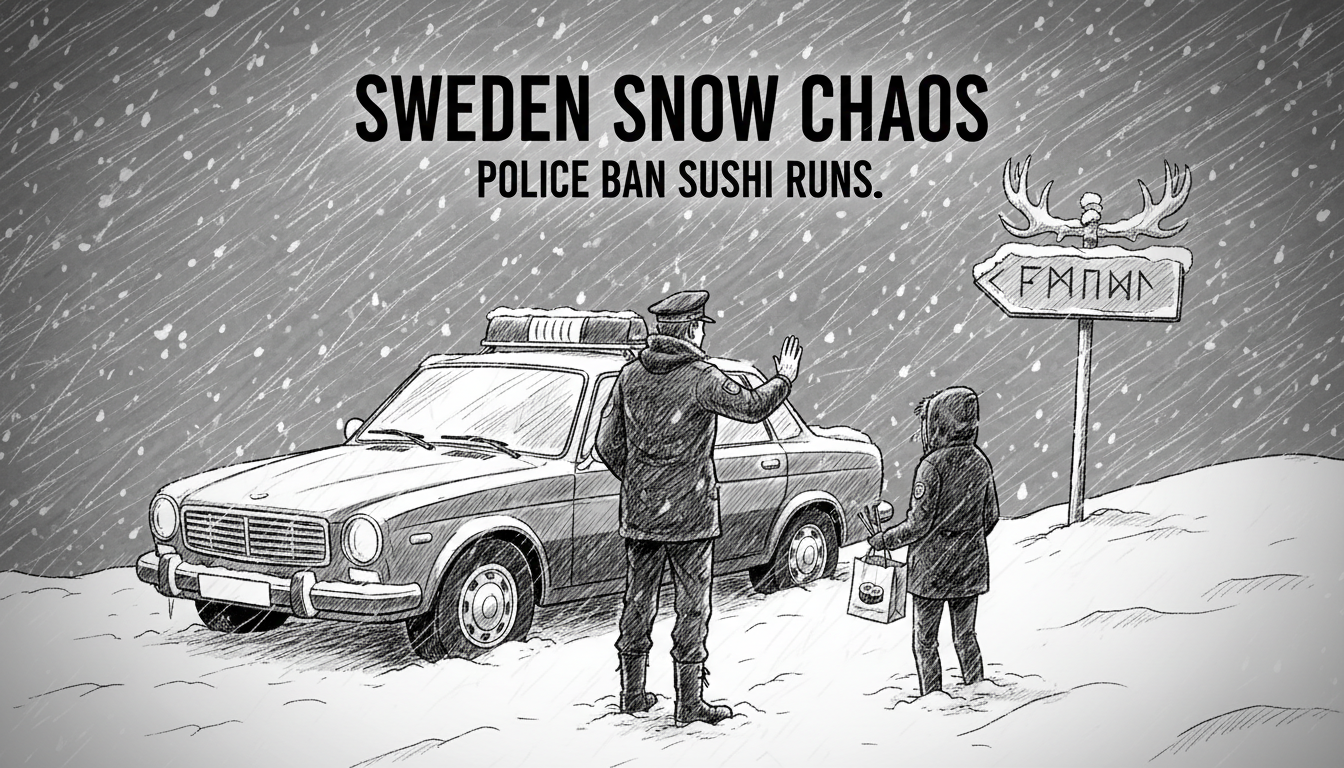
Sweden's capital faced a blanket of white chaos on January 3rd. Stockholm police issued a stark warning to residents: stay off the roads. Their advice included a specific, culturally resonant plea. Avoid non-essential travel, and that includes trips to pick up sushi. The unexpected directive, mixing practical safety with a touch of dry Swedish humor, became the talk of a city grinding to a halt. It highlighted the clash between modern urban habits and the raw power of a Nordic winter.
A City Slows Under Heavy Snow
The Swedish Meteorological and Hydrological Institute (SMHI) had issued warnings for intense snowfall across the Stockholm region. By evening, predictions suggested the capital could see significant accumulation. Roads quickly became treacherous. Public transport experienced delays and cancellations. For Stockholmers, a heavy snowstorm disrupts the rhythm of city life in a way that differs from the more prepared northern towns. The infrastructure, built for efficiency, strains under the weight. Commutes double in length. Sidewalks disappear. The police warning was a direct response to this mounting disruption, aiming to keep people safe and roads clear for emergency services and snowplows.
“We are urging the public to avoid all unnecessary car journeys,” a police spokesperson said in a statement. “Consider if your trip is truly essential. Is it necessary to go out for sushi, for example? That is not an essential journey in these conditions.” The comment, quickly shared on social media, struck a chord. It pinpointed a very Stockholm dilemma. In a city with a profound love for sushi, where a Friday night ‘sushi queue’ is a common ritual, the police were challenging a deeply ingrained lifestyle habit. They framed public safety in terms of postponed culinary pleasure.
The Sushi Statement and Swedish Society
The police’s sushi reference was more than a throwaway line. It was a sharp piece of social observation. Sushi consumption in Sweden is among the highest per capita in Europe. It’s a staple of modern Swedish life, a common takeaway choice, and a standard feature at office lunches. By singling it out, the police tapped into a shared cultural understanding. They communicated severity by targeting a normalized luxury. “It’s a very Swedish way of putting it,” said Lars Trägårdh, a historian and author on Swedish society. “It’s not a dramatic, shouting order. It’s practical, slightly humorous, and assumes a citizen who will understand the reasoning. It says, ‘We all know you like sushi, but be sensible.’”
The request also underscores a broader social contract in Sweden. There’s a high expectation of individual responsibility during crises. Citizens are generally trusted to heed expert advice from authorities like SMHI or the police. The sushi comment worked because it relied on that mutual understanding. It was a nudge, not a draconian decree. In neighborhoods like Södermalm or Vasastan, known for their dense populations of restaurants and cafes, the message was particularly resonant. A usual evening scene of people popping out to collect dinner was replaced by quiet, snow-filled streets.
Beyond the Weather: A Night of Multiple Alerts
While the snowstorm dominated headlines, the police and emergency services were dealing with multiple incidents across Stockholm. In a separate event, unrelated to the weather, neighbors in a residential building had to be evacuated during a firefighting operation. This incident served as a stark reminder of why keeping roads clear is so critical. Fire trucks and ambulances need to navigate swiftly, a task made nearly impossible when streets are clogged with cars stuck in snow or drivers making ‘non-essential’ trips.
Meteorologists emphasized that while the evening snowfall was expected to be intense, the system was predicted to move through relatively quickly. “The key is to get through the peak of the event without major incidents,” explained a meteorologist with SMHI. “Heeding travel warnings is the most effective thing the public can do. It prevents accidents, reduces the burden on emergency services, and allows our infrastructure teams to do their job.” The clean-up operation, involving an army of municipal snowplows, would begin in earnest once the snow stopped.
The Cultural Weight of a Winter Warning
For international observers, the sushi detail might seem quirky. For Swedes, it was a perfectly logical benchmark. Swedish culture news often highlights this blend of the practical and the mundane. The story isn't just about a snowstorm; it's about how Swedish society communicates and functions under pressure. There’s a certain pride in handling weather extremes, a concept known as ‘vinterberedskap’ or winter preparedness. This event tested that preparedness in an urban, modern context.
The police advice also touched on trends in Swedish lifestyle and consumption. The convenience economy—food delivery, easy travel—meets the immutable force of nature. It prompted a minor, collective pause. Would people actually listen? Social media suggested many did, with posts showing homemade meals instead of the usual takeaway boxes. Others shared memories of past snowstorms, a common bonding experience in a country where winter is a dominant force for half the year. Stockholm events today, from canceled concerts to quieted streets, all traced back to the weather.
Looking Ahead: Thaw and Reflection
As forecasted, the intense snowfall began to subside overnight. January 4th dawned with the familiar scene of a city digging out. The clean-up was underway, a well-rehearsed dance of machinery and municipal workers. The ‘sushi ban’ was lifted, but the conversation it sparked lingered. It served as a small, perfect case study in Swedish societal values: practicality, trust in authorities, and a dash of self-deprecating humor.
The incident raises questions about resilience in the face of climate change. While Sweden is no stranger to snow, weather patterns are becoming more volatile. Can urban infrastructure keep pace? Does the social contract of individual responsibility hold during more frequent or severe events? The snowstorm of January 3rd was a routine winter event. But the response to it—from the official warnings to the public's reaction—offers a snapshot of a society navigating its relationship with nature, convenience, and community. The final question remains: next time a storm hits, will Stockholmers remember the lesson of the non-essential sushi run, or will the call of salmon and avocado prove too strong?