
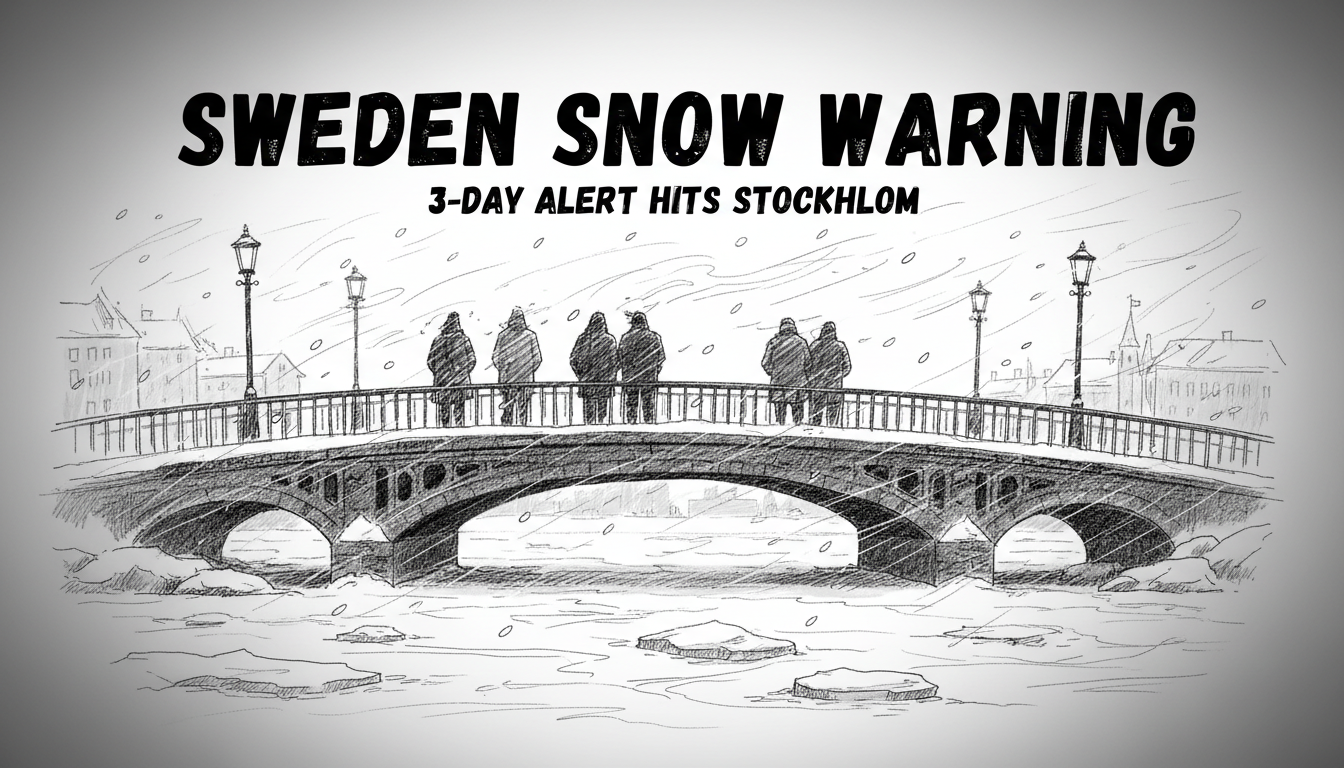
Sweden's SMHI has issued a three-day weather warning for heavy snow across Stockholm and northeastern Svealand. An orange alert for up to 4 decimeters of snow and strong winds is in effect for Roslagen, while a yellow warning blankets the capital. The forecast promises a significant disruption to the first real winter weekend of the season.
For Stockholm residents, the gentle dusting that began Thursday night is just the opening act. The Swedish Meteorological and Hydrological Institute predicts a steady accumulation of 1 to 2 decimeters from Friday through Sunday evening. North of the city, in the coastal archipelago region of Roslagen, conditions will be more severe. Up to 4 decimeters could fall, driven by brisk winds that will create blowing snow and reduced visibility.
"It's the combination of persistent snowfall and wind that creates the real challenge," a meteorologist at SMHI explained in their warning statement. "We urge the public to follow the warnings and consider postponing non-essential travel." The agency's color-coded system is a crucial part of Sweden's winter preparedness. A yellow warning signals potentially disruptive weather, while orange indicates dangerous conditions that could pose a risk to the public and property.
A Capital Braces for a White Weekend
In Stockholm, the approach of a snow warning triggers a familiar, almost rhythmic, urban response. By Friday morning, the city's efficient fleet of snowplows was already making early passes on main arteries like Sveavägen and Birger Jarlsgatan. In suburbs like Hägersten and Enskede, residents were seen digging out their classic, sturdy spark sleds from storage sheds. The mood on the streets was one of pragmatic preparation mixed with a touch of anticipation.
"I've already switched my online grocery order to include extra coffee and kanelbullar," said Lena Forsberg, a teacher in Vasastan. "If we're going to be housebound, we might as well make it cozy. My kids are already hoping school is canceled on Monday." This blend of mys—the Swedish concept of cozy contentment—and practical readiness defines the local approach to winter storms. It’s less about panic and more about systematic adjustment.
However, the warning period, stretching across the entire weekend, complicates the usual routine. Friday commutes were slowed, but the greater test will be Saturday and Sunday. These are days typically filled with leisure travel, youth sports matches, and trips to the countryside. All are now under a cloud of uncertainty.
The Deeper Impact Beyond the City Limits
While Stockholm adjusts, the orange warning for northeastern Svealand highlights the varied impact of Swedish winter. Roslagen, with its sparse population, forested roads, and island communities, is far more vulnerable. Four decimeters of snow, whipped by wind, can quickly isolate smaller villages and hamper emergency services. For farmers, it means urgent work to secure livestock and ensure feed supplies are accessible.
"Out here, a warning like this isn't just an inconvenience; it's a planning imperative," said Erik Lundström, a ferry operator based in Norrtälje. "We monitor the wind forecasts even more closely than the snow totals. Strong winds mean we might have to cancel routes to the outer islands, and that cuts people off." This reality underscores a key aspect of Swedish society: the deep connection to, and respect for, nature's power, especially in more remote regions.
The snow also arrives at a time of heightened energy awareness. Following Europe's energy crisis, many Swedes are more conscious of heating costs. A sustained cold snap with heavy snow can lead to increased electricity demand, testing the national grid. While Sweden's energy system is robust, the SMHI warnings serve as an indirect prompt for households to be mindful of consumption during the peak cold periods.
Navigating the Practical and Cultural Snowfall
The societal response to such weather is woven into Swedish culture. Employers, especially in the public sector, often show flexibility. The concept of vab (caring for a sick child) might extend to snövab when schools close. Public transportation, a point of pride for Stockholm, enters a stressed state. Buses face delays, and while the subway system is largely protected, above-ground commuter rail lines like the Roslagsbanan can experience significant disruptions.
For newcomers to Sweden, the formal warning system is an essential introduction to the climate. "Where I'm from, this much snow would shut down the entire city for a week," said Anya Patel, who moved to Stockholm from the UK two years ago. "Here, the system is so clear. Yellow warning? Okay, expect delays, dress warmly. Orange? Seriously reconsider that drive. It removes the guesswork and helps you integrate the weather into your life, rather than just fighting it."
This integration is visible in the cityscape itself. Cafés in neighborhoods like Södermalm and Östermalm don't empty; they adapt. Outdoor seating areas are swiftly cleared, and blankets appear on chairs for the hardy patrons who still want to enjoy a fika in the fresh, snowy air. The snow becomes part of the ambiance, not an obstacle to it.
Looking Ahead: The Long-Term Forecast of Winter
This three-day event is not an anomaly but a feature of the Swedish winter. While climate change is leading to warmer average temperatures, it can also contribute to more intense, wetter precipitation events—including snowfall. SMHI's role in providing accurate, localized forecasts is becoming increasingly critical for urban planning, infrastructure resilience, and public safety.
The current warnings will test the winter maintenance contracts of municipalities and the preparedness of the Swedish Transport Administration. Their performance is closely watched, as efficient snow clearance is a non-negotiable expectation for most Swedes. A failure to keep major roads and public transit links open can quickly become a political issue.
As the snow continues to fall through Sunday, the true measure of the event will be in its aftermath. How quickly can normalcy be restored? For children, the answer might be "not too quickly," as they hope for hills perfect for sledding in parks like Vitabergsparken or Observatorielunden. For commuters facing Monday morning, the hope is for a clear, plowed path to work.
This weekend's snow warning is more than a meteorological bulletin. It is a shared experience that momentarily synchronizes the rhythm of an entire region. It prompts preparation, demands respect for nature, and ultimately reinforces the communal resilience required to thrive in the Nordic climate. The snow will come, the city will adapt, and life in Sweden will carry on—perhaps a little slower, and certainly with more layers on.