
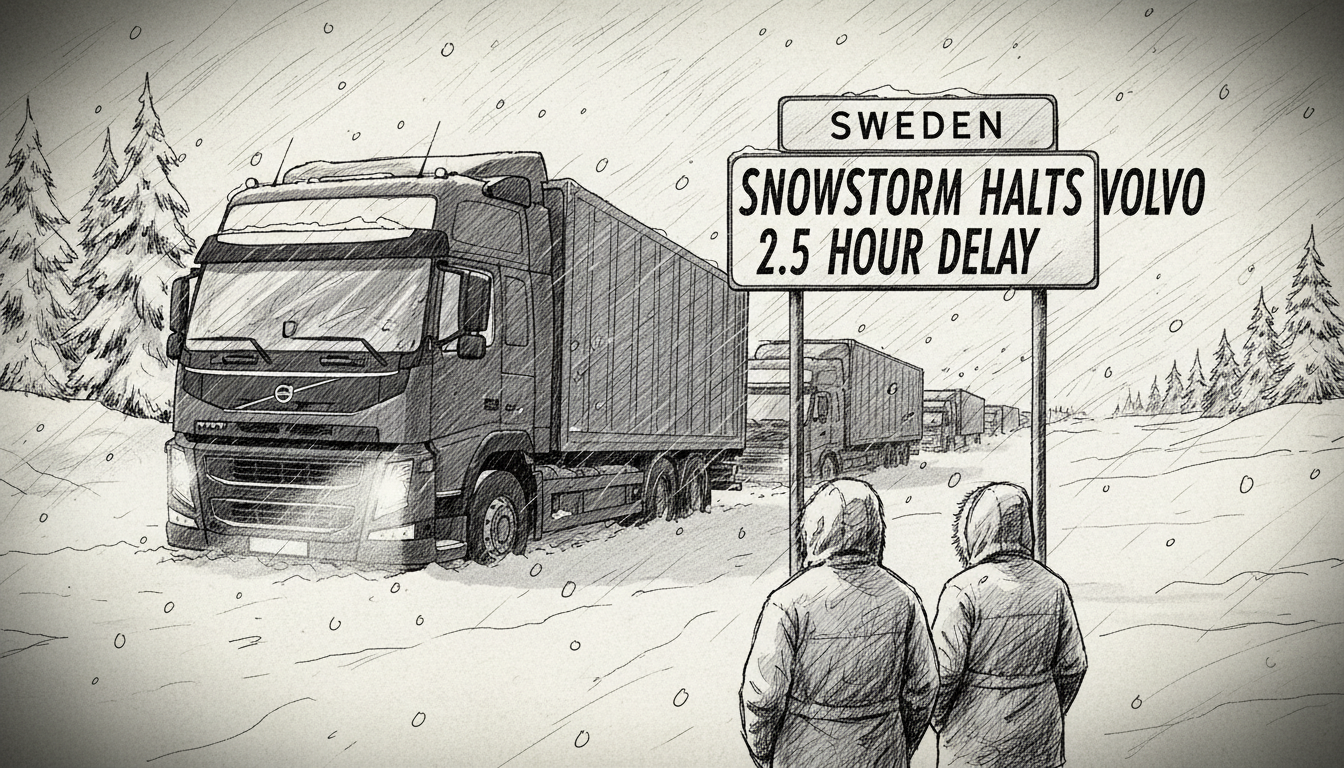
Sweden's Volvo Cars production at its flagship Torslanda plant faced a significant 2.5-hour delay on Wednesday morning. A heavy snowstorm sweeping across the west coast brought the morning shift to a near standstill, highlighting the vulnerability of even the most advanced industrial operations to classic Nordic weather. For thousands of workers, the day began not with the hum of machinery but with a slow, cautious commute through snow-clogged streets.
I spoke with several employees arriving at the vast factory complex. "It was like driving in a white tunnel," said Erik Lundström, a quality inspector with a 45-minute commute from Mölndal. "You plan for snow, but this was something else. The plows couldn't keep up." This human element—the delayed breakfasts, the rescheduled daycare drop-offs, the shared stories of slippery roads—forms the real backdrop to the production figures. The delay, while measured in hours, rippled through the local community of Gothenburg, where Volvo is not just a company but an integral part of the social and economic fabric.
The Heart of Swedish Industry Stalls
The Torslanda plant is no ordinary factory. It is Volvo Cars' largest manufacturing facility globally, with the capacity to produce hundreds of thousands of vehicles each year. Its operations are a finely tuned symphony of robotics, logistics, and human skill. A disruption here doesn't just mean idle machines; it can delay the global supply of a specific model, affect delivery timelines to customers from Shanghai to San Francisco, and create a backlog that takes days to clear. In 2023, Volvo sold over 708,000 cars, a 15% increase. Keeping that momentum requires relentless precision, a rhythm broken by nature's intervention.
"Even a short delay has a cost," explains automotive industry analyst Karin Fjellström. "It's not just the lost production hours. It's about the rescheduling of component deliveries, the potential overtime needed to catch up, and the strain on a supply chain that is already complex. For an automaker aiming for full electrification by 2030, every day of smooth production is critical." The incident exposes a tension at the core of modern Swedish industry: a drive towards a high-tech, efficient future, yet a reality still grounded in a climate that can be fiercely unpredictable.
More Than a Traffic Headache
This story transcends a simple weather report. It's a snapshot of Swedish society grappling with its environment and its economic ambitions. Sweden is built to handle snow—its cities have fleets of plows, its citizens own winter tires as a matter of course. Yet, extreme weather events, potentially intensified by climate change, test this preparedness. The snowstorm that halted Volvo is the same system that delayed trains, closed schools, and asked the famous Swedish concept of 'lagom'—moderation—to face a very immoderate snowfall.
The impact is felt in homes across Västra Götaland. Anna Berg, a logistics coordinator at the plant and a mother of two, described the morning chaos. "We got the alert about the delayed shift start, but you still have to get the kids to their förskola (preschool). Everything gets pushed back. It throws the whole ecosystem of a working family off balance." This human cost, the domino effect of a weather event, is often absent from corporate statements but is deeply felt in the communities that power companies like Volvo.
Resilience and the Road Ahead
Volvo Cars, employing some 43,000 people worldwide, is a symbol of Swedish resilience. The company has navigated global recessions, ownership changes, and a monumental industry shift towards electrification. A snow delay is a temporary setback, a problem the operational teams in Torslanda are adept at managing. The real question analysts are asking is about long-term resilience. How does a global manufacturer in a northern climate build flexibility into its systems for an era where weather patterns may become more volatile?
The response will likely be a blend of practical Swedish pragmatism and technological innovation. Could more flexible shift patterns for extreme weather days be part of the solution? Is there a role for better hyper-local weather forecasting integrated directly into production planning? The event serves as a real-world stress test. "It's a reminder that the automotive supply chain is only as strong as its weakest link, and sometimes that link is a snowdrift on a country road," Fjellström notes.
A Cultural Perspective on Productivity
There's a cultural dimension here too. The Swedish relationship with nature is profound, encompassing both a deep appreciation for the seasons and a respectful acknowledgment of their power. The famous Allemansrätten (the right of public access) allows people to roam freely, but it comes with an unspoken responsibility to be prepared and to adapt. In a way, this industrial delay is a manifestation of that same principle on a corporate scale. You can plan, you can innovate, but you must also sometimes yield to the weather, regroup, and carry on safely.
As the day shift finally got underway in Torslanda, the focus shifted to recovery. The production lines hummed back to life, building the next generation of electric Volvos destined for global markets. The snow will melt, the roads will clear, and the production charts will aim to make up for lost time. But the event leaves a lingering thought. In Sweden's journey to a high-tech future, its iconic industries remain in a constant, quiet negotiation with the timeless forces of Nordic winter. The true measure of strength isn't just in avoiding disruption, but in the calm, methodical way a nation and its flagship companies adapt when the snow finally falls.
Will this single event show up in Volvo's annual report? Probably not in a major way. But it is a stitch in the larger tapestry of Swedish industrial life—a reminder that even in an age of automation and AI, the path to work can still be blocked by a fresh blanket of snow, and a community's response to that challenge remains its most valuable asset.