
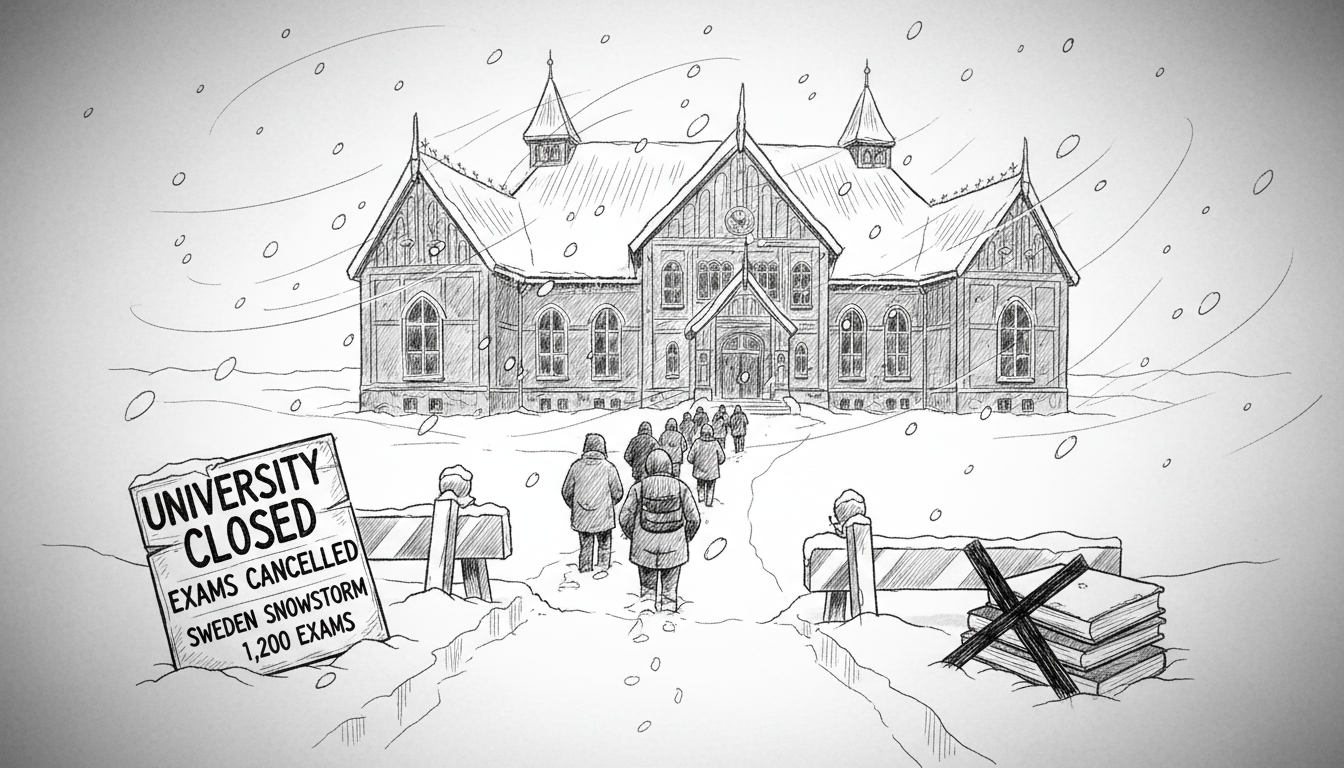
Sweden's Chalmers University of Technology cancelled all exams on Wednesday due to a severe snowstorm, affecting approximately 1,200 students. The unprecedented decision highlights how even a nation famed for its winter resilience can be brought to a standstill by nature's force. For students across Gothenburg, a day of intense academic pressure transformed into an unexpected snow day.
"To my knowledge, this has never happened before," said Chalmers press officer Henrik Dahlberg. His statement underscores the rarity of the event. Swedish universities are built to function through dark, cold winters. This cancellation signals something extraordinary. The maritime climate of Sweden's west coast, where Gothenburg sits, typically brings manageable snow. This week, it delivered chaos.
A City Grinding to a Halt
The exam cancellations were just one part of a wider disruption. Gothenburg's extensive tram network, the backbone of the city, faced major delays and stoppages. Buses crawled along treacherous routes. For the 1,200 Chalmers students, the primary concern was simply getting to campus safely. Many live in student areas like Johanneberg or in suburbs reliant on public transport. The university's decision, communicated urgently, prioritized student and staff safety over academic schedule.
This human impact is the real story. Imagine the stress. Students spend weeks, sometimes months, preparing for these pivotal exams. The mental focus is intense. Then, the weather intervenes. For international students, particularly those from milder climates, the scene was likely a shocking introduction to Nordic winter's potential. The cancellation brings a mix of relief and new anxiety. When will the rescheduled exams be? How does this impact study plans and travel arrangements?
The Infrastructure Challenge
Sweden is a country that masters winter. Heated pavements in Stockholm, massive snowplow fleets, and winter tire laws are points of national pride. Yet, this event shows the limits of preparation. Climate experts point to a troubling trend. While Sweden is getting warmer on average, weather patterns are becoming more volatile. This can lead to more intense, concentrated snowfall events that overwhelm even robust systems.
"We are seeing an increase in these high-impact, short-duration weather events," says Dr. Elin Moberg, a climatologist at the University of Gothenburg. "The infrastructure is designed for a certain historical range. When we get a snowfall of 30-40 centimeters in a day, especially in a coastal city like Gothenburg, it tests every part of our society." Her analysis moves the story beyond a simple news item. It frames the cancellation as a case study in climate adaptation. Universities, like cities, need resilient contingency plans.
What does contingency look like for an exam? Could digital alternatives work for some assessments? The pandemic forced Swedish education to adapt rapidly to online formats. That experience may now inform planning for weather emergencies. Henrik Dahlberg at Chalmers confirmed the university is now actively reviewing its crisis protocols. "The safety of our students and staff is paramount. This event will certainly lead to discussions on how we plan for the unexpected," he said.
Student Life Interrupted
To understand the cultural impact, you must look at the student experience. The tenta (exam) period is a rite of passage in Swedish university life. Libraries are packed. Coffee consumption soars. There's a collective, quiet tension across campuses. Cancelling this process is like stopping a well-oiled machine. The sudden pause creates a strange vacuum.
I spoke to Linnea Karlsson, a second-year engineering student, outside a café in the Haga district. She was supposed to have a calculus exam. "I was already on the bus, trying to get there, when I got the email," she said, clutching a takeaway coffee. "First, I was relieved. Then, I just felt... lost. All that adrenaline with nowhere to go. Now I have to stay in this focused mode for who knows how much longer. It's mentally tough."
Her sentiment is shared by many. The structure provided by the exam schedule is gone. Students are left in a state of limbo, trying to maintain their knowledge peak. Some turned their sudden free time into a positive. Social media showed students building snowmen on campus, having impromptu fika (coffee breaks), and helping dig out stranded cars. It was a display of typical Swedish pragmatism mixed with student camaraderie.
A Broader Swedish Winter Story
This incident is a microcosm of a larger Swedish relationship with winter. The country is globally associated with cold and snow. Yet, modern urban life is finely tuned and vulnerable to disruption. When public transport in Stockholm or Gothenburg falters, the effect is immense. Most Swedes do not own cars, especially in cities. They depend on reliable buses, trams, and trains.
The Chalmers cancellation forces a conversation about resilience. Is it enough to have great snowplows? Or do institutions need to build more flexibility into their core operations? For a technology university like Chalmers, known for innovation, this is a practical problem to solve. Other universities in Lund, Uppsala, and Stockholm will be watching closely. They face similar risks.
Furthermore, Sweden's appeal to international students and researchers hinges on a reputation for efficiency and stability. Events like this, while understandable, chip away at that image. It shows that the Nordic model, for all its strengths, is not immune to global patterns of extreme weather. The very climate that defines the region is becoming a source of unpredictability.
Looking Ahead: The New Normal?
The key question now is whether this is a one-off or a sign of things to come. Dr. Moberg, the climatologist, suggests caution. "We cannot say one storm is caused by climate change. But the models consistently predict an increase in the intensity of precipitation events in this region, including snowfall. What was a once-in-a-generation disruption could become more frequent."
This means Swedish society, from national transport administration to local universities, must think ahead. The response to this snowstorm was reactive. The challenge is to become proactive. For students at Chalmers, the immediate future holds rescheduled exams and revised timelines. For university administrators, the task is bigger. They must plan for a world where the classic Swedish winter is less predictable and more powerful.
As the snow melts in Gothenburg's streets, the lessons remain. The incident at Chalmers is more than a cancelled exam day. It is a story about adaptation, about the intersection of nature and modern life, and about how even the most prepared societies must constantly re-evaluate their relationship with the environment. The next time heavy snow is forecast, will Swedish universities have a Plan B ready? The answer will define how they weather the storms of the future.