
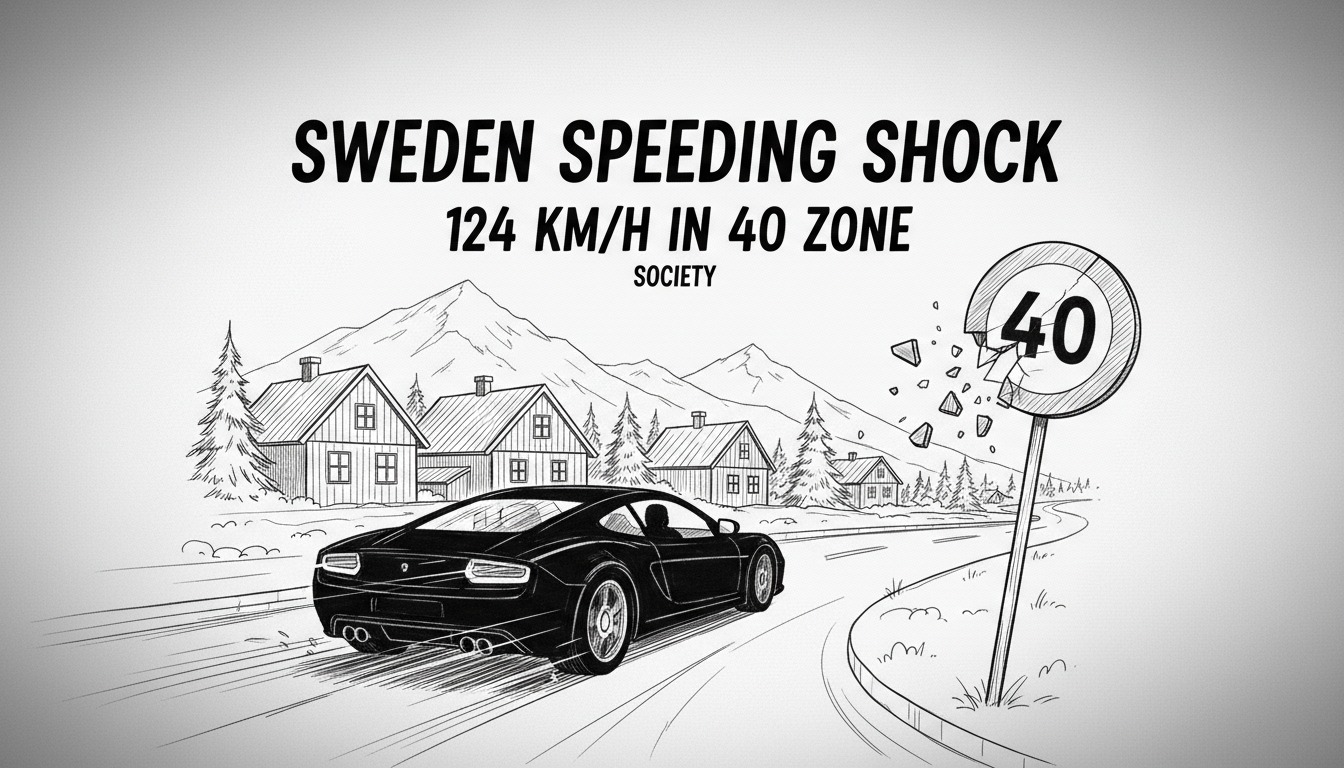
Sweden speeding laws faced a stark test in Jönköping this week. A man in his 30s was caught driving at 124 kilometers per hour in a residential area with a 40 km/h limit. The incident, described by police as exceptionally reckless, occurred in the Torpa district just after 2 a.m. It highlights a persistent challenge for a nation globally praised for its road safety.
"It's not unusual to see speeding, but this really stood out," said Hans Pettersson, a police officer familiar with the case. "This will likely result in a hefty fine, I imagine." The driver stopped after police signaled with blue lights. This single act of extreme speeding cuts against the grain of Swedish societal values around collective safety.
A Nighttime Drive Defying 'Vision Zero'
The event is more than a simple traffic violation. It is a direct contradiction of Sweden's foundational 'Vision Zero' policy. Adopted in 1997, this policy aims to eliminate all deaths and serious injuries from road traffic. It shifts responsibility from the individual driver to system designers—road planners, car manufacturers, and lawmakers. The core idea is simple: human beings make mistakes, but those mistakes should not cost lives.
In a 40 km/h zone, typically found in residential areas like Torpa, the design philosophy is clear. These speeds allow for interaction between cars, cyclists, and pedestrians. They provide drivers time to react. At 124 km/h, the physics change dramatically. Stopping distances become impossibly long. The force of any potential impact is catastrophic. A collision at that speed in such an area would almost certainly be fatal.
"This is the kind of behavior that 'Vision Zero' is designed to systematically prevent," explains traffic safety analyst Lena Forsberg. "It's not just about one driver's poor judgment. It forces us to ask if enforcement is consistent enough, if penalties are a true deterrent, and if our cultural messaging about speed is getting through to everyone."
The High Cost of a Moment's Decision
The legal consequences for the driver will be severe. Sweden operates a day-fine system, where penalties are based on the offender's daily income. For an extreme violation like this—more than triple the speed limit—the fine will be substantial, likely running into tens of thousands of Swedish kronor. A lengthy driver's license suspension is almost guaranteed.
Beyond the fine, there is a social cost. In Swedish society, where trust in collective responsibility runs high, such flagrant disregard for communal safety often draws sharp criticism. It is seen as a selfish act, putting countless others at risk for a thrill or a moment of impatience. Conversations in coffee shops and on social media following such incidents often center on this breach of the social contract.
Statistics consistently show speeding is a major factor in road fatalities. While Sweden ranks among the safest countries in the world for road travel, thanks to strict laws, safe vehicle standards, and extensive infrastructure like 2+1 roads, individual risk-taking remains a stubborn problem. Each incident like the one in Torpa is a reminder that perfect safety is a constant effort.
Jönköping's Quiet Streets and a Global Reputation
Jönköping, a picturesque city by the shores of Lake Vättern, is not known for chaotic traffic. Its streets are typically orderly, a reflection of the national culture. This makes the nighttime speeding incident even more jarring for residents. The Torpa area, like many Swedish suburbs, is designed for calm, safe living. Children play near roads, cyclists commute, and people walk their dogs.
This local event touches on a national identity point. Sweden's road safety record is a source of pride and a model exported worldwide. The 'Vision Zero' concept has been adopted in various forms by cities across Europe and North America. When a driver hits 124 km/h in a 40 zone, it feels like an anomaly. It challenges the stereotype of the universally rule-following Swede.
Yet, experts argue it's precisely because of this strong cultural and legal framework that such incidents are so shocking. They are the exception, not the rule. The system is designed to catch them, penalize them severely, and thus deter others. The swift police response in Jönköping is part of that system in action.
Beyond the Fine: A Cultural Conversation
The story does not end with the police report. It sparks a recurring conversation in Swedish media and homes. How do you stop the few who engage in such extreme behavior? Are fines enough? Some advocate for stricter measures, like immediate vehicle confiscation for extreme speeding. Others emphasize technological solutions, such as more widespread use of speed-limiting geofencing in new cars.
There is also a discussion about cause. Was the driver under influence? While not indicated in the initial report, it's a standard line of inquiry. Was it a deliberate act of rebellion, or a moment of lost judgment? The police investigation will look into all aspects.
For the average Swede, the reaction is often a mix of anger and bewilderment. The social democratic ideal underpinning 'Vision Zero' is that everyone benefits from a safe system. One person's choice to operate outside that system is viewed as a threat to all. It undermines the collective trust that makes Swedish society function smoothly.
The Road Ahead for Swedish Safety
As the driver in Jönköping awaits his formal summons, the incident serves as a case study. Sweden's road safety success is real, but it is not automatic. It requires continuous enforcement, public education, and cultural reinforcement. The 'Vision Zero' policy is a marathon, not a sprint. It acknowledges that perfection is the goal, even if it is difficult to ever fully attain.
This single speeding case will soon fade from the headlines. The fine will be paid, the suspension served. But its legacy will be a small, sharp reminder in the mind of the public and policymakers. It shows that even in the world's safest systems, human error and poor judgment can—and do—occur. The true test is how a society responds: with consistent application of the law, and a renewed commitment to the principle that no life should be lost on the road.
For visitors and new residents in Sweden, understanding this context is key. The strict speeding laws are not arbitrary. They are the backbone of a societal promise. The events in Torpa are a stark illustration of what happens when that promise is broken, and a demonstration of the mechanisms that work to uphold it every day.