
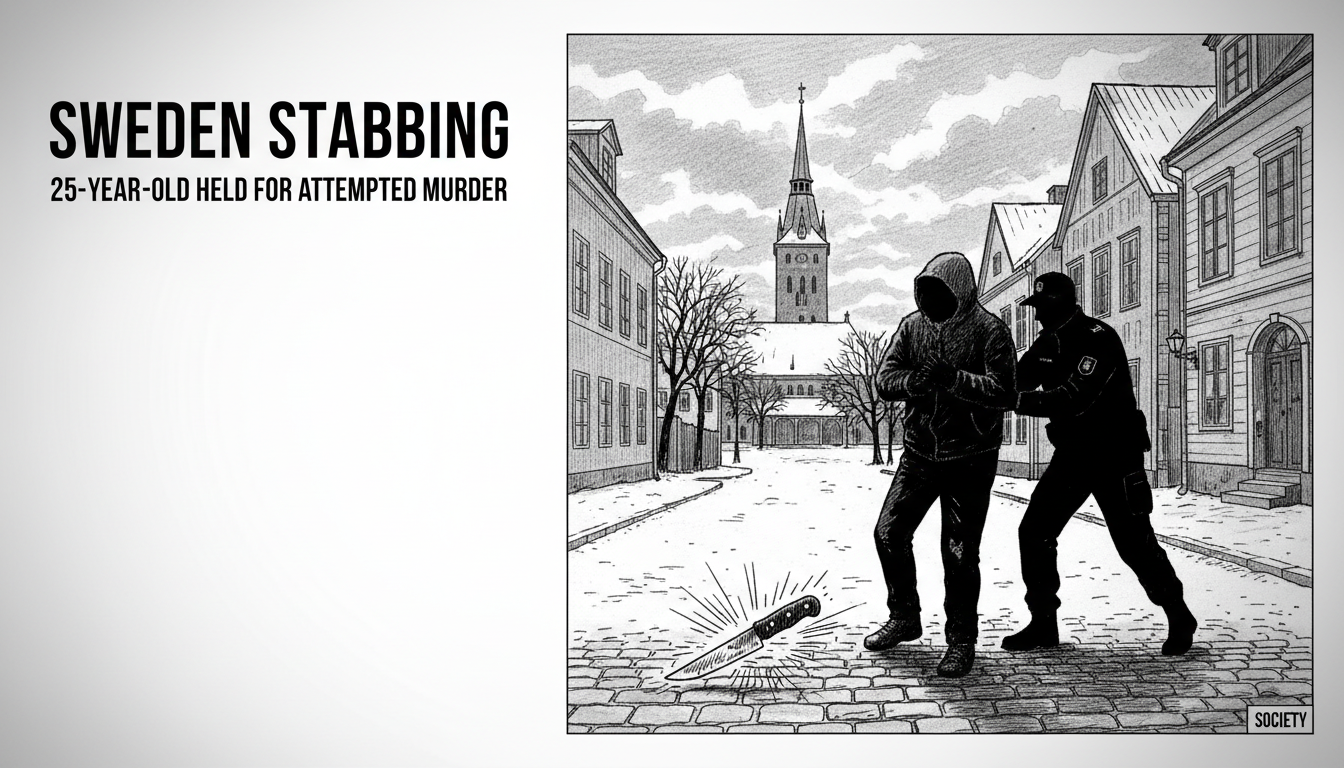
Sweden stabbing in central Eskilstuna has left a man hospitalized and a 25-year-old suspect in custody. Police were alerted at 4:22 PM on Sunday afternoon to reports of a violent assault. The victim, a man, suffered stab or cut wounds and was transported by ambulance to the hospital. His current condition remains unclear. Authorities acted swiftly, arresting a 25-year-old man at the scene on suspicion of attempted murder. The incident unfolded in the heart of the city, a place typically bustling with Sunday shoppers and families enjoying the afternoon.
For residents like Lena, a shopkeeper who has worked in the area for fifteen years, the news brought a familiar chill. "You hear the sirens, and you just hope it's not serious," she said, looking out her store window. "It's a quiet Sunday. This should be a time for peace." The quick police response provided some reassurance, but the underlying tension lingers. Violent crime in Swedish cities, even on a weekend afternoon, is a reality that communities are grappling with.
A City's Sunday Shattered
Eskilstuna, a historic city on the river connecting Lake Mälaren and Lake Hjälmaren, presents a complex picture. It's a city of industry and green spaces, known for its zoo and long history of steel production. Like many urban centers in Sweden, it faces the dual challenges of maintaining its community spirit while addressing issues of crime and social cohesion. Sunday's suspected attempted murder is a stark reminder of these pressures. The police have not released a motive, leaving a community to speculate and worry.
"These incidents create fear," said Erik Månsson, a local community safety coordinator. "They happen quickly, in public spaces, and they make people feel vulnerable." Månsson emphasizes that while statistics may show fluctuations, the perception of safety is deeply personal. A single violent act can alter how residents use their city center. Will they hesitate before going out for an evening stroll? Will parents keep a tighter grip on their children's hands?
The Broader Context of Urban Violence
Experts point to a confluence of factors when analyzing such incidents. While each case is unique, patterns emerge in urban violence across Sweden. Socio-economic disparities, mental health crises, and conflicts linked to organized crime or personal disputes are often cited. "We cannot look at an act of violence in isolation," explained Dr. Anette Hjorth, a sociologist focusing on urban studies. "It exists within an ecosystem of opportunity, deprivation, and social networks. The weapon used, a knife, is tragically common in personal conflicts and requires different prevention strategies than gun violence."
In Eskilstuna, local initiatives have tried to tackle these root causes. Youth outreach programs, increased street lighting, and community policing efforts are part of the fabric. The effectiveness of these strategies is constantly tested. The swift arrest in this case demonstrates operational police efficiency. Yet, the larger question remains: how to prevent the conflict from occurring in the first place? For a city working to integrate new residents and support long-standing communities, building trust is as crucial as enforcing the law.
The Human Cost Beyond the Headline
Behind the police report is a human story with widening ripples. Two lives are immediately altered—the victim, facing physical and psychological trauma, and the suspect, whose future is now uncertain. Then there are the witnesses, the first responders, and the families of both men. A Sunday afternoon's normality is shattered, replaced by hospital visits, police interviews, and a creeping anxiety.
This incident also feeds into a national conversation about safety in Sweden. International media often portrays a nation grappling with gang-related shootings. However, a daytime stabbing in a city center speaks to a different, though equally serious, layer of violence. It is often more personal, more spontaneous, and harder for broad policing strategies to predict. It disrupts the very idea of the fredagsmys (cozy Friday) or söndagsstek (Sunday roast) culture, where weekends are sacrosanct for family and relaxation.
Looking Ahead: Response and Resilience
The immediate legal process is clear. The 25-year-old suspect will be held while the investigation proceeds. Prosecutors will examine evidence, interview witnesses, and determine the formal charges. The victim's recovery will be the primary concern for his loved ones and medical staff. For the city administration and police, the work involves both solving this crime and addressing community concerns.
Public meetings may be called. Local politicians will be asked about resources for police and social services. There will be calls for more CCTV cameras or more youth workers. The challenge for Eskilstuna, and for Sweden, is to respond to the acute crisis without neglecting the chronic, systemic issues that foster environments where violence can erupt. It is about balancing a strong judicial response with compassionate, preventative social investment.
As the investigation continues, the ordinary life of Eskilstuna's city center will slowly return. Shopkeeper Lena will continue to serve her customers. But the memory of the sirens on a quiet Sunday will linger. The true test for this community is not just in the efficiency of its police force, but in its collective ability to heal, to support the vulnerable, and to reaffirm the safety of its public spaces for everyone. The path forward requires looking beyond the crime statistic to the human connections that ultimately make a city safe.