
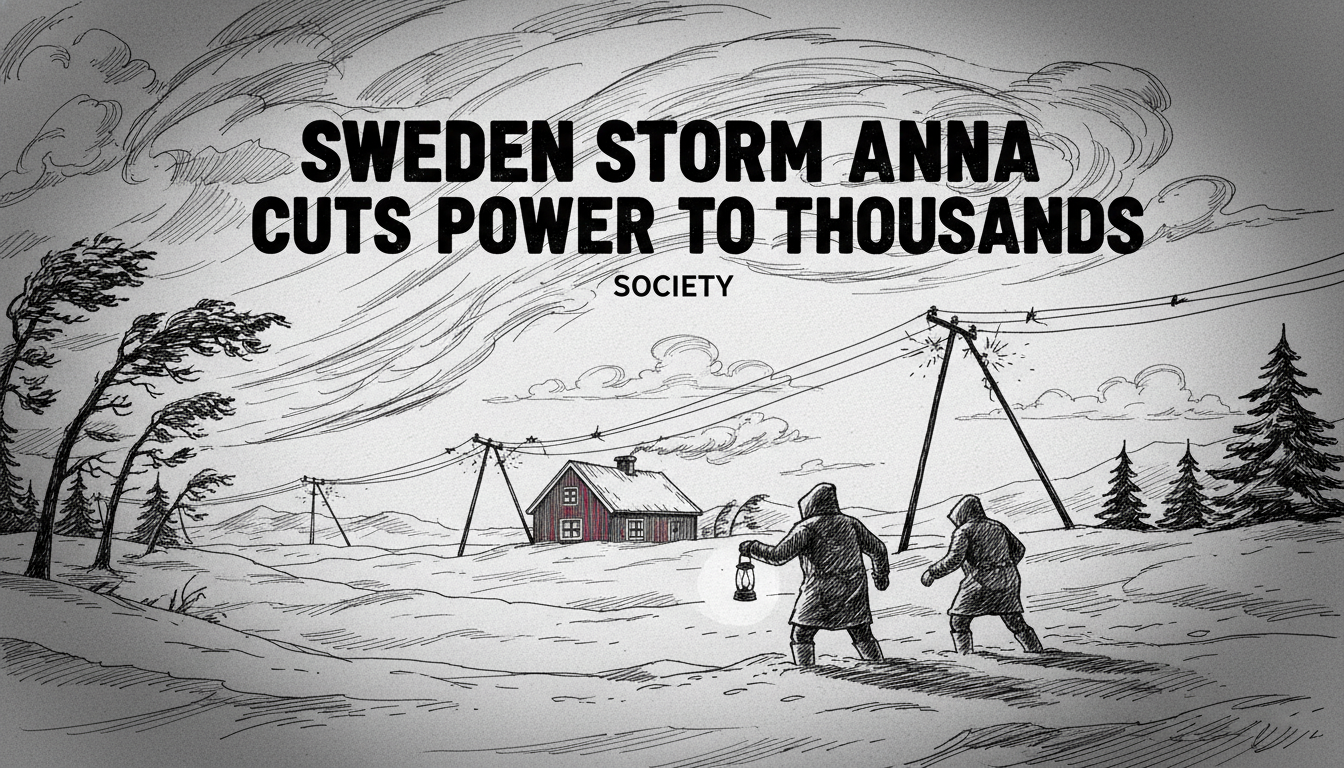
Sweden's New Year's Day was plunged into darkness for thousands as Storm Anna swept across the country. The powerful storm, arriving with fierce winds and heavy precipitation, left approximately 4,700 households without electricity, primarily in the central region of Gävleborg. For residents in Bollnäs, where around 2,500 homes lost power, the festive day turned into a battle against the cold and disruption.
"We were just sitting down for our leftover herring when everything went black," says Karin Bergström, a resident of a housing association in central Bollnäs. "The silence was immediate. No fridge humming, no lights from the neighbor's window. You realize how dependent we are." Her family spent the evening huddled in one room with candles and blankets, their traditional New Year's Day movie marathon cancelled. This scene played out across affected towns, turning a day of relaxation into one of significant inconvenience and concern.
A Storm's Sudden Impact on Swedish Winter Life
Power distributor Ellevio reported the bulk of the outages, with roughly 4,000 affected customers in Gävleborg County. Energy company Eon confirmed another 700 customers were impacted in the storm's path. While not the largest outage in recent memory, its timing on a major holiday amplified the disruption. In Sweden, where January days are short and heating is essential, a power cut is more than an inconvenience—it's a direct threat to basic comfort and safety.
Local emergency services and municipalities quickly activated contingency plans. Heating centers, or värmestugor, were opened in several community buildings in Bollnäs and surrounding areas. These public spaces, often schools or sports halls, provide a crucial refuge where residents can warm up, charge essential devices, and get hot drinks. "The community response is always swift," notes Lars Pettersson, a crisis management coordinator in the region. "But it underscores a vulnerability. People are at home, families are together, and suddenly the fundamental infrastructure fails."
The Growing Challenge of Grid Resilience
Experts see Storm Anna as part of a troubling pattern. "We are observing an increase in the frequency and intensity of these extreme weather events," says Dr. Elin Mårtensson, a climate researcher at Uppsala University. "What we once considered a 'once-in-a-decade' storm now seems to occur more regularly. Our infrastructure, built for a different climate reality, is being tested." Sweden has invested heavily in renewable energy sources like wind and hydro power, but the distribution grid—the network of poles and cables that delivers electricity to homes—remains exposed.
The debate often turns to the cost and feasibility of burying power lines. Underground cabling is significantly more resilient to storms but can cost up to ten times more than overhead lines. For a country with vast, sparsely populated areas, the economics are challenging. "We are prioritizing strategic hardening of the grid," a spokesperson for the Swedish Energy Markets Inspectorate said. "This means identifying critical nodes and the most vulnerable lines, often in areas with a history of outages. But a nationwide underground network is not currently feasible."
Life on Hold in the Heart of Winter
Back in Bollnäs, the human impact of the outage became tangible as night fell. Johan and Mia Lindgren, who live in a house on the outskirts of town, fired up their wood-burning stove for heat. "We're lucky we have this alternative," Johan says, gesturing to the crackling fire. "But the electric pump for our well doesn't work, so we have no running water. We can't cook properly, and the kids are getting restless without their usual screens." Their experience highlights a secondary layer of dependency; a modern Swedish home loses not just light and heat, but often water and communication.
For the elderly and vulnerable, the situation carries greater risk. Municipal home care services conducted welfare checks on known at-risk individuals. "Our priority is ensuring no one is left in a cold, dark home without support," says Anette Forsberg, a social services manager in Gävle Municipality. The event tests the social safety net in real-time, relying on neighbors checking on neighbors—a concept, known as grannsamverkan, deeply ingrained in Swedish culture.
Looking Ahead: Smart Grids and Societal Adaptation
The path forward likely involves a mix of technology and adaptation. Smart grid technologies, which can automatically isolate faults and reroute power, can minimize the scale of outages. More households are also investing in small-scale backup solutions, like battery systems paired with solar panels. "There's a growing awareness of self-sufficiency," says energy consultant Fredrik Holm. "It's not about going off-grid, but about having resilience for 12 to 48 hours. That can make a massive difference."
Storm Anna also reignites conversations about societal preparedness. The Swedish Civil Contingencies Agency (MSB) consistently advises households to keep an emergency supply of water, non-perishable food, and alternative light and heat sources. In the aftermath of this New Year's outage, many in affected areas are reviewing their own krishanteringskitt—their crisis management kit.
By the evening of January 2nd, power had been restored to most households in Bollnäs and Gävleborg. Repair crews worked through the night in difficult conditions to mend downed lines. The lights are back on, but the questions remain. As climate change alters weather patterns, how will Sweden safeguard the reliable flow of electricity that its modern society and harsh winters demand? The silence left by Storm Anna was temporary, but the conversation about resilience has just been powered up again.