
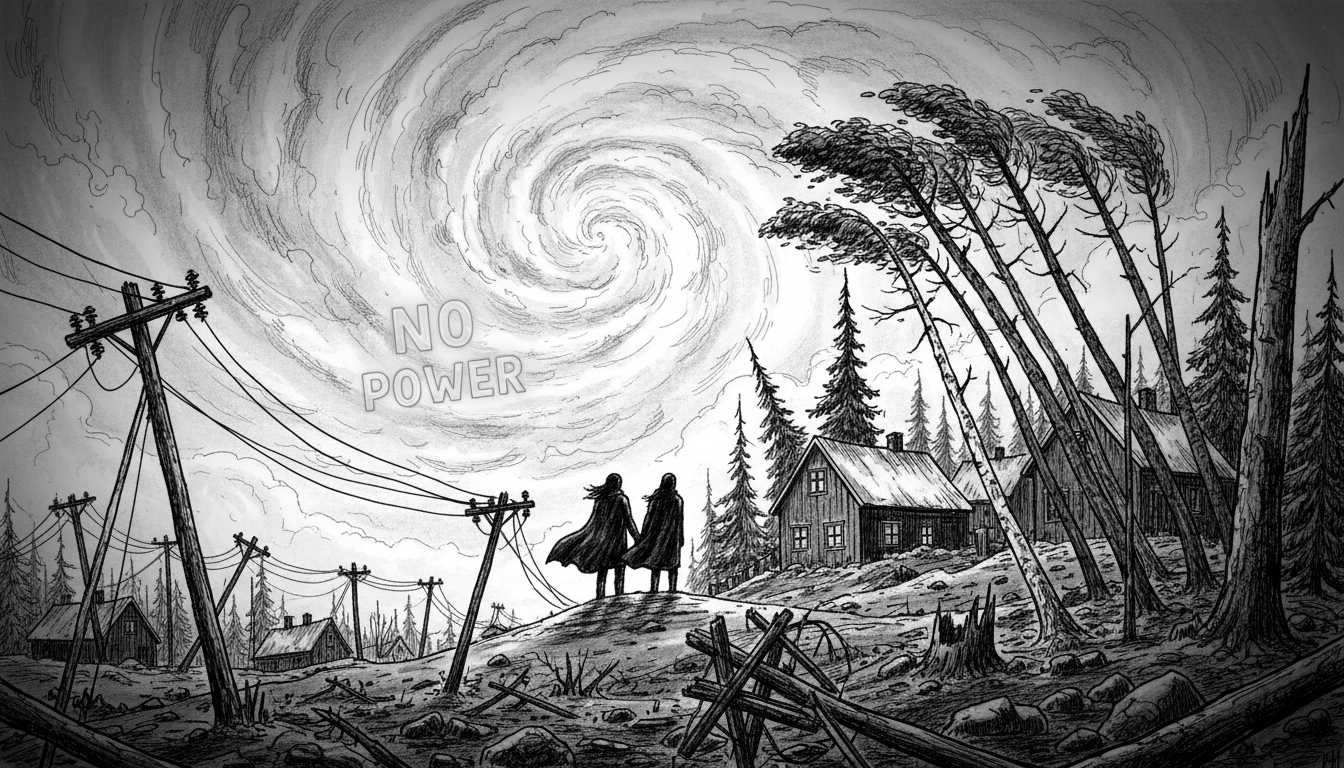
Sweden storm damage from Storm Johannes left over 40,000 households in darkness during the Christmas holiday. The storm's fury was felt most acutely in northern municipalities like Kramfors, where residents witnessed nature's raw power firsthand. "I saw a spruce tree fold in the middle," said local resident Kerstin Frånlund, describing the moment the winds tore through her community. Her simple statement captures the visceral shock that replaced festive lights with chaos across central and northern Sweden.
For communities like Kramfors in Västernorrland County, the storm was a severe test. The region's beautiful but dense forests and coastal location make it uniquely vulnerable. Falling trees and broken branches became weapons against the power grid. Roads were blocked, and the familiar hum of electricity fell silent. Anton Gustafsson, the emergency preparedness coordinator for Kramfors municipality, confirmed the storm's intense impact on local infrastructure. His team, along with power companies and volunteers, shifted into crisis mode during what should have been a quiet holiday.
A Christmas Interrupted
The timing of Storm Johannes added a layer of hardship. Families preparing for Christmas Eve celebrations on December 24th instead faced a cold, dark reality. Traditional Swedish Christmas, with its electric candle-lit windows and warm smorgasbords, was disrupted. In many homes, the julbord (Christmas buffet) had to be adapted, and the search for flashlights and batteries became a priority. This wasn't just a power outage; it was a cultural interruption during Sweden's most cherished family holiday.
Emergency response plans, usually managed at the municipal level, were activated. The challenge was immense: coordinating tree clearance, restoring power lines, and ensuring vulnerable residents had heat and support. In rural areas, the isolation felt more profound. Neighbors checked on each other, a reflection of the Swedish value of 'grannsämja' (neighborly harmony), often cited as crucial during crises. The community spirit, much like the resilient 'folkhemmet' (the people's home) ideal, became a practical necessity.
The Recurring Challenge of Nordic Storms
Storms causing widespread blackouts are, unfortunately, a recurring feature of Swedish winters. The country's vast forest cover, while a source of national pride and a key part of its identity, presents a constant risk. Overhead power lines running through wooded areas are susceptible. Each major storm reignites a complex debate about infrastructure resilience. Should more power lines be buried underground? How aggressively should vegetation near lines be managed? These questions carry significant financial and environmental weight.
Experts in forestry and infrastructure management stress preventative measures. Strategic tree clearing near power lines is one key tactic. Another is investing in a more resilient grid. However, the scale and cost of hardening infrastructure across Sweden's expansive and often remote landscapes are daunting. Energy companies walk a fine line between reliability, cost to consumers, and environmental stewardship. Sweden's energy mix is diverse—relying on hydro, nuclear, wind, and biomass—but the final delivery to homes can still be vulnerable to a falling pine tree.
Life in the Dark: A Human Story
Beyond the statistics of 40,000 affected households are individual stories of adaptation. For urban Swedians, a power cut might be a minor inconvenience. In the forested north, it can mean a total loss of communication, heating, and access. People like Kerstin Frånlund, who watched trees buckle, experienced the storm not as a news item but as a direct threat to their immediate environment. The sound of cracking wood is one many in the region know all too well.
Local municipalities become the frontline. Coordinators like Anton Gustafsson must balance immediate triage with long-term recovery. They work with power companies like Vattenfall and E.ON, but also with local volunteer organizations. The crisis highlights the importance of local knowledge and decentralized response in a country where distances are great and conditions can vary dramatically from one village to the next. It's a practical example of the 'närhetsprincipen' (principle of proximity) in Swedish public administration.
Looking Ahead: Preparedness in a Changing Climate
Every severe storm now comes with an unspoken question: is this the new normal? While not directly attributing Storm Johannes to climate change, experts agree that a warming planet may lead to more frequent and intense weather events. This puts Sweden's crisis preparedness in a new light. The systems tested over the Christmas weekend must be robust enough for future challenges.
Investment is a political decision. Allocating funds for infrastructure hardening competes with other societal needs. The debate often centers on who should pay: taxpayers, energy consumers through higher rates, or the state. There's also a cultural dimension. Swedes have a high tolerance for harsh weather and a strong sense of self-reliance. Yet, there is an expectation that vital services will be restored promptly. This storm, during a sacred holiday, may sharpen that public expectation.
For now, the lights are back on in most homes in Kramfors and surrounding areas. Cleanup continues. The broken spruce trees will be cleared, and power lines repaired. But the memory of a dark Christmas will linger. It serves as a stark reminder of the fragile balance between modern society and the powerful Nordic nature that surrounds it. The quiet resilience of the people, mirrored by the bending but not breaking spruce Kerstin described, will be needed again. The question is how Sweden will choose to build a stronger buffer before the next storm arrives.