
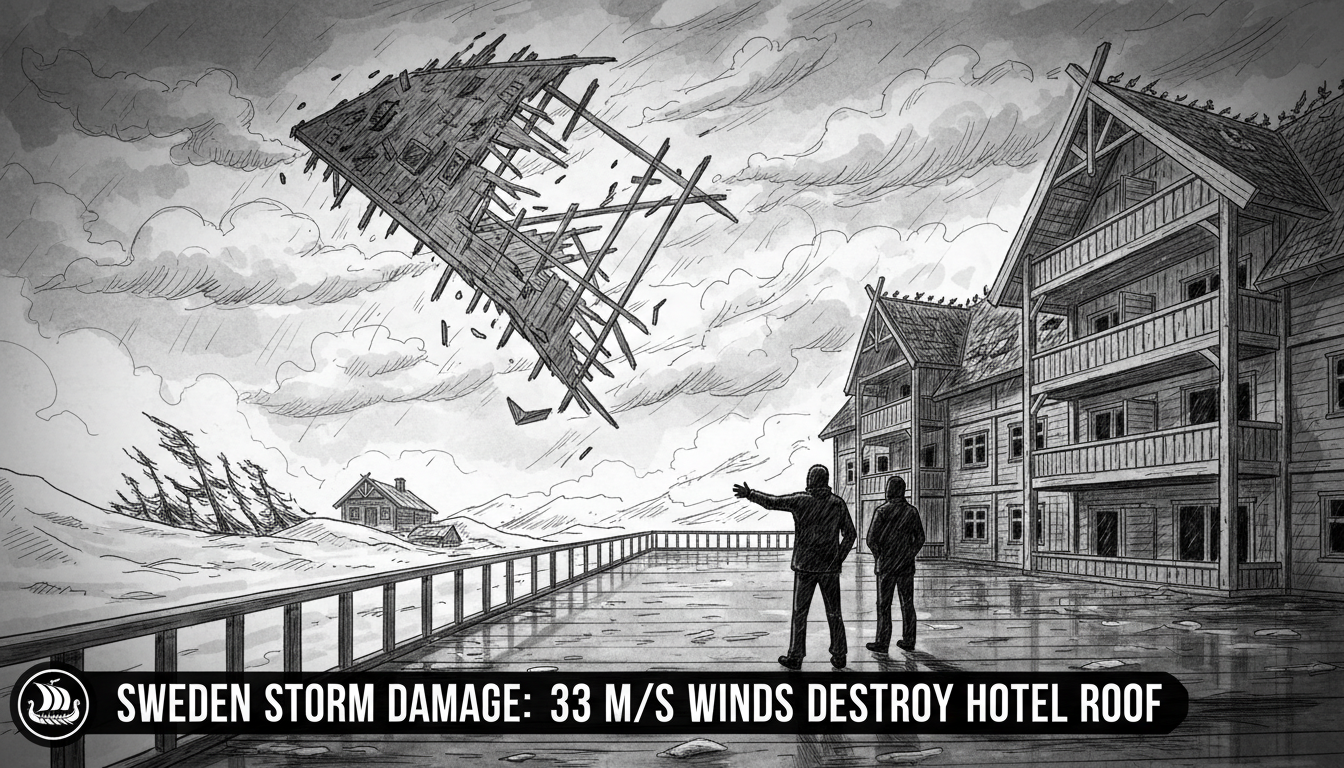
Sweden hurricane-force winds exceeding 32.7 meters per second tore the roof from Hotel Södra Berget in Sundsvall on Saturday. This event triggered an immediate rescue service alert at noon, highlighting severe weather vulnerabilities in northern regions. Rescue operators confirmed sections of the metal roof were dangling from the building's side, creating hazardous conditions. Fallen trees blocked access roads, forcing emergency crews to clear paths before reaching the scene. Guests were redirected from the main entrance, now cordoned off, to alternative entry points.
Immediate Emergency Response and Scene Assessment
Rescue services from Sundsvall municipality responded swiftly to the alarm at the mountain-top hotel. Their initial report described a perilous situation with structural debris threatening the property. A journalist on site noted unprecedented wind strength on the hotel parking lot, comparing it to past storms. The rescue team's priority was securing the area to prevent injuries or further damage. This operation involved assessing the stability of the roof and managing guest safety.
Emergency protocols, established under Swedish civil contingency laws, were activated seamlessly. The response demonstrates the efficiency of Sweden's decentralized rescue services, coordinated at the municipal level. However, this incident will likely prompt reviews at the national crisis management agency, MSB. Such reviews often influence Riksdag decisions on emergency funding and resource allocation.
Meteorological Analysis and Warning Systems
The Swedish Meteorological and Hydrological Institute (SMHI) had issued warnings for high winds in Västernorrland County. Meteorologists define 'orkanstyrka' as sustained winds surpassing 32.7 m/s, a threshold met during this storm. This event fits a pattern of intense autumn and winter storms in the Baltic Sea region. Climate models suggest increasing frequency of such extreme weather, a point raised in recent Swedish Parliament debates on environmental policy.
SMHI's warning system, integral to public safety, relies on advanced forecasting technology. Yet, the damage at Hotel Södra Berget questions whether building codes adequately reflect current climate realities. Experts argue that historical data may underestimate future wind loads. This gap between forecasting and construction standards requires attention from Stockholm policymakers.
Structural Integrity and Building Code Scrutiny
The roof failure at Hotel Södra Berget will inevitably lead to inspections by building engineers. Sweden's building regulations, shaped by Riksdag decisions, mandate wind resistance based on geographic zones. Sundsvall, in a region prone to storms, should have structures designed for high wind loads. Initial speculation focuses on whether the hotel's roof met the latest Boverket (National Board of Housing, Building and Planning) standards.
Building codes are periodically revised, often after significant damage events. The Swedish government, through the Ministry of Climate and Enterprise, oversees these updates. A 2022 Riksdag motion proposed strengthening codes for coastal and mountainous areas, but it is still under committee review. This incident may accelerate such legislative processes, emphasizing the need for resilient infrastructure.
Government Policy and Infrastructure Resilience
Storm damage in Sundsvall directly implicates Swedish government policy on climate adaptation and infrastructure. The Minister for Climate and Environment, Romina Pourmokhtari, has emphasized preparedness in public statements. Following this event, her ministry may coordinate with MSB to evaluate response effectiveness. Funding for municipal reinforcement projects often originates from state budgets approved by the Riksdag.
Historically, storms causing widespread damage lead to parliamentary inquiries. For example, after the 2005 Gudrun cyclone, the Riksdag allocated extra funds for tree clearing and grid repairs. Similar allocations could follow if assessments show systemic weaknesses in Västernorrland. The Swedish Parliament's role in sanctioning emergency expenditures is crucial for long-term resilience.
Policy discussions in Rosenbad, the government offices, frequently balance immediate response with preventive investment. This storm damage underscores the economic stakes, as repair costs strain local municipalities. Insurance claims from such events also affect national risk pools, a topic analyzed by the Swedish Financial Supervisory Authority.
Historical Context of Swedish Storms and Damage
Sweden has a recorded history of severe storms causing property damage and disruptions. The 1969 storm in Uppland caused similar roof failures, leading to updated building norms. More recently, the 2018 Alfrida storm battered eastern Sweden, resulting in significant insurance payouts. Each event has prompted incremental improvements in warning systems and construction practices.
Västernorrland County, with a population of 245,000, is no stranger to extreme weather. Its coastal location makes it susceptible to North Atlantic weather systems. Data from SMHI indicates a gradual increase in wind intensity over recent decades. This trend aligns with global climate patterns, making adaptation a priority for the Swedish government.
Comparing responses across different storms reveals progress in coordination. The 2021 storm in Gävle saw improved inter-agency communication, a lesson applied here. However, the Sundsvall incident shows that despite advancements, vulnerabilities persist in older structures or those in exposed locations.
Expert Perspectives on Preparedness and Future Risks
Meteorologists from Uppsala University note that specific atmospheric conditions, like low-pressure systems over the Baltic, fueled this storm. Their analysis will contribute to refining SMHI's models. Building engineers stress that regular maintenance and retrofitting are as important as initial construction standards. Many older hotels in scenic locations may not meet current codes, posing a widespread risk.
Emergency management experts highlight the role of public awareness and timely evacuations. Sweden's rescue services, while effective, face challenges with increasing extreme weather frequency. Experts advocate for more robust public-private partnerships to enhance infrastructure resilience. This could involve tax incentives for property owners to upgrade buildings.
From a policy perspective, experts urge the Riksdag to consider mandatory wind resistance certifications for hotels and public buildings. Such a measure would require legislative action, potentially introduced as a government bill. The Ministry of Finance would need to assess cost implications for businesses and municipalities.
Conclusion: Implications for Swedish Storm Policy
The damage at Hotel Södra Berget serves as a stark reminder of nature's force and infrastructure limits. It will likely influence ongoing discussions in the Swedish Parliament about climate adaptation funding. Future Riksdag decisions may mandate stricter building codes for regions like Sundsvall, affecting construction costs and insurance premiums.
As repair work begins, questions remain about preventive investments versus reactive spending. The Swedish government must balance immediate economic concerns with long-term safety goals. This event may become a case study in how Sweden integrates meteorological data into urban planning and emergency preparedness. Will policymakers in Stockholm act decisively to strengthen national resilience against increasingly common storms?