
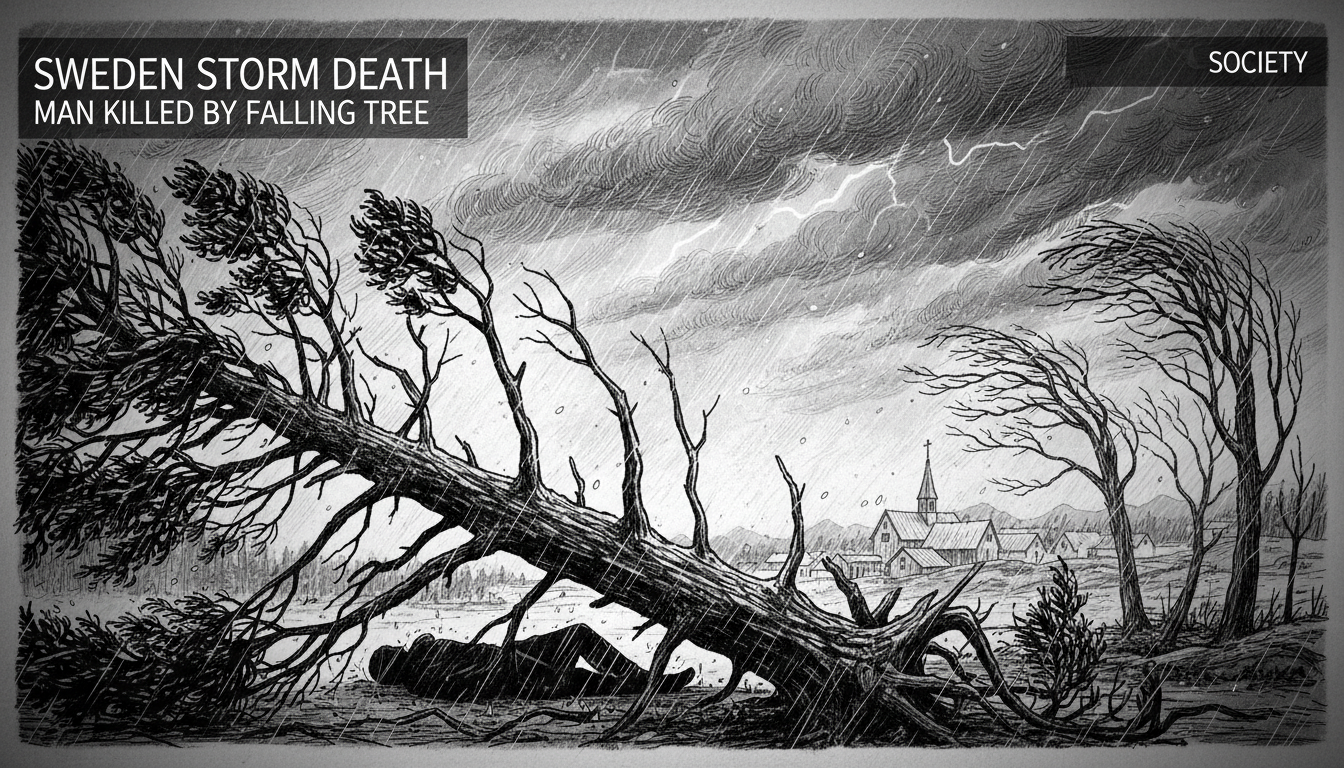
One of Sweden's deadliest storms in recent years has claimed another life. A man in his 50s died after a tree fell on him at an illuminated trail near the Kungsberget ski resort in Sandviken. The tragic accident occurred during a severe weather event that swept across Gävleborg County, turning a popular outdoor recreation area into a scene of emergency.
Emergency services received the alarm around 1:00 PM on Tuesday. Despite rapid response and transport to the hospital, the man's injuries were too severe. He could not be saved. This incident highlights the hidden dangers that extreme weather poses, even in familiar and typically safe environments.
Kungsberget is a well-known family destination for skiing and winter activities. Its network of illuminated trails, or elljusspår, is a cornerstone of Swedish outdoor culture. These trails allow people to walk, jog, or ski in the dark winter months. They symbolize the Swedish commitment to outdoor life, regardless of the season.
The victim was reportedly using one of these trails when high winds caused a tree to fall. The local community of Sandviken, a municipality of about 40,000 people, is in shock. The area is more accustomed to welcoming visitors for leisure than dealing with such fatal accidents.
A Community in Mourning
News of the death spread quickly through this tight-knit region. The tragedy strikes at the heart of a common Swedish pastime. "It's something so many of us do," said local resident Eva Karlsson, who often walks her dog on similar trails. "You go out to clear your head, to get some fresh air. You never think a tree will fall. It's a terrible shock."
The accident prompts difficult questions about safety protocols during extreme weather. While official warnings are often issued for major storms, the decision to use forested trails can sometimes rest with the individual. This puts a focus on public awareness and personal risk assessment.
The Science of Sudden Storms
Sweden's weather has become increasingly unpredictable. While storms are not uncommon, their intensity can catch people off guard. Meteorological institutes had issued warnings for strong winds across central Sweden. However, predicting exactly where a single tree might fall is impossible.
Forestry and safety experts note several factors at play. Saturated ground from autumn rains can loosen a tree's roots. Strong gusts then act as the final trigger. In managed forests, risk is assessed regularly. But near popular trails, the balance between natural landscape and public access is delicate.
"The force of wind in a storm is often underestimated," explained Lars Holmberg, a retired forestry manager from the Dalarna region. "A mature tree can weigh several tons. When it falls, there is virtually no warning sound above the roar of the wind. It's a silent, immediate danger."
Emergency Response Under Pressure
The response to the incident showcases Sweden's emergency systems. SOS Alarm coordinated the call. Ambulances and first responders navigated the challenging terrain to reach the victim swiftly. Their efforts were extensive but ultimately faced an impossible situation.
This event tests the protocols for trail safety. In the aftermath, municipalities across Sweden are likely to review their guidelines. Questions arise about proactive closures of forest parks and illuminated trails when wind speeds exceed certain thresholds.
Some regions already have automatic closure systems. Others rely on posted signs and public service announcements. This tragedy may lead to a more unified, precautionary approach nationwide.
The Swedish Relationship with Nature
This accident touches a cultural nerve. The Swedish concept of Allemansrätten, or the right of public access, allows people to roam freely in nature. It is a cherished freedom. With it comes an inherent responsibility to assess personal safety.
Outdoor activity is a fundamental part of Swedish lifestyle and identity. From berry picking to ski touring, the forest is a communal backyard. A fatal event in such a space feels like a violation of a safe haven. It forces a conversation about how to coexist with nature's raw power.
"We encourage people to be outdoors for physical and mental health," said Karin Svensson, a culture writer based in Stockholm. "This is a core Swedish value. But climate change is bringing more volatile weather. Our relationship with nature is having to adapt. We must learn when to stay inside."
Analysis: Preventing the Next Tragedy
What lessons can be learned? Expert perspective points to a multi-layered approach. First, weather warnings must be specific and action-oriented. Telling people to "be careful" is less effective than stating "avoid all forested areas."
Second, physical infrastructure could be reviewed. More frequent inspections of trees near high-traffic trails might identify potential hazards. This is a resource-intensive but potentially life-saving measure.
Third, public education is key. A societal shift may be needed where staying indoors during a storm is not seen as weak, but smart. "It's about cultivating a new kind of respect," notes safety analyst Peter Månsson. "We respect the ice on lakes in winter. We must now respect the wind in the forests during autumn storms."
Local authorities in Sandviken and Gävleborg will conduct their own investigations. Their findings could influence national policy for recreational area management during extreme weather events. The goal is clear: preserve the freedom of outdoor access while better protecting human life.
A Final Thought on Risk and Remembrance
As the community grieves, the broader Swedish society reflects. This was not a disaster on a massive scale. It was a single, heartbreaking event where nature's randomness intersected with a human life. It reminds us that safety is fragile.
The illuminated trails will reopen. People will return to the forests of Kungsberget. But they will walk with a different awareness, a quiet respect for the towering pines and spruce around them. The challenge moving forward is to build a culture of safety that is as strong as the Swedish love for the outdoors. Can we learn to read the weather not just as a forecast, but as a direct instruction? The answer will determine if this tragedy becomes a catalyst for change.