
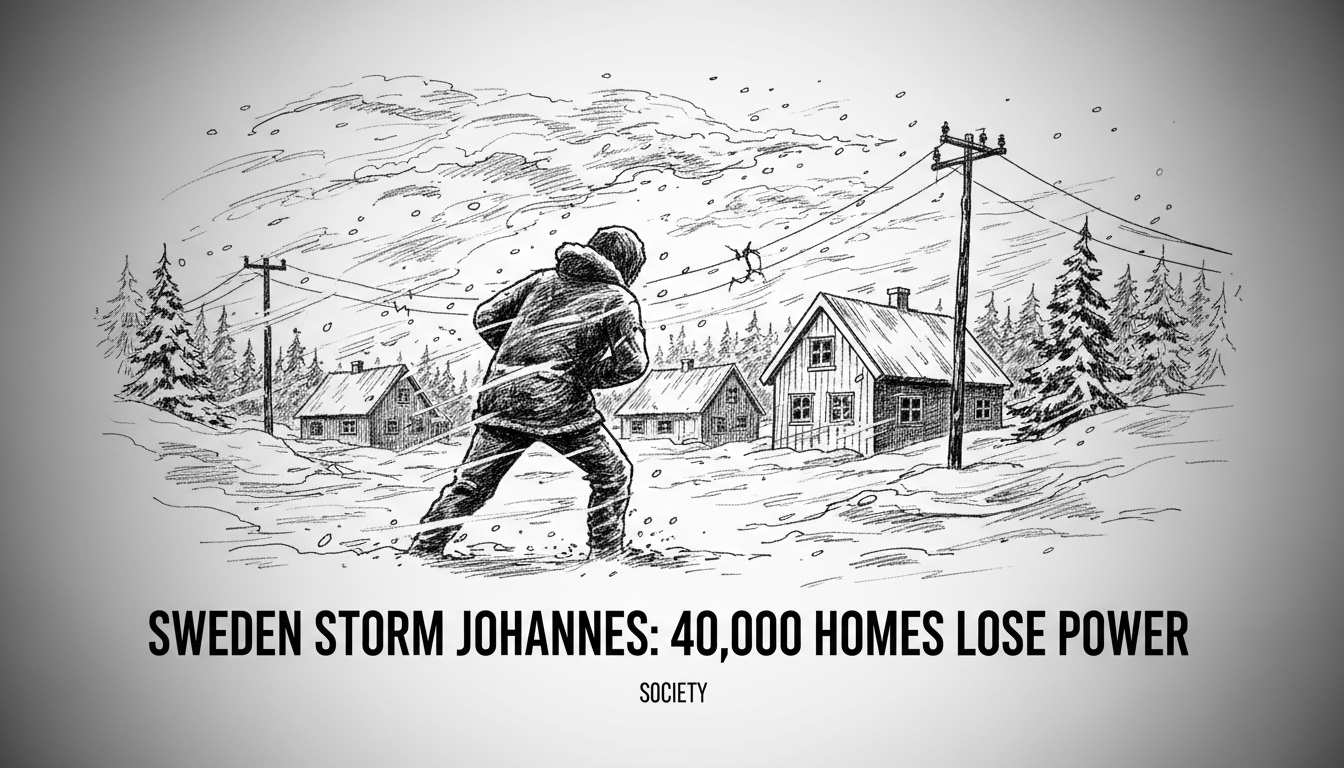
Sweden's northern forests are facing a massive power crisis after Storm Johannes tore through the country. Approximately 40,000 households remain without electricity, with some potentially waiting until Monday for restoration. The hurricane-strength storm downed countless trees onto power lines, creating what one official called a 'string of outages' across Gävleborg, Västernorrland, Härjedalen, and Jämtland counties.
For families like the Lundströms in Hudiksvall, Gävleborg, the blackout means more than just darkness. 'We’re relying on our wood-fired stove for heat and cooking,' says Erik Lundström, a father of two. 'The kids think it’s an adventure, but we’re watching our freezer thaw. This is our reality in the Swedish winter, even with a modern energy grid.' His story echoes across the region, where temperatures hover near freezing and daylight is scarce.
A Nation Confronts Its Vulnerable Grid
Sweden prides itself on a reliable energy mix of hydro and nuclear power. Yet this storm reveals a critical weakness: the vast overhead network stretching through dense forests. 'The winds have been very intense, causing a string of power outages,' explains Jesper Liveröd, press chief at grid operator Ellevio. The primary damage comes from fallen trees and branches, a predictable yet devastating result when hurricane-force winds meet Sweden's wooded landscapes.
Lena Berglund, northern region chief for energy company Eon, offers little immediate comfort. 'Some may have to wait until Monday,' she states bluntly. For affected residents, that timeline means days without modern conveniences, posing genuine challenges in a climate where warmth is not a luxury but a necessity. The disruption cuts deeper than inconvenience; it impacts local businesses, schools, and essential services.
The Human Cost of a Blackout
The impact extends beyond statistics. In smaller villages across Härjedalen, community centers have opened as warming shelters. Grocery stores with backup generators have become social hubs. 'There’s a strange camaraderie,' notes Anna Forsberg, a teacher in Sveg. 'We check on elderly neighbors, share hot coffee from thermoses. It reminds us of a time before constant connectivity, but also shows how dependent we are.'
This dependency is a key feature of modern Swedish society. The expectation of flawless infrastructure clashes with the reality of nature's power. While urban centers like Stockholm experience minor disruptions, rural northern Sweden bears the brunt. This geographic disparity highlights an ongoing tension in Swedish society between developed metropolitan regions and the more vulnerable, forested interior.
Expert Analysis: A Future of More Frequent Storms?
Energy analysts point to this event as a warning. 'Our grid was built for a different climate reality,' says Professor Henrik Strömberg, an infrastructure researcher at Luleå University of Technology. 'Forest management and grid resilience need urgent review. We can't just repair; we must adapt.' He suggests increased investment in burying lines in critical corridors or creating more robust defensive zones around power lines.
The conversation inevitably turns to climate change. While not attributing a single storm to global warming, experts agree that Sweden can expect more frequent and intense weather events. This makes grid resilience a national security issue, not just an economic one. The Swedish Civil Contingencies Agency (MSB) regularly warns about society's vulnerability to prolonged power cuts, especially during winter.
Cultural Resilience Meets Modern Expectation
There is a cultural dimension to this crisis. Swedes have a historical concept of 'stormaktstiden' – the period of great power – but also a deep-seated practice of 'orka', meaning to have the energy or strength to cope. Events like this test that modern 'orka'. The traditional Swedish stove, the 'kakelugn', in many older homes, suddenly becomes a vital asset, not just a charming antique.
Local traditions of self-reliance are being tested against the expectation of state-provided reliability. In many ways, the storm holds up a mirror to Swedish society. It shows both its strengths – community cooperation, preparedness – and its vulnerabilities – an exposed infrastructure in a changing climate.
The Long Road to Restoration
Crews from Ellevio, Eon, and other operators are working around the clock. The process is methodical and dangerous. First, they must locate the faults, often in remote, storm-damaged forests. Then, they must clear debris and repair or replace lines and pylons. Each step is slow in the difficult terrain and lingering bad weather.
The financial cost will be immense, running into tens of millions of kronor. The greater cost is the trust in a system that failed for tens of thousands. For the second time in recent years, a major storm has plunged northern Sweden into darkness, raising hard questions about investment priorities and regional equity.
Looking Ahead: Lights On, Questions Remain
As power slowly returns, the debate is just beginning. Will this event trigger a serious discussion about modernizing the northern grid? Or will it fade as another 'force majeure'? For residents, the immediate future is about warmth and waiting. The broader future for Sweden involves deciding how to power its society in an era where the storms have new names and new strength.
The silence left by the hum of absent electricity is loud. It speaks of our shared vulnerability and the complex relationship between a modern nation and the ancient, powerful landscape it inhabits. When the lights finally come back on across the north, what will Sweden have learned?