
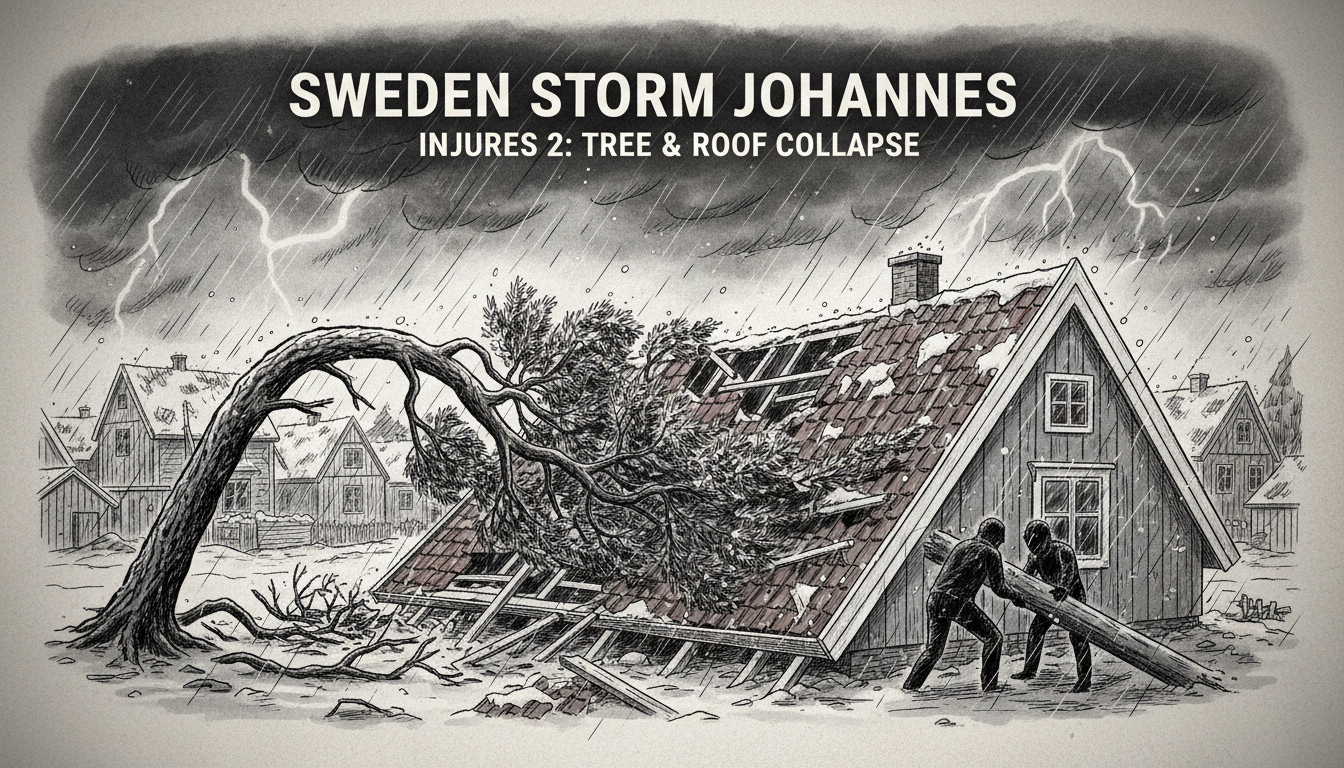
Sweden Storm Johannes sent two people to hospital with serious injuries on Wednesday after a violent weather front swept across central regions. One person was struck by a falling tree while walking near a nature reserve by the Kungsberget ski resort outside Sandviken. Just an hour later, another person was trapped under a collapsed metal roof in Järvsö. Both incidents underscore the sudden danger posed by autumn storms in Sweden, a country increasingly grappling with more frequent and intense weather events.
A Walk in the Woods Turns Dangerous
The first alarm sounded around 2 PM near Sandviken, a town known for its steel history and outdoor life. Rescue services and an ambulance rushed to a nature reserve adjacent to the Kungsberget ski area. A person out for an afternoon walk, likely seeking fresh air despite the brewing storm, was hit by a falling tree. The scene in Gästrikland, a region of dense forests and rolling hills, would have been one of chaos. Paramedics worked swiftly to stabilize the individual before transporting them to hospital. The specific trail or path was not disclosed, but local trails like those around Storsjön lake are popular for quiet recreation. 'People here are used to wind and weather,' says local resident Erik Lundström, reached by phone. 'But these storms seem to be coming harder and faster now. You think you're safe in the woods, and then...' His voice trails off.
Metal Roof Traps Resident in Järvsö
As emergency crews dealt with the first incident, another call came in at 3 PM from Järvsö, approximately 120 kilometers north. There, a person was trapped beneath a large plåttak—a corrugated metal roof common on sheds, barns, and older homes in the Swedish countryside. The roof had been torn free by the storm's powerful gusts and pinned the individual underneath. Police joined the rescue effort, indicating a complex extraction. The person was also taken to hospital by ambulance. The duality of the injuries—one from a natural object, one from a man-made structure—highlights the pervasive threat. Järvsö is a small community in Hälsingland, famous for its UNESCO-listed decorated farmhouses. These historic buildings, with their large, sweeping roofs, are symbolic of the region but also vulnerable in extreme weather.
The Growing Force of Autumn Storms
Storm Johannes is not an isolated event. Sweden's long coastline and geographical position make it a frequent target for low-pressure systems, especially from late autumn through winter. These storms bring strong winds, heavy rain, and sometimes snow. What experts are noting, however, is a shift in pattern. 'While Sweden has always had severe storms, the data suggests we are seeing a trend toward more intense precipitation events and stronger wind gusts linked to a warming climate,' explains meteorologist Karin Bergström, who has studied Nordic weather patterns for over fifteen years. 'The autumn season, in particular, is becoming more volatile.' Warmer sea temperatures in the North Atlantic can fuel these systems with more energy, leading to the kind of destructive force that topples trees and rips roofs from their moorings.
How Sweden Responds to Storm Emergencies
The coordinated response by räddningstjänst (rescue services), ambulans, and polis follows well-rehearsed Swedish emergency protocols. The country has a decentralized but highly integrated system where municipal rescue services are first responders, backed by regional healthcare and national police. For storm damage, chainsaw teams and heavy lifting equipment are often mobilized immediately. 'Public awareness is our first line of defense,' says Lars Pettersson, a crisis preparedness manager. 'We advise people to secure loose objects, avoid forests during warnings, and stay informed via SMHI's [Swedish Meteorological and Hydrological Institute] forecasts.' The SMHI issues yellow, orange, and red warnings, with red indicating a high danger to the public and property. For many Swedes, checking the weather forecast, particularly the wind strength (vindstyrka), is a routine part of daily planning during these months.
A Cultural Shift in the Face of Nature
There is a deep-seated cultural concept in Sweden known as 'allemansrätten'—the right of public access. It allows people to roam freely in nature, including forests. This freedom is cherished. Yet storms like Johannes create a tension between this cultural right and personal safety. The injured person in Sandviken was exercising this very freedom. Furthermore, the Swedish lifestyle heavily emphasizes outdoor activity regardless of season, from promenading in the woods to maintaining summer stugas (cottages) that may have older structures. The storm damage challenges this way of life. 'We are an outdoor nation,' reflects culture writer Maja Nilsson. 'But our relationship with nature is changing. We're learning that its tranquility can switch to fury with little notice. It demands more respect and preparation than before.'
Looking Ahead: Resilience in a Stormier Climate
The aftermath of Storm Johannes will involve cleanup and repair across affected regions. For the two injured individuals, the road to recovery begins. Their current conditions remain unclear, but their experiences serve as a stark reminder. Sweden's infrastructure and personal preparedness are being tested. Homeowners may need to inspect roof fixings more regularly. Municipalities might need to review tree health along popular walking paths. The storm season is just beginning. As Karin Bergström, the meteorologist, notes, 'The question is no longer if we will have a major storm each season, but how many we will have, and how severe they will be.' For a society built on harmony with nature, adapting to its more violent moods is the new reality. The quiet forests and picturesque villages now hold a different kind of lesson, one written in the wind.