
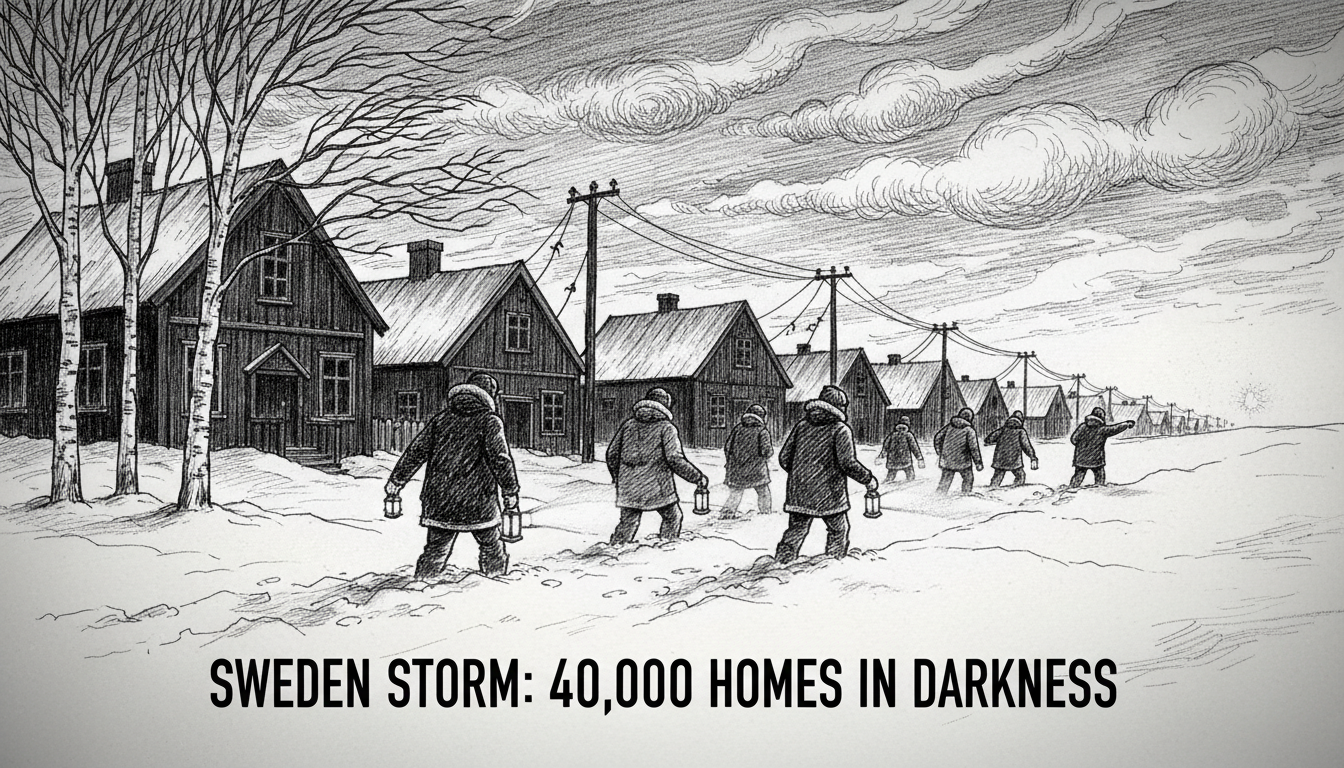
Sweden's Storm Johannes has left nearly 40,000 households without power, with repair crews warning outages could last over a week in the hardest-hit areas. The storm, battering the northern regions of Hälsingland and Dalarna, has brought down trees onto power lines, creating what the grid operator calls a 'string of pearls' of electrical failures across the countryside.
For families like the Erikssons in Bollnäs, Hälsingland, the reality is a cold, dark home. "We lost power yesterday afternoon," says Anna Eriksson, 42, as she prepares a simple meal on a camping stove. "The fridge is warming up, the phones are dying, and the kids are asking when the Wi-Fi will come back. We're told it might be days. You don't realize how much you depend on electricity until it's gone."
Jesper Liveröd, press chief at grid operator Ellevio, describes a challenging situation. "It is very troublesome, especially in Hälsingland," he says. "This is exclusively about trees falling on power lines. The winds are intense, and our service technicians cannot work safely. Then the staff must wait, which means the outages drag on."
A Rural Vulnerability Exposed
The crisis highlights a persistent weak spot in Swedish infrastructure. While major cities like Stockholm and Gothenburg have largely underground, resilient networks, vast rural areas rely on overhead lines stretching through dense forests. When a major storm like Johannes hits, these lines are exceptionally vulnerable.
"We have raised our preparedness and are calling in extra staff," Liveröd states. The company hopes to restore power to most by Sunday morning, but acknowledges the aftermath will be lengthy. "In some cases, it can take even longer. The follow-up work can go on for over a week."
The immediate advice to the public is stark. "Do not go out unnecessarily," Liveröd warns. "Fallen power lines are life-threatening." For residents in affected counties, the storm means hunkering down, hoping food stays cold, and finding alternative ways to heat their homes as autumn temperatures drop.
The High Cost of Keeping the Lights On
This is not a new problem for Sweden. Experts point to a recurring debate about the cost of modernizing the grid versus the societal cost of these prolonged outages. Burying power lines underground is the most effective solution for storm resilience, but it is an enormously expensive undertaking, especially across Sweden's vast and sparsely populated north.
"Every major storm reignites this discussion," says energy infrastructure analyst, Dr. Lena Karlström. "The economic calculation is complex. The investment to bury thousands of kilometers of line is colossal. But we must also account for the cost to households, the disruption to businesses, the strain on emergency services, and the sheer inconvenience for tens of thousands of people over a week or more."
For local businesses, the blackout is a direct hit. Small shops lose perishable goods. Remote workers cannot connect. The economic ripple effect in these communities will be felt long after the power returns.
Life on Hold in the Heart of Sweden
Back in Dalarna, a region famous for its picturesque lakes and cottages, the mood is one of frustrated patience. In smaller villages, community centers and libraries with generators have become impromptu warming shelters and charging stations. The Swedish tradition of 'fika' – a coffee break – continues, but now by candlelight and with a focus on shared resources.
"We are used to harsh winters, but this early autumn storm caught many off guard," says Mikael Berg, a farmer outside of Mora. "My biggest concern is for the livestock. We have backup systems, but they are not meant for days on end. This is when community matters. We check on our older neighbors."
The storm also tests Sweden's famous societal preparedness. Most households are well-equipped for short disruptions, but a week-long outage pushes beyond the standard emergency kit. It raises questions about national infrastructure priorities in an era where climate change may increase the frequency of extreme weather events.
Looking Beyond the Storm
As Ellevio's crews work in dangerous conditions to clear trees and repair lines, the political and public policy discussion is beginning. Is the current model, where grid reliability varies dramatically between urban and rural areas, sustainable? Should Sweden invest billions in a nationwide effort to bury lines, or accept that certain regions will periodically be plunged into darkness by storms?
For the families sitting in the dark, the policy debate feels distant. Their immediate reality is one of practical challenges: preserving food, keeping warm, and maintaining a sense of normalcy. The storm will pass, and the lights will eventually come back on. But the memory of this week-long disruption, and the question of whether it will happen again next year, will linger much longer.
The event serves as a stark reminder of the delicate balance between nature and modern life in Sweden. Even in one of the world's most technologically advanced nations, a strong wind can still turn out the lights for thousands, revealing the fragile threads that connect society.