
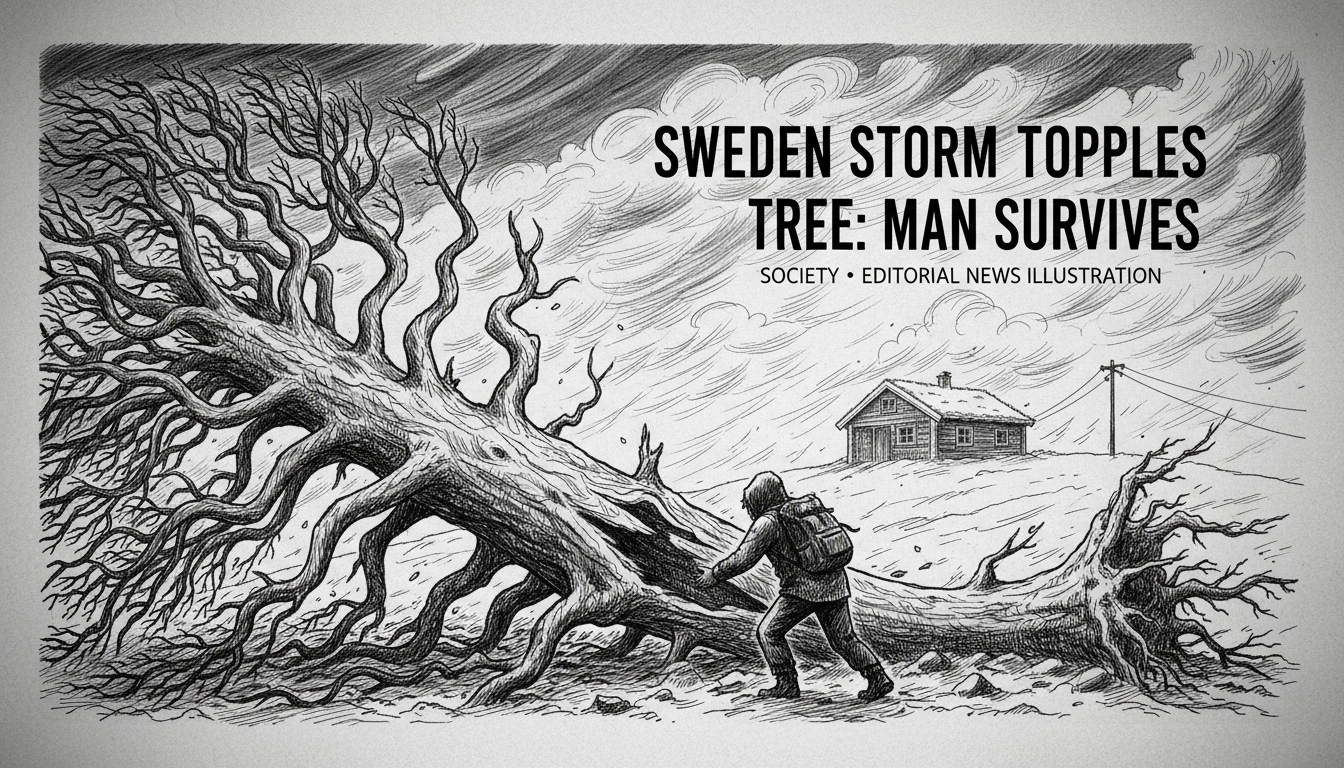
Sweden's vast forests, covering 70% of the nation, present a hidden danger when fierce autumn storms roll in. For Tobbe Starkman, that danger became terrifyingly real on a forest road in Jämtland. A massive tree crashed directly onto his car as Storm Johannes swept across northern Sweden. The vehicle was crushed, but Starkman walked away. “You realized afterwards that you had some hellish luck,” he said.
The incident happened midday on a minor road outside the village of Ladumyråsen. Starkman had already stopped once to clear a fallen tree blocking his path to the local shop. He continued his journey, the wind howling around him. Moments later, another tree gave way. It fell perfectly across the road, its full weight landing on his car's roof. In the sudden silence after the impact, surrounded by shattered glass and splintered wood, Starkman found himself unhurt. The event was over in seconds. “It just snapped,” he recalled of the moment.
A Close Call in the County of Forests
Jämtland County, where this happened, epitomizes Sweden's relationship with its wilderness. It's one of the country's largest yet most sparsely populated regions. Dense forests border countless winding rural roads. For residents, navigating these roads during storm season is a calculated risk. This is everyday life in the Swedish glesbygd—the sparsely populated countryside. Communities are resilient but exposed. When a major storm like Johannes hits, the familiar landscape of pine and spruce transforms into a field of hazards. Fallen trees blocking roads are a common, sometimes deadly, occurrence.
“The challenge in regions like Jämtland is the sheer scale combined with low population density,” explains Mats Larsson, a former regional emergency services coordinator. “A single storm can bring down trees across hundreds of kilometers of road. Clearing them all and reaching isolated properties takes time, even with a strong response.” Larsson notes that while municipalities and the Swedish Transport Administration are well-practiced, the first hours after a storm are chaotic. Residents often take matters into their own hands, like Starkman did, using private chainsaws to clear paths—a testament to self-reliance but also a potential risk.
The Unseen Peril on Every Road
Starkman's story is a stark reminder of a threat many Swedes downplay. We adore our allemansrätt—the right of public access to roam in nature. Yet the very forests we hike and forage in can turn dangerous. Autumn storms, bearing names like Johannes, are a fixture of the Nordic climate. They barrel in from the Atlantic, gaining strength over the North Sea before hitting the long Swedish coastline and moving inland. Meteorologists track their trajectories and wind speeds, issuing warnings through the Swedish Meteorological and Hydrological Institute (SMHI). But in the countryside, where cell service can be patchy and the nearest neighbor is kilometers away, these warnings only go so far.
The statistics frame the risk. With forests covering seven-tenths of the country, the raw material for such accidents is everywhere. In Jämtland, the population density is around 2.5 people per square kilometer, compared to over 25 nationally. This means fewer people on the roads, but also fewer witnesses and longer waits for help if something goes wrong. The forestry industry, vital to the local economy, manages these woodlands intensively. However, storms can topple trees in protected zones, private plots, and areas awaiting harvest, leaving no pattern to the destruction.
Expert Analysis: Preparedness in a Changing Climate
I spoke with Dr. Elsa Berggren, a climatologist focusing on Nordic weather systems, for perspective. “Storm Johannes was a strong autumn low-pressure system, but not historically exceptional,” she notes. “What we are observing, however, is a trend of increasing precipitation intensity accompanying these storms. Saturated ground means tree root systems have less grip, making them more likely to fall under high wind stress.”
Her analysis points to a broader, more worrying context. Climate models for Scandinavia predict not necessarily more storms, but more powerful individual weather events. This has direct implications for public safety and infrastructure. Are the current preparedness models sufficient? “The systems are good,” Dr. Berggren says, “but they are based on historical data. Municipalities and transport agencies must continuously update their risk assessments with future projections in mind. This is especially critical for rural infrastructure.”
From a forestry management perspective, the conversation is also evolving. Jens Olofsson, a forest manager in southern Jämtland, explains the dilemma. “We create clear-cut areas that can act as wind tunnels. We also have dense, mature stands vulnerable to domino-effect falls. There’s active research into creating more storm-resistant forest borders along roads and near homes. It’s a balance between economics, ecology, and safety.” He emphasizes that no management practice can eliminate the risk entirely when winds exceed 25 meters per second, as they did during Johannes.
The Human Element of Resilience
Beyond the expert commentary lies the human story that defines these events. Tobbe Starkman’s experience is a jarring, personal interruption. The car, a modern metal shell designed for safety, was totaled—reduced to what he called skrot (scrap). Yet it did its final job: it protected him. After the shock faded, the dominant emotion was gratitude. This narrative of a close call and thankfulness is a common thread in Swedish storm stories, often shared over fika or in local newspaper interviews. It underscores a communal understanding of nature’s power.
In Stockholm or Gothenburg, a storm might mean delayed trains and cancelled events. In Ladumyråsen, it means tangible, immediate danger from the environment itself. The response is characteristically pragmatic. Starkman cleared the first tree himself. Neighbors would likely check on each other. The local kommun (municipality) crews would work long hours to restore access. This collective resilience is deeply ingrained in the Swedish rural mindset.
What does this mean for the future? As Dr. Berggren indicated, the environmental baseline is shifting. For provinces like Jämtland, Värmland, and Dalarna—heartlands of Swedish forestry and rural life—the storms of tomorrow may carry greater force. Investment in road clearance equipment, more frequent safety inspections of trees near infrastructure, and community alert systems will be crucial. For now, residents will continue to listen to the SMHI warnings, secure loose items in their gardens, and think twice before driving through the woods when the winds pick up. They know the risk, but life must go on. The forests are both their livelihood, their home, and, on days like these, a formidable force.
The next storm is already brewing out over the Atlantic. It will eventually get a name. And somewhere on a quiet forest road, another driver might glance nervously at the swaying pines, remembering Tobbe Starkman’s story, and wonder if today they should just stay home.