
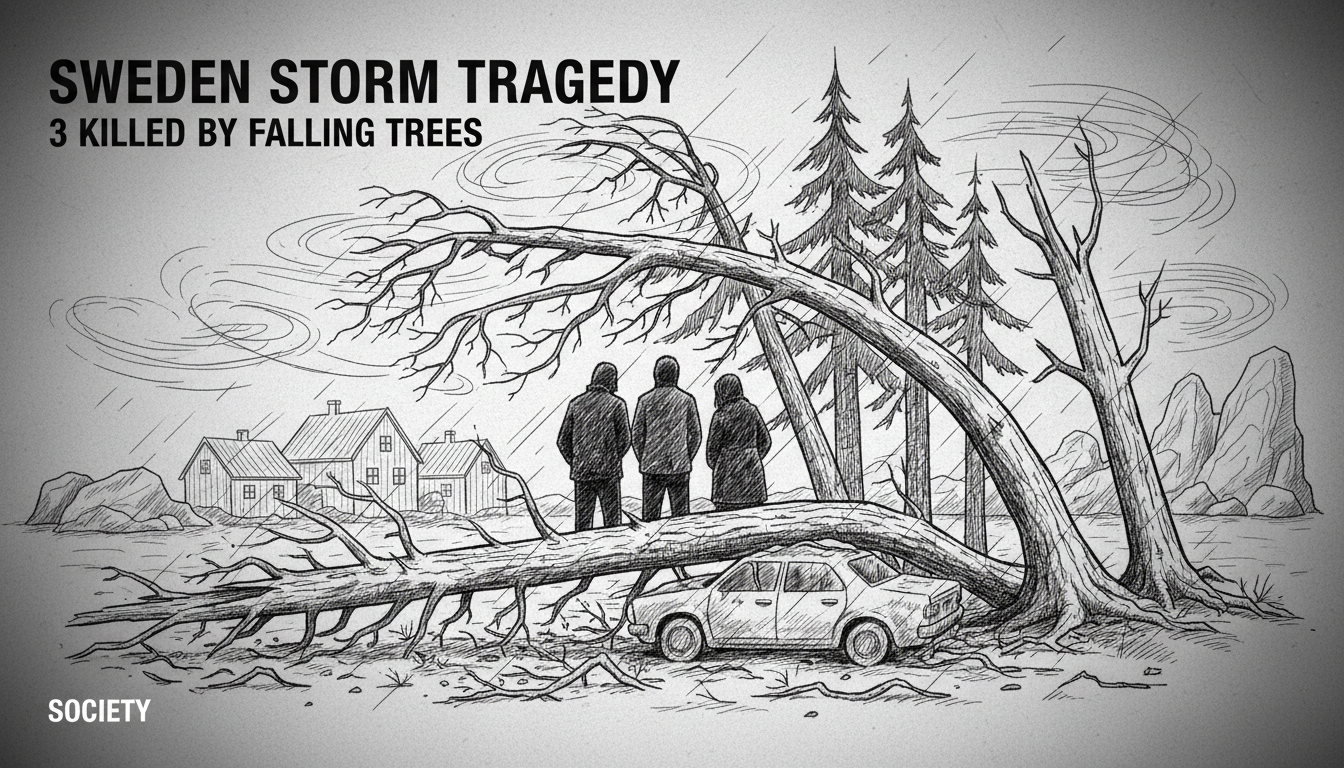
Sweden's latest autumn storm has claimed three lives in a single day, highlighting the deadly risks of forestry work and outdoor activity during severe weather. A man in his 60s died in Hofors after a tree fell on him while he was working in the forest on Saturday evening. He was taken to hospital but could not be saved. In similar tragedies, a man in his 50s was killed by a falling tree in Kungsberget, Sandviken, and another man in his 60s died during tree clearing work in Härnösand.
A Deadly Saturday Across Central Sweden
The storm that swept across central and northern Sweden on Saturday was not the most severe on record, but its human cost was devastating. In Hofors, a small industrial town in Gävleborg County, emergency services responded to a call from the forest. The victim was a local man, performing what was likely routine work. The powerful winds, common during this season, proved fatal. Similar scenes unfolded nearly 200 kilometers away in Sandviken municipality and further north in Härnösand. Three separate incidents, three families shattered, all linked by the same brutal mechanism: a tree brought down by the wind.
These deaths are a grim reminder of the raw power of Nordic nature. For international readers, Sweden's vast forests are both a source of national pride and a major economic engine. They are also a workplace for tens of thousands. Saturday's storm turned that workplace into a lethal environment. "When the weather warnings are at the highest level, the only right decision is to stay indoors," a safety inspector with the Swedish Forestry Agency told me last year. That advice, clearly, was not heeded or could not be followed by those who lost their lives.
The Inherent Risks of Sweden's Forestry Industry
Forestry is woven into the fabric of Swedish society and economy. It accounts for about 0.5% of GDP and supports countless rural communities. From the large-scale operations of the north to the smaller family-owned plots in central Sweden, working among trees is a common profession. This makes storm-related deaths in the forest a recurring, if infrequent, tragedy. Statistics show storms in Sweden cause an average of 2-3 fatalities annually, though numbers spike during particularly violent years.
The work doesn't stop for bad weather. Deadlines, economic pressure, and a sense of personal responsibility for one's land can compel people to work when it's unsafe. "There is a culture of self-reliance and toughness, especially among older generations of forest owners," explains Lars Mårtensson, a researcher in occupational safety at a Swedish university. "The risk from falling trees or branches during a storm is extremely high, and it's not always a direct hit. A tree can snap and whip around with tremendous force."
Safety protocols exist, but their implementation on private land or in remote areas is inconsistent. Modern forestry companies have strict weather policies, but for individual landowners or small contractors, the calculation is often personal. The victims in Hofors, Kungsberget, and Härnösand were all men in their 50s and 60s, an age group that represents a significant portion of small-scale forest owners in Sweden.
Warnings, Climate, and a Culture of Outdoor Life
The Swedish Meteorological and Hydrological Institute (SMHI) had issued warnings for strong winds across the affected regions. These warnings are broadcast widely through apps, websites, and media. Yet, bridging the gap between a general public warning and individual action remains a challenge. Swedish culture has a deep-seated appreciation for friluftsliv – outdoor life. There's a tendency to dress for the weather and proceed, not to cancel plans. This mindset, while healthy in most conditions, becomes dangerous during official storm warnings.
Climate scientists have long warned that a warming climate will lead to more frequent and intense extreme weather events in the Nordic region. This doesn't just mean more storms, but potentially more storms occurring outside the traditional autumn-winter season. The infrastructure and public awareness are adapted to a certain pattern. As that pattern shifts, the risk of unexpected tragedies may grow. Are Sweden's safety protocols and public communication strategies ready for this new normal? Experts are beginning to ask this question more urgently.
Furthermore, the health of Sweden's forests themselves is under pressure from climate change, with drought and pests weakening trees. A weakened tree is more likely to fall in a storm. This creates a compounding risk for forestry workers and anyone living near forest edges.
Beyond the Statistics: The Human Cost
Behind the number three are three individual stories, families, and communities in mourning. Hofors, with a population of around 7,000, is the kind of town where news travels fast and losses are felt collectively. Sandviken and Härnösand are larger, but the impact is no less personal. These are not anonymous fatalities; they are neighbors, friends, and breadwinners.
In the days following such a tragedy, local communities typically rally around the affected families. The Swedish model of social support provides a safety net, but it cannot replace a loved one. The quiet, stoic grief that often characterizes these rural areas will now settle over three homes. For the colleagues and fellow forestry workers, the deaths serve as a terrifyingly close reminder of their own vulnerability.
A Call for Greater Vigilance
So, what can be done? Safety campaigns often target professional forestry companies, but Saturday's victims may not have been part of those structured systems. There is a need for targeted communication towards private forest owners and the general public. The message must be unambiguous: during a Class 2 or 3 wind warning from SMHI, the forest is a no-go zone. No job is so urgent that it's worth your life.
Technology could offer partial solutions. More localized, cell-broadcast storm alerts that scream a warning to phones in specific risk areas might grab attention better than a general forecast. For workers, improved personal safety equipment is always being developed, but no helmet or vest can withstand a full-sized falling tree.
Ultimately, it comes down to risk assessment and culture. The Swedish relationship with nature is one of respect, but also of use and management. Balancing that practical relationship with a necessary caution during extreme events is the ongoing challenge. As one emergency responder somberly noted after a previous storm death, "We can clear the roads of fallen trees after the storm passes. We cannot bring back a life."
The three men who died on Saturday paid the ultimate price for being in the wrong place at the wrong time, doing work that fuels a nation. Their deaths are a tragic punctuation mark in Sweden's storm season, a harsh reminder that nature's beauty is matched by its power. As the climate changes and the winds may grow stronger, will we learn to listen more carefully to the warnings?