
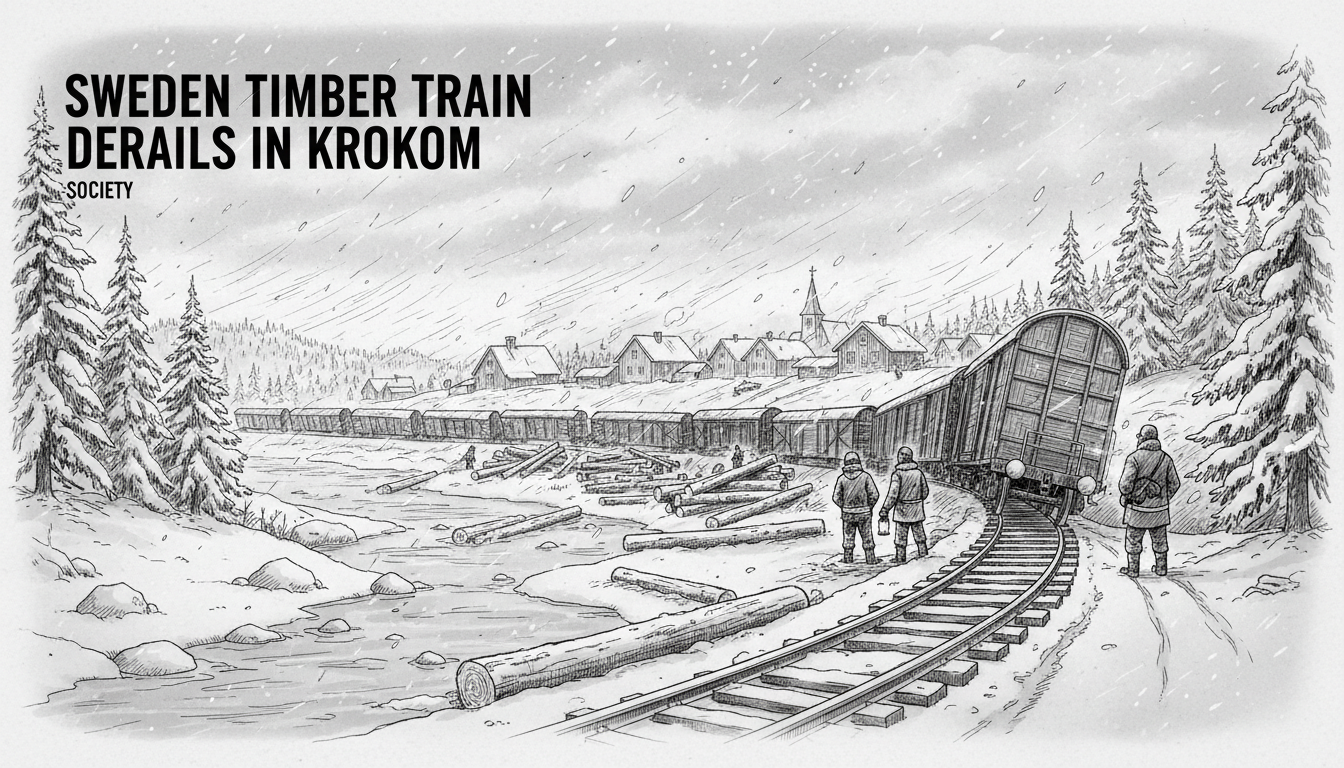
Sweden train derailment in the northern municipality of Krokom blocked a key local road for 40 minutes early Thursday morning. The incident involved a timber train, a common sight in the forest-rich Jämtland region, but caused no injuries. The event highlights the quiet yet critical role of rail freight in Sweden's rural economies and the infrastructure that supports them.
A Morning Interrupted
Just before 9 AM, the routine rhythm of Hissmofors was broken. A loaded timber train, traveling through the dense forests near Offerdalsvägen, left the tracks. County Road 611, known locally as Offerdalsvägen, was immediately blocked at the railway crossing. For residents of nearby villages like Nyheden and those heading towards the Hissmoböle roundabout, the morning commute hit an unexpected stop. The transport authority's initial prognosis was simply 'unclear,' leaving drivers to wait or find long alternate routes through the winding backroads of Jämtland.
The response was swift. By 9:40 AM, the rail cars had been moved and the road reopened. The efficiency of the cleanup points to well-practiced emergency protocols. Yet for that brief period, the incident cut a vital artery. Offerdalsvägen is not a major highway. It is a local lifeline connecting smaller communities, farms, and forestry operations. Its closure, even for less than an hour, sends ripples through the daily life of a sparsely populated area.
The Forestry Lifeline
This was not a high-speed passenger train. It was a 'timmertåg' – a timber train. That detail speaks volumes about the local context. Krokom Municipality is part of a landscape where forestry is a cornerstone industry. The sight of trains carrying raw logs from harvest sites to processing mills is as normal as seeing a bus in Stockholm. The rail network here functions as the region's industrial circulatory system. A derailment is more than a transport delay; it is a disruption to a core economic activity.
“The freight lines in these northern regions are absolutely essential,” says Lars Nilsson, a infrastructure analyst based in Östersund. “They carry heavy loads over long distances in all weather. The wear and tear is significant. Maintenance is a constant challenge, especially on older stretches of track that run through remote areas.” While the cause of this specific derailment is under investigation, experts like Nilsson point to a combination of factors often at play: track alignment issues, wheel health, and the specific dynamics of shifting heavy loads like timber.
The Safety Record and Rural Realities
The most important fact from the police report is also the most reassuring: no one was hurt. This aligns with Sweden's strong railway safety record. Passenger safety often dominates the headlines, but the safe operation of countless freight movements daily is a silent success story. It relies on technology, strict regulations, and the skill of drivers and logistics teams.
However, the incident underscores a tension in rural Sweden. There is immense pressure on the transport network to support the green transition. Biofuel from forestry residues, timber for construction, and minerals for battery production are all increasingly moved by rail, which is favored over road for its lower carbon footprint. This increases the strain on existing infrastructure. Communities want the economic benefits but also rely on the roads that cross these increasingly busy tracks.
Beyond the Headlines: A Community's Resilience
For the people of Krokom, this is a minor event. It will be a topic of conversation at the local petrol station or grocery store, a small story of a morning inconvenience. It lacks the drama of a major crash. Yet, it perfectly illustrates the interconnectedness of life outside the urban centers. The train driver, the truckers waiting at the crossing, the forestry company awaiting its shipment, and the family trying to get to school – for a moment, their routines converged at a blocked crossing in Hissmofors.
It also shows the resilience built into these systems. The protocol worked. Emergency services were alerted, the area was secured, the clean-up was executed, and normal service resumed quickly. The timber, a valuable commodity, was secured. Life moved on by mid-morning. This resilience is a point of pride in the Swedish countryside, where people are accustomed to solving problems with pragmatism and a collective spirit.
Looking Down the Track
The Krokom derailment is a small snapshot with larger implications. As Sweden pushes to shift more freight from road to rail to meet climate goals, the state of the national rail network comes into sharp focus. Investment decisions made in Stockholm have direct consequences for crossings like the one on Offerdalsvägen. Can the infrastructure handle the increased load? Is maintenance keeping pace with use, particularly in harsh northern climates?
This single, non-fatal derailment serves as a gentle reminder. Sweden's economic engine doesn't just hum in city offices. It rumbles along forest tracks, carrying the raw materials that build and fuel the nation. Ensuring that journey remains safe and efficient, for both goods and the communities the tracks bisect, is a continuous and critical task. The next timber train is already on its way, and the people of Krokom will be crossing the tracks, trusting the system to hold.