
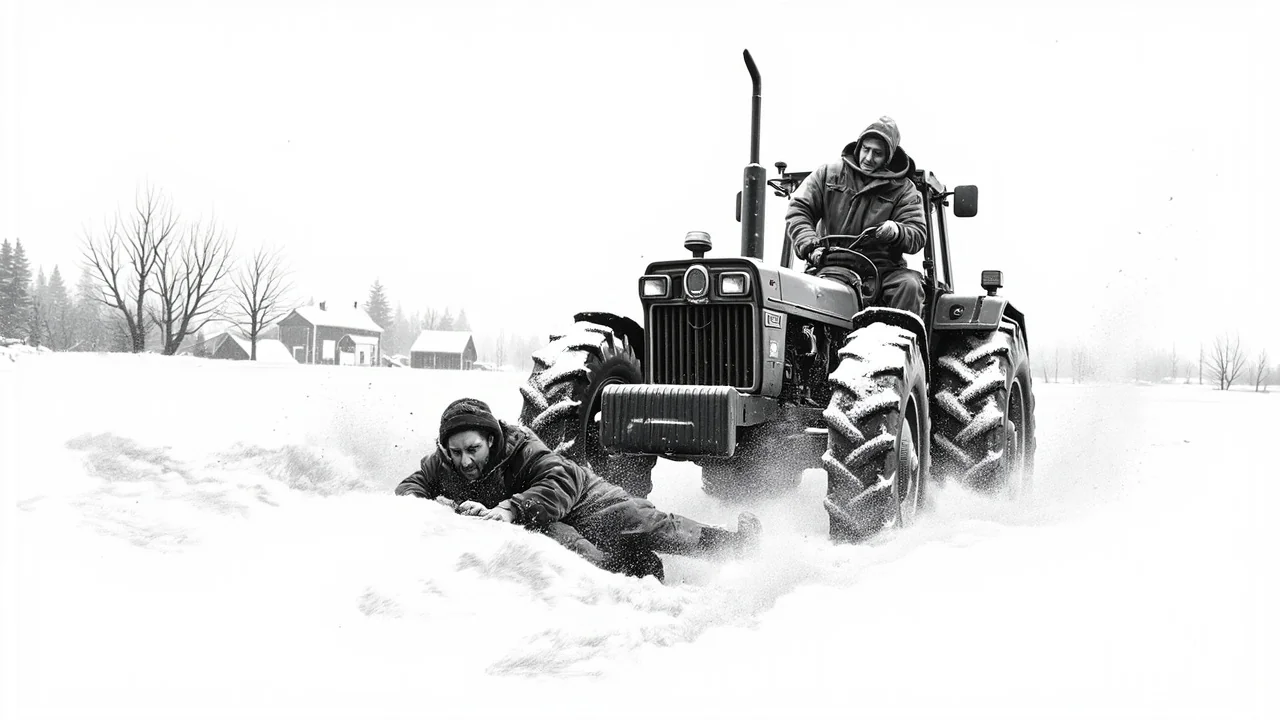
Sweden's rural winter isolation turned deadly for one man until an unlikely farm tool became a lifeline. Ingemar Edblom, a resident of Sundsvall, suffered a severe blood clot while shoveling snow last Thursday morning. Trapped alone in deep snow and unable to move or speak clearly, his chance of survival dwindled with each passing minute in the freezing cold.
A Desperate Call for Help
Edblom's coherent thoughts had narrowed to a single, grim realization: "I am not getting out of here." Despite having a smartphone with an emergency SOS app, the sudden onset of his medical crisis prevented him from initiating a standard rescue call. His mind, clouded by the emergency, could not process the logical steps. Instead, in a moment of sheer will, he managed to place a call to his neighbor, Åke Tjernell. No clear words could be formed; only strained sounds communicated the profound distress on the other end of the line. Tjernell, recognizing the irregularity and urgency in the broken communication, understood immediately that his neighbor was in grave danger. He terminated the call and acted without hesitation.
The Unconventional Lifesaving Operation
Åke Tjernell was already outdoors with his tractor, a common sight on Swedish properties after heavy snowfall. He rushed to Edblom's location, where he found the man immobilized and in critical condition. The deep snow and Edblom's inability to move presented an impossible challenge for a conventional extraction. Ambulance access was problematic and time was the ultimate enemy. Tjernell's solution was born of rural practicality. He carefully maneuvered the tractor's front-loader scoop, typically used for moving gravel or manure, to gently lift the stricken man. This improvised medical transport ensured Edblom was kept stable and above the snow as Tjernell navigated the path to a point where he could be transferred for urgent medical care. This quick, innovative thinking bridged the deadly gap between incident and professional medical intervention.
Recovery and Reflection in Hospital
Ingemar Edblom is now receiving treatment in an Intensive Care Unit. From his hospital bed, he recounted the terrifying experience to local media. He expressed a stark self-criticism about not using the 112 emergency app, a common reaction in trauma survivors. His gratitude towards his neighbor is immense and unambiguous. The event highlights a critical vulnerability in even the most technologically equipped societies: when acute medical trauma strikes, the simplest, most familiar connection—a neighbor's phone number—can prove more accessible than a digital emergency system. The human instinct to call someone you know overrode all other training, a factor emergency services planners constantly study.
The Context of Rural Swedish Resilience
This incident is not merely an anecdote but a testament to a specific aspect of Swedish civic culture, particularly in regions outside major urban centers like Stockholm. The concept of 'egenkraft' (self-reliance) and neighborly duty is deeply ingrained. In remote areas where response times for ambulances or helicopters can be longer due to weather and distance, community members often serve as the crucial first link in the emergency chain. This story echoes countless less-dramatic examples where farmers with snowplows clear roads for midwives, or villagers use private boats during coastal emergencies. It underscores a social contract that complements the state's welfare systems, especially in the vast, sparsely populated north where winter conditions from October to April present persistent dangers.
Analyzing the Gaps in Emergency Response
While the outcome was positive, the event invites analysis of emergency preparedness for isolated individuals. Sweden has a widely promoted '112' app that allows for silent alarms and GPS location sharing. Why was it not used? Medical experts note that conditions like pulmonary embolisms or strokes can cause confusion, impaired judgment, and aphasia—the inability to speak or understand speech. This renders even the best-designed smartphone apps useless. The alternative, medical alert pendants often marketed to the elderly, may not be adopted by active individuals like Edblom. The incident suggests a potential gap for individuals who live alone but are not part of formal at-risk registries. It raises questions about integrating community awareness, like checking on neighbors after a storm, as a formalized adjunct to technological solutions.
A Lesson in Pragmatic Ingenuity
The Sundsvall rescue ultimately succeeded because of pragmatic ingenuity. Åke Tjernell did not have specialized training for a medical evacuation. He applied the tools and skills at his disposal—a tractor, knowledge of the terrain, and a commitment to his neighbor—to solve an immediate, life-threatening problem. This reflects a broader Scandinavian ethos of functionality over formality. The tractor scoop, an emblem of agricultural labor, was repurposed in minutes as a vital piece of medical equipment. This improvisation highlights how everyday resources in rural communities hold latent potential for crisis response, a factor that urban-centric emergency planning can sometimes overlook.
The Unquantifiable Value of Community
Beyond the mechanics of the rescue lies the fundamental element: a community where people are known to each other. In an increasingly digitized and anonymized world, the simple fact that Ingemar Edblom could call a neighbor who would both recognize his voice and act decisively was his most significant asset. This social fabric, often taken for granted, forms an invisible safety net. It is what transforms a collection of houses into a village capable of collective action. As Edblom continues his recovery, his story serves as a powerful, frozen-in-time reminder that for all our advanced systems, human proximity and willingness to act remain the most reliable first responders. Will this near-tragedy inspire other communities to reinforce those vital, informal bonds before the next emergency strikes?