
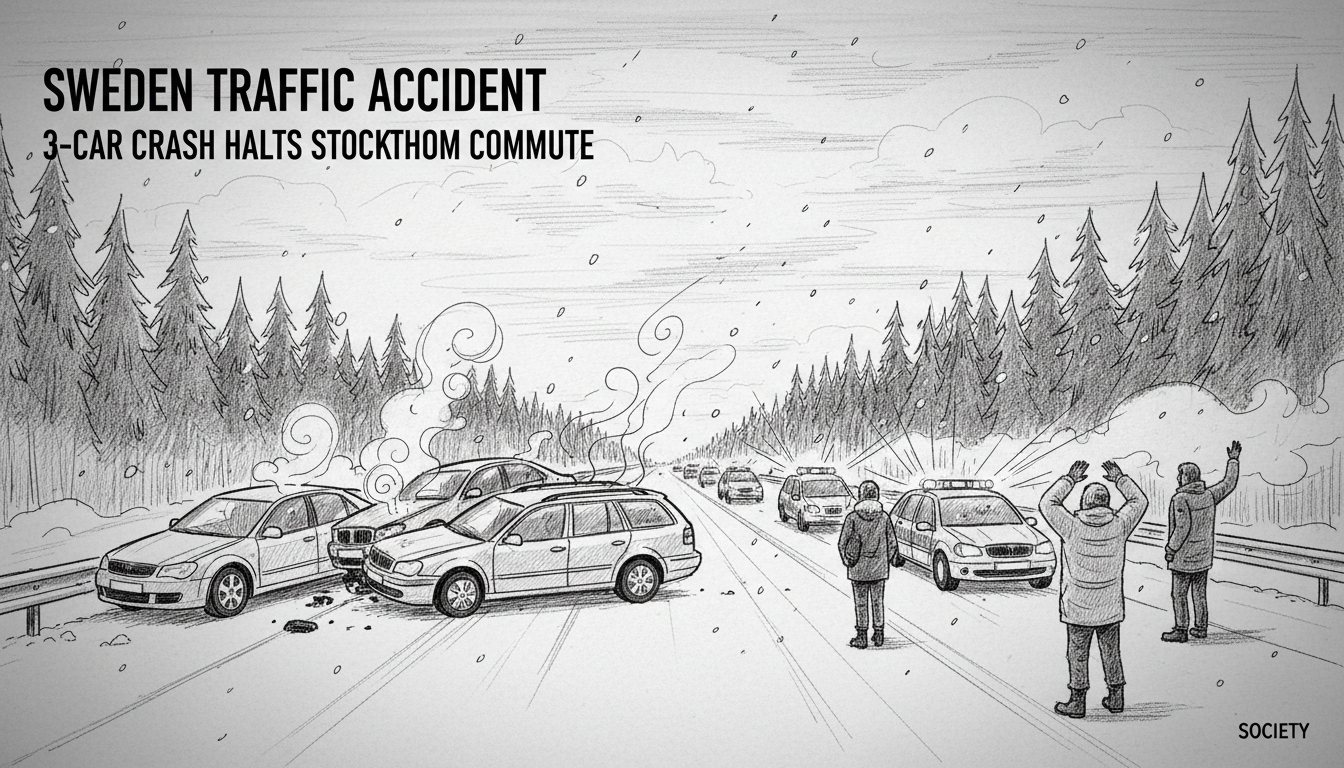
Sweden traffic accident reports began flooding emergency services at 8:23 on Tuesday morning. A chain-reaction collision, known locally as a 'seriekrock', involved three cars traveling west between Rosenkalla and Mossen. The crash immediately disrupted the morning rush for countless Stockholmers. 'With three cars involved, we are looking at a minimum of three people,' said Henrik, a dispatch operator with the Stockholm Fire Department. His calm voice belied the potential chaos on the road. For the thousands navigating Stockholm's arterial routes, this was more than a news alert. It was a stark reminder of the fragility of the daily commute.
This stretch of road is a familiar pressure point. It connects residential areas to the city's economic heart. Every weekday, it pulses with traffic. Parents drive to daycare, workers head to offices, and delivery vans keep the city running. Tuesday's crash brought that flow to a sudden, jarring halt. The specific causes will take time to determine. Yet the incident fits a known pattern. Dense traffic, tight schedules, and sometimes, a moment's distraction can have cascading effects.
The Morning Rush Turns to Standstill
The timing of the crash, deep within the peak morning commute, maximized its disruptive impact. Emergency vehicles raced to the scene against the tide of traffic. Each passing minute added to the queue of idling cars. For those caught in the resulting jam, frustration mounted. Appointments were missed, school drop-offs delayed, and workdays began with stress. Beyond the immediate victims in the crashed vehicles, hundreds more felt the ripple effects. This is the hidden cost of such accidents. It stretches far beyond the crumpled metal at the scene.
Swedish road safety statistics provide sobering context. In 2022, 321 people lost their lives in road traffic accidents across the country. Approximately 3,800 more suffered serious injuries. While Sweden is a global leader in Vision Zero—the policy aiming to eliminate all traffic fatalities and serious injuries—each crash is a setback. It prompts difficult questions. Are safety measures keeping pace with traffic volume? Is driver education sufficient? The stretch between Rosenkalla and Mossen, now an accident site, will soon return to normal. But the questions will linger.
Understanding the 'Seriekrock' Phenomenon
The Swedish term 'seriekrock' precisely describes Tuesday's event. It is a chain-reaction collision where one initial impact triggers others. These often occur on highways or busy commuter routes. Factors typically include high speed, insufficient following distance, and sudden braking. In wet or icy conditions, the risk multiplies. Traffic safety experts consistently warn drivers about tailgating, especially during rush hour. 'Maintaining a safe distance is not just a rule, it's your primary buffer against the unexpected,' says a veteran driving instructor in Stockholm. 'A two-second gap can be the difference between a scare and a crash.'
Investigators will now piece together the sequence. They will examine skid marks, vehicle damage, and road conditions. They will interview drivers and witnesses. The goal is not just to assign blame, but to understand. Could better road design have prevented this? Were there obscured signs or confusing lane markings? Every investigation feeds into Sweden's data-driven approach to traffic safety. The findings from Rosenkalla and Mossen will become part of that larger puzzle.
Infrastructure and the Daily Grind
Coincidentally, the crash occurred as local infrastructure projects make headlines. Recent municipal communications highlight work on 'Vackra vägen'. Officials note the 'removal of a play street has begun' and that 'lane and parking spaces are returning according to plan'. This underscores a constant tension in growing cities. Urban planners balance safety, livability, and traffic flow. A road is never just asphalt. It is a contested space. It must accommodate cars, cyclists, pedestrians, and sometimes, children at play. Decisions made in city hall directly affect the risk on roads like the one between Rosenkalla and Mossen.
For residents in these Stockholm suburbs, the road is a lifeline. It is how they access schools, supermarkets, and the tunnelbana. When it fails, even temporarily, their connection to the city weakens. The response from emergency services is typically swift and professional. Stockholm's Fire Department, like others across Sweden, trains extensively for road rescues. Their priority is to secure the scene, provide medical aid, and clear the wreckage efficiently. Their work restores order from chaos.
A Broader Look at Swedish Road Culture
Swedes are generally law-abiding drivers. The country has strict laws on drink-driving and speeding. Safety features like daytime running lights have been mandatory for decades. Yet, the human element remains. The pressure of modern life—running late, checking a phone, dealing with stress—can compromise judgment. Cultural attitudes also play a role. The famous Swedish value of 'lagom' (just the right amount) ideally applies to driving: not too fast, not too slow. But during the competitive merge of a rush hour, 'lagom' can sometimes be forgotten.
Public transportation offers an alternative, but for many, the car is non-negotiable. It provides flexibility for complex family logistics or jobs outside the city center. This dependency means the smooth functioning of the road network is critical. When an accident occurs, it exposes this vulnerability. It also showcases community. Witnesses often stop to help before emergency crews arrive. The tradition of 'dugnad'—communal voluntary work—manifests spontaneously at crash sites.
The Path Forward from the Crash Site
As the tow trucks cleared the final debris from Vackra vägen, the normal rhythm resumed. Cars began moving again. The digital traffic maps turned from red back to green. But for the individuals involved, the aftermath continues. They face insurance claims, vehicle repairs, and possibly physical therapy. The psychological shock of a sudden collision can also linger. Meanwhile, traffic planners in Stockholm's Stadshuset will likely examine this incident. They will ask if this corridor needs better signage, improved lighting, or altered speed limits.
The ultimate goal, embedded in Swedish policy, is to prevent the next crash. Not just on this road, but on every road. This requires continuous investment, education, and enforcement. It requires drivers to make conscious choices every time they get behind the wheel. The Tuesday morning crash between Rosenkalla and Mossen is a single data point. But it represents a break in the social contract of shared road use. It reminds us that safety is a collective responsibility. As the city moves on, the lesson should not be left at the roadside. Will this event lead to a renewed focus on commuter safety, or will it be just another statistic in tomorrow's traffic report?