
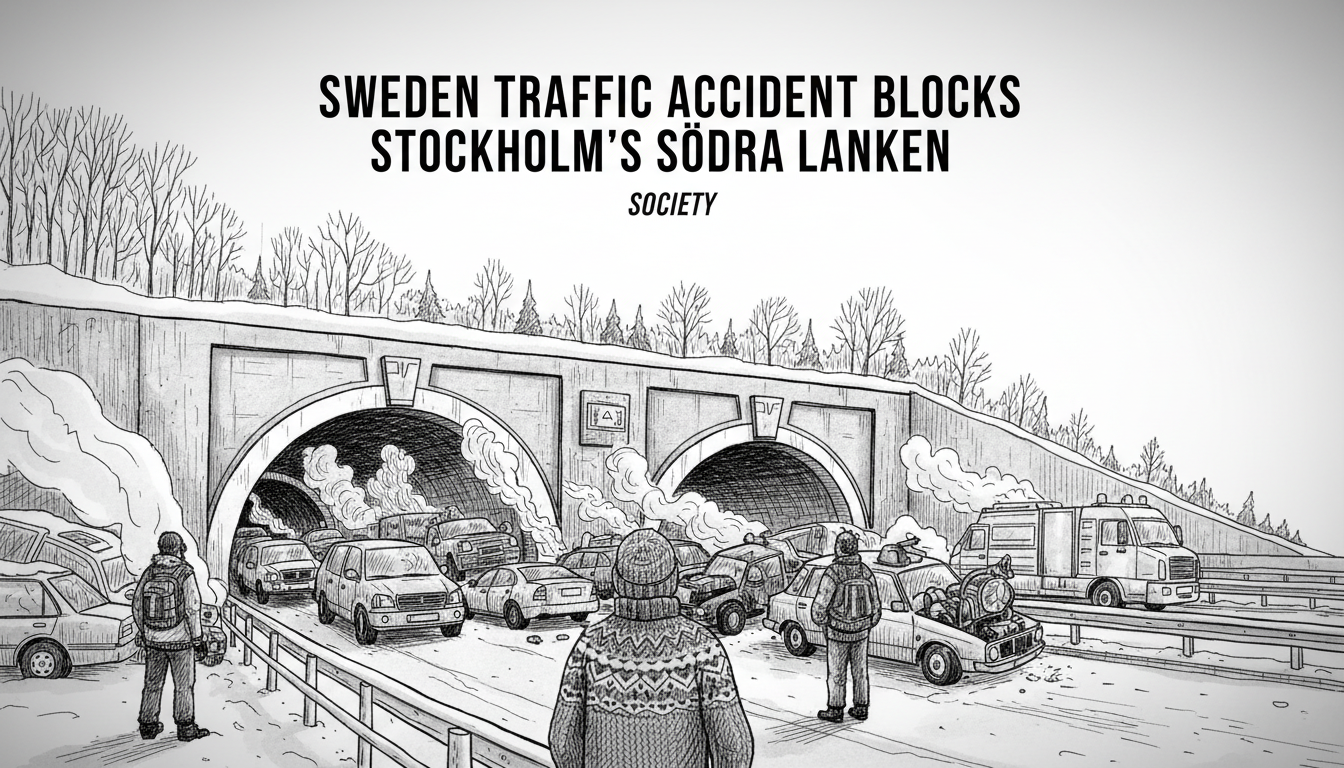
Stockholm traffic accident brings over 100,000 daily commuters to a standstill. On a busy Thursday afternoon, a collision inside the Södra Lanken tunnel created a cascade of delays across Sweden's capital. The accident occurred around 2 PM, blocking the left lane and forcing the closure of key entry points from Sickla and Gullmarsplan. For drivers trapped in the 6-kilometer stretch, it was a frustrating reminder of the city's fragile traffic network.
Emergency services responded swiftly to the confined space. The tunnel's design, with two separate tubes of three lanes each, presents unique challenges. Rescues and clearances take longer underground. This incident quickly backed up traffic onto surface streets in Södermalm and Hammarby Sjöstad. Commuters faced lengthy, unexpected detours.
The Daily Choke Point
Södra Lanken is not just any road. It is a critical artery in Stockholm's circulatory system. As part of the E4 and E20 European routes, it funnels a massive volume of cars and trucks beneath the southern districts. The tunnel handles over 100,000 vehicles every single day. That's a number equivalent to the entire population of a city like Uppsala passing through a single, narrow corridor.
When it stops, much of Stockholm's east-west connectivity stops with it. 'It's like a main vein getting clogged,' says local traffic analyst Mats Johansson. 'The effects are immediate and widespread. Alternative routes, like Värmdöleden or going through the city center, become saturated almost instantly.' This particular closure, affecting the exits for two major residential and commercial areas, maximized the disruption during the early afternoon lull.
A City Built for Traffic Challenges
Stockholm is no stranger to congestion. The city's island geography creates natural bottlenecks. For decades, engineers have worked on solutions like the congestion tax, implemented in 2007. This pricing system aims to manage demand and reduce traffic volume, especially during peak hours. It has been largely successful in cutting city-center traffic. Yet incidents like this one reveal the system's vulnerabilities. A single crash can undo hours of careful traffic management planning.
The human cost is measured in missed meetings, late daycare pickups, and lost productivity. For Erik, a delivery driver stuck in the queue, it meant failed deliveries. 'My entire schedule is ruined,' he said, watching the line of red brake lights stretch into the tunnel's darkness. 'This costs me money directly.' Others, like teacher Anna Forsberg, used the time to call home. 'I told my kids to start their homework without me. It's just part of life in Stockholm sometimes.'
Tunnel Safety and Response
Traffic incidents inside tunnels are a special concern for authorities worldwide. The Swedish Transport Administration has specific protocols for Södra Lanken. Ventilation systems can be adjusted to manage smoke. Emergency refuges are spaced at intervals. Communication with drivers via electronic signs is crucial. The response to this afternoon's accident followed these established procedures. The priority is always safety over speed, even if it prolongs the closure.
Experts point out that while Swedish roads are statistically very safe, high traffic density increases incident frequency. Stockholm sees thousands of traffic incidents annually, most minor. But their impact on commute times is disproportionate. A ten-minute clearance in an open area might cause a thirty-minute delay. The same incident in Södra Lanken can create two hours of gridlock. The limited entry and exit points turn the tunnel into a trap for flowing traffic.
Looking Beyond the Concrete Tubes
This event sparks a recurring conversation in Stockholm. How does a growing city build resilience into its transport network? Investment continues in public transit, with the extension of the metro's Blue Line and new tram lines. The goal is to offer reliable alternatives to the car. For many, the tunnelbana is already the default. But for tradespeople, delivery services, and those living outside the core, the road network remains essential.
Cultural attitudes also play a role. The Swedish concept of folkhemmet (the people's home) extends to infrastructure. There's an expectation that public systems should function smoothly for the collective good. A major tunnel blockage feels like a collective failing. It prompts public debate about maintenance budgets, accident prevention technology, and the balance between private and public transport.
The afternoon sun was beginning to dip by the time the scene was fully cleared. The left lane reopened. Traffic began its slow, grudging return to a tense normalcy. The digital boards along the motorway finally switched from red warnings to green speed indicators. Yet the ripple effects lasted well into the evening rush.
Each incident like this writes itself into the city's shared memory. It becomes another story of 'the time Södra Lanken was closed.' It reinforces the Stockholm resident's reflexive check of traffic apps before any important journey. It highlights the delicate equilibrium of urban life, where one skid, one moment of distraction, can send waves of delay through the lives of tens of thousands. As Stockholm continues to expand, the pressure on its concrete veins will only grow. The question remains: how many more afternoon standstills can the city afford?