
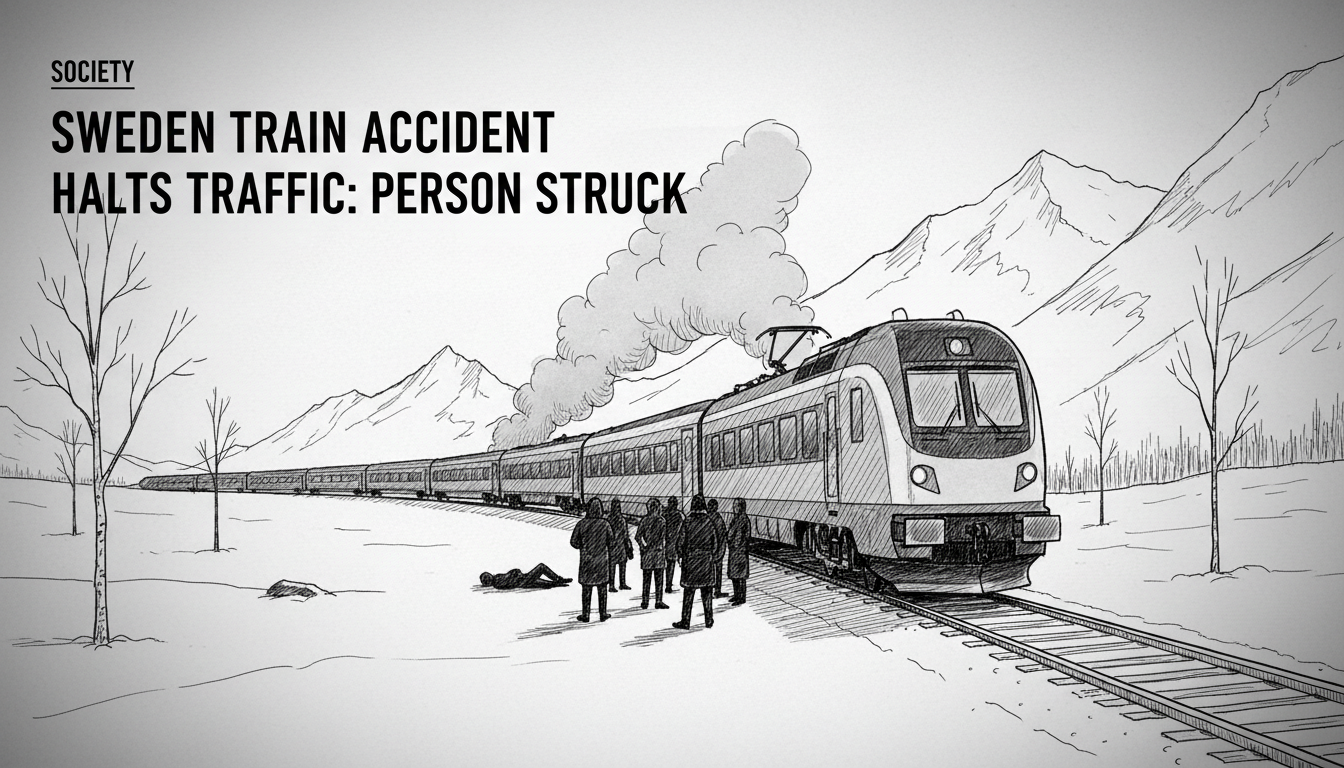
Swedish police and emergency services responded to a serious incident on the railway line between Västerås and Ludvika on Thursday afternoon. A person was struck by a train near Surahammar, bringing all traffic to an immediate standstill. The condition of the individual remains unclear, according to initial reports from rescue services.
"It is a person who has been struck by a train," said Ulf Tholén, a command operator with the rescue service, in a statement to local media. The accident occurred around 2:00 PM on the stretch between Hallstahammar and Surahammar in central Sweden. The response involved multiple agencies, a common coordination effort for such critical incidents in Sweden.
The Immediate Aftermath and Commuter Impact
For hours, the regional rail network was paralyzed. Commuters faced sudden cancellations and long delays, a stark reminder of how a single, tragic event ripples through the daily lives of hundreds. The main line between Västerås, a major city, and Ludvika serves both passenger and freight traffic, making it a crucial artery. Trafikverket, the Swedish Transport Administration, worked to inform travelers through its app and website, but for many stranded at stations, the information was just one part of a frustrating and somber afternoon.
I spoke with Mia, a commuter waiting at Västerås Centralstation. She was trying to get home to Ludvika after work. "First there was just a 'delay' notice," she said, checking her phone. "Then it updated to 'serious incident on the track.' You hear that phrase and your stomach drops. You know it's bad, and you think about the person, their family. The wait becomes secondary."
A Deeper Look at Railway Safety in Sweden
Sweden boasts a well-developed and generally safe railway network managed by Trafikverket. Yet, accidents involving pedestrians on the tracks are a persistent and devastating challenge. Every incident triggers a standard protocol. The Swedish Accident Investigation Authority (Statens haverikommission, SHK) will likely examine this event to determine the precise cause and identify any potential safety improvements.
Rail safety experts consistently point to specific risk factors. "While the investigation will determine the specifics of this case, we know that level crossings, trespassing on tracks, and, most tragically, intentional acts are the primary causes," explained a railway safety analyst I contacted, who requested anonymity as the investigation is pending. "Prevention is a multi-front effort: physical barriers, public education, and support systems."
The human cost of these incidents is immense, both for the victims and for train drivers, who often suffer severe trauma. Driver support programs are a critical, though less visible, part of Sweden's rail safety infrastructure. The statistics behind these tragedies are sobering. While annual figures fluctuate, incidents where people are struck by trains remain a focus for Trafikverket and public health authorities. The latest available data underscores the scale of the issue, highlighting why each accident prompts renewed discussion on prevention.
The Complex Task of Prevention
What can be done? In Sweden, efforts range from the technological to the community-based. Fencing along high-risk urban sections, improved lighting at crossings, and public awareness campaigns about the dangers of taking shortcuts across tracks are all part of the strategy. Organizations like the Swedish Mental Health Foundation also work on broader societal prevention, addressing the root causes that can lead to individuals being on the tracks.
Jonas, a veteran train conductor based in Stockholm, shared his perspective with me last year after a similar incident. "We have extensive training, not just in operating the train, but in handling crisis situations," he said. "But nothing prepares you fully. The sound, the sight... it stays with you. The best day is one where nothing happens. So you become a vocal advocate for any safety measure, any fence or gate that might stop someone from being where they shouldn't be."
This latest accident near Surahammar will once again bring these discussions to the fore. Can infrastructure be improved further on this specific stretch? Were all existing safety protocols adequate? The SHK's final report, which may take months, will provide those answers.
A Community Pauses and Reflects
Beyond the statistics and safety protocols lies a simple, human truth. An event like this sends a wave of sadness through the local community and the wider nation. It is a sudden break in the normal rhythm of travel and life. In the Swedish context, where trust in public systems and collective safety is high, such incidents feel particularly jarring.
As services slowly resumed in the evening, the tracks were silent for a time. For the investigators, the work was just beginning. For the emergency responders, it was another difficult call. For commuters like Mia, it was a delayed journey home, with time to reflect on the fragility that exists just beside our daily routines.
The question that lingers after the news alerts fade is a familiar one in Sweden: in a society dedicated to 'Vision Zero'—the goal of eliminating all traffic fatalities and serious injuries—how can such tragedies on the rails be finally prevented? The search for that answer continues, one painful investigation at a time.