
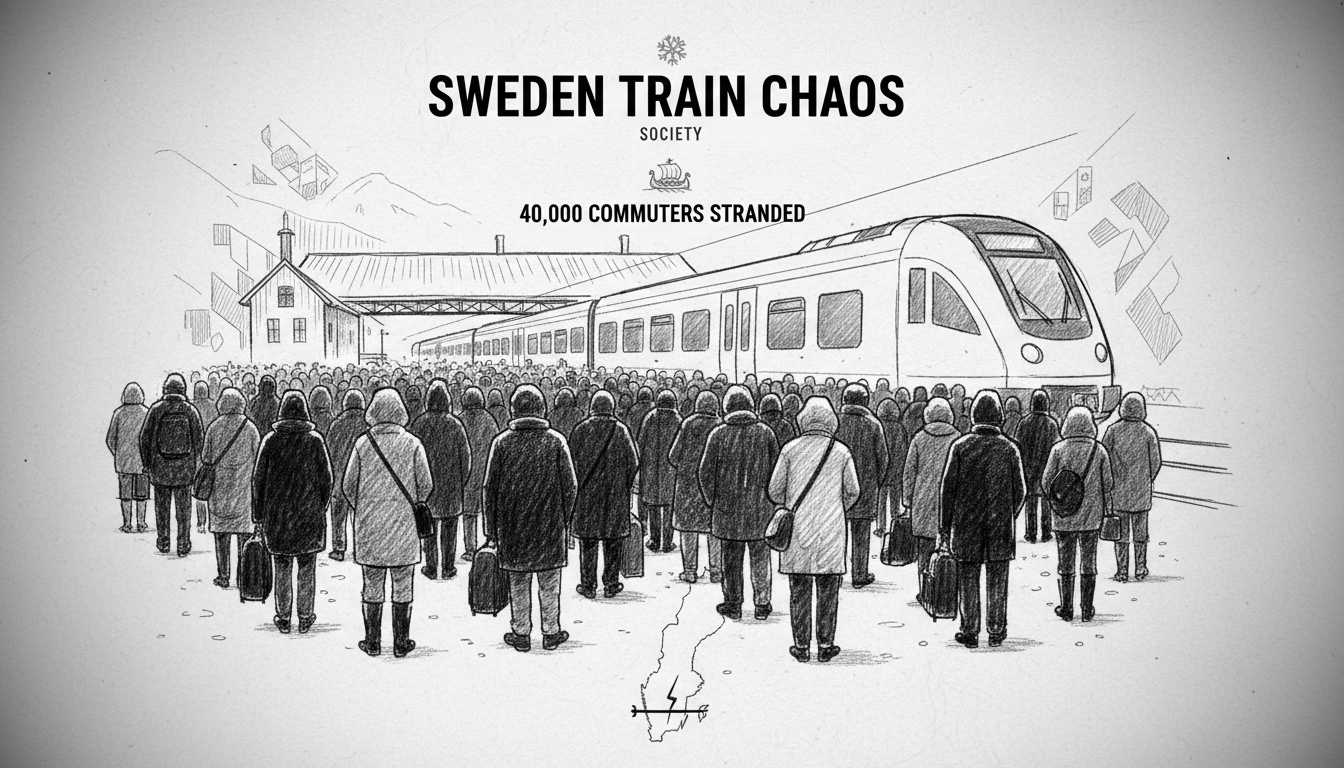
Sweden's vital Stockholm-Uppsala rail corridor ground to a complete halt today. An electrical fault between Upplands Väsby and Rosersberg stopped all traffic, stranding thousands. The disruption affected commuter trains, regional services, and the high-speed Arlanda Express to the country's main airport. Repair crews are on site, but officials cannot say when trains will run again. For the more than 40,000 passengers who rely on this line daily, the sudden silence on the tracks meant a morning of frustration and improvisation.
At Stockholm Central Station, the departure boards flashed a sea of red 'Inställd' – cancelled. Commuters stared at their phones, searching for bus alternatives or calculating the cost of a last-minute taxi. "I have a critical meeting at the university in Uppsala at 10 AM," said Erik Lundström, a researcher, checking a ride-sharing app. "This is lost time and lost money. The system just isn't resilient." The scene was a stark contrast to the usual efficient hum of Scandinavia's largest train hub.
A Nation Grinds to a Halt
The stoppage reveals the fragility of a system under strain. The Stockholm-Uppsala line is not just a commute; it's an economic and academic lifeline. It connects the capital with a historic university city, research hubs, and Arlanda Airport. When it fails, the ripple effects are immediate and widespread. Business meetings are missed, flight connections are jeopardized, and students are late for exams. The Arlanda Express, which normally departs up to six times per hour, sat motionless, leaving air travelers scrambling.
Local commuter trains, known as Pendeltåg, form the backbone of the regional network. Their cancellation forces people onto already crowded buses and onto the roads, worsening Stockholm's traffic. "I've been trying to get a seat on a replacement bus for 45 minutes," said Anya Petrova, a nurse who lives in Märsta and works in central Stockholm. "It feels like the whole city is trying to move on one road. This isn't just an inconvenience; it stresses everyone out."
The Infrastructure Debate Heats Up
This incident is not an isolated one. Electrical faults are a common culprit in Swedish rail disruptions, often linked to aging infrastructure or extreme weather. Railway analysts have long warned about the vulnerability of parts of the network. "We are running a 21st-century demand on a 20th-century foundation in many areas," said transport analyst Lena Kofoed, who has studied Nordic rail systems for over a decade. "The economic impact of a major stoppage like this is significant. We're talking about lost productivity, logistical nightmares for businesses, and a hit to public trust in rail travel."
Investment in rail infrastructure is a perennial topic in Swedish politics. Debates often center on the balance between building new high-speed lines and maintaining the existing network. Critics argue that maintenance backlogs make the system prone to failures that cost the economy more in the long run. "Preventative maintenance and modern signaling systems are not glamorous investments," Kofoed added. "But they are what keep daily life running smoothly. Today shows what happens when that foundation cracks."
A Day of Improvisation and Cost
For stranded passengers, the abstract debate becomes very concrete. The search for alternatives reveals the true cost of the disruption. Taxi fares from Stockholm to Uppsala can exceed 2000 SEK (approx. 170 EUR). Ride-sharing groups on social media saw a surge in activity. Some decided to work from home, if their jobs allowed it. Others faced difficult choices about missing important appointments or family obligations.
The disruption also highlights the dependency on this single corridor. While buses provide a partial alternative, they cannot match the capacity or speed of the trains, especially during peak hours. The incident serves as a real-time stress test for the region's contingency plans. For tourists unfamiliar with the system, the cancellation was particularly daunting, adding unexpected complexity to their travel plans in a country renowned for its efficiency.
Looking Down the Track
As repair crews work to fix the fault, questions about long-term solutions remain. Can the system handle increasing passenger volumes and climate extremes? How can redundancy be built into critical transport arteries? For regular commuters, the desire is simple: reliability. "I don't need it to be the fastest in the world," said student Moa Lindgren, waiting at Uppsala station. "I just need to know it will work when I plan my day. That trust is broken a little every time this happens."
The silence on the tracks between Stockholm and Uppsala today is more than an operational issue. It is a loud reminder of the interconnectedness of modern society and the quiet infrastructure we all depend on. When it works, it's invisible. When it fails, everything stops. The real test will be what lessons are learned once the trains finally start running again. Will this be just another delay, or a catalyst for a more robust system? For now, thousands of Swedes are still waiting for an answer, and a ride home.