
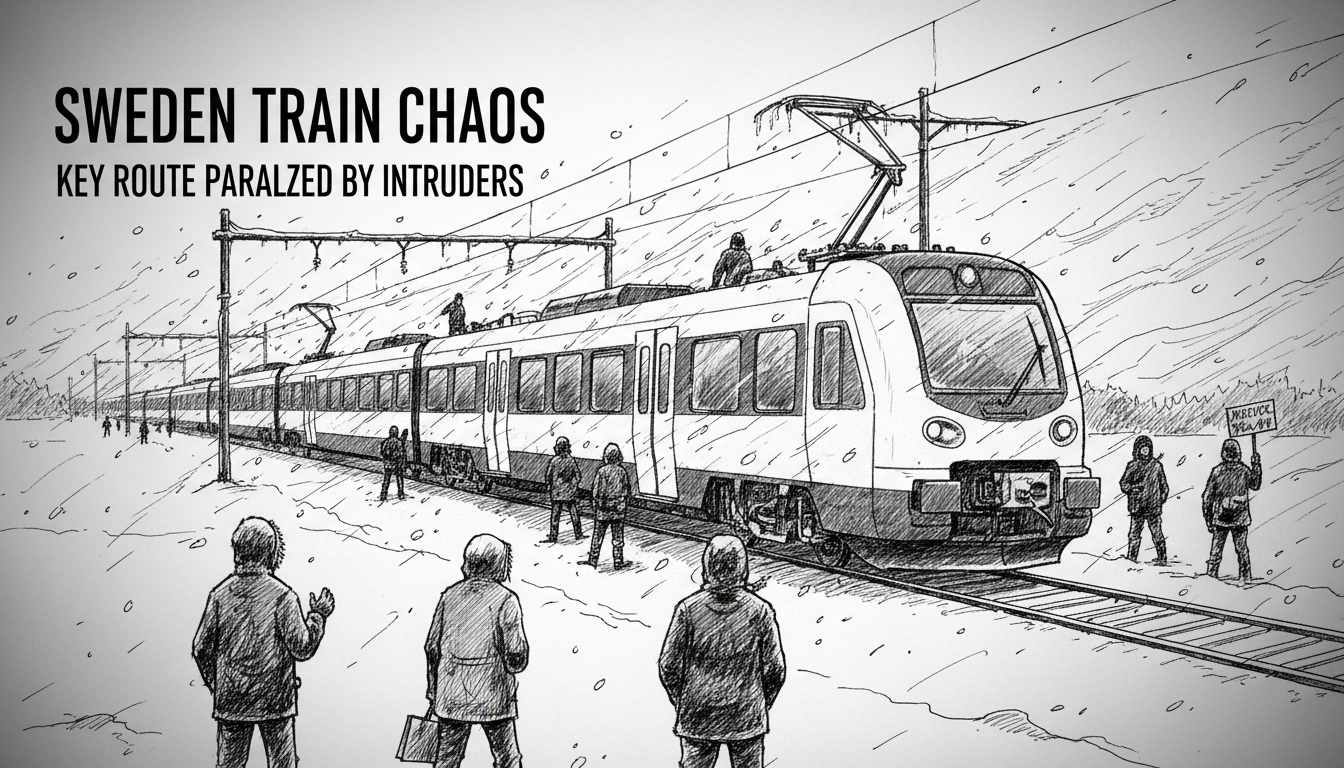
Sweden train delays caused major disruption across the country's vital southern corridor today. A complete stop in traffic between Gothenburg and Malmö, triggered by unauthorized persons on the tracks, left thousands of commuters stranded and highlighted the fragility of a key national artery. The incident, which began at 5:00 AM between Åsa and Varberg, cascaded into widespread cancellations and delays, paralyzing connections between Sweden's second and third largest cities during the morning rush.
For commuters like Elin Forsberg, a teacher from Kungsbacka, the morning turned into a stressful puzzle. "I got the alert on my phone just as I was leaving home," she said, waiting at a crowded Gothenburg Central Station. "Now I'm trying to find a bus, but everyone else is doing the same. I'll be late for my first class, and the children will be waiting." Her story was repeated at stations from Helsingborg to Halmstad, where digital boards flashed red with the word 'Inställt' – cancelled.
The Swedish Transport Administration confirmed the full stop was due to "obehöriga vid spårområdet" – unauthorized individuals in the track area. Security personnel were dispatched to locate and remove the persons, but the protocol in such situations is strict. All traffic must halt until the tracks are confirmed clear and safe, a process that can take hours. A separate incident near Älmhult, reported just before 5:00 AM, compounded the chaos, creating a perfect storm of disruption across the region.
A Nation Grinds to a Halt
The ripple effects of the stoppage were immediate and severe. Major hubs like Malmö Central, Helsingborg C, and Lund C saw platforms swell with confused passengers. Regional trains connecting smaller coastal towns like Falkenberg, Varberg, and Ängelholm to the main line were also axed. For the many who rely on this coastal railway for work, education, and healthcare, the disruption was more than an inconvenience. It was a breakdown of their daily lifeline.
"This isn't just a train line; it's the backbone of West Sweden," said Lars Bengtsson, a transport analyst. "When it stops, the economic and social costs accumulate rapidly. Freight is delayed, people miss work, appointments are cancelled. The dependency on this single corridor is a known vulnerability." While annual passenger numbers on this specific segment are not officially broken down, the entire Southern Main Line carries tens of millions of passengers yearly. The freight impact is also significant, with Swedish railways transporting over 60 million tonnes of goods annually, much of it moving through this region.
The Human Cost of Disruption
At Halmstad C, the mood was one of resigned frustration. Students compared notes on ride-sharing apps, while business travelers anxiously rescheduled meetings. The lack of immediate alternative transport on such a scale left many with few options. Replacement bus services, often the fallback, were quickly overwhelmed. The incident exposes a critical gap in Sweden's otherwise praised transport network: its limited resilience to unexpected shocks.
"Communication is key in these situations, but it often feels too generic," said Karin Lindahl, a frequent traveler from Helsingborg. "We get 'unauthorized on the track,' but no sense of how long it will really take. Should I go home? Wait? It leaves you in limbo." This sentiment points to a broader challenge for authorities – managing passenger expectations during unpredictable security incidents.
Security and Society's Vulnerabilities
The term 'obehöriga' or unauthorized persons covers a range of scenarios, from trespassers and vandals to individuals in acute personal crisis. Railway trespassing is a persistent and dangerous problem in Sweden, posing severe risks to both individuals and public safety. Each incident forces a full shutdown, prioritizing human life over schedule. However, the frequency of such disruptions raises tough questions about infrastructure protection and social welfare.
"Every stoppage like this is a multi-layered event," explained Anna Pettersson, a sociologist who studies infrastructure. "It's a security issue, a transport policy issue, and often a social issue. Are these individuals trespassing due to mental health crises, homelessness, or criminal intent? The response needs to address all these possibilities to prevent recurrences." The economic toll is direct, but the erosion of public trust in rail reliability is a slower, more damaging consequence.
Picking Up the Pieces
By late morning, services began a slow and tentative restart. The clearance process involved security sweeps and technical checks before the first cautious train could pass. The backlog, however, lasted throughout the day. For the Swedish Transport Administration, the post-incident analysis will focus on response times and communication. For train operators, it meant managing a day of cascading delays and dissatisfied customers.
The disruption also reignites a perennial debate in Swedish politics: investment in rail infrastructure versus road. Proponents of increased rail funding argue that a more robust, possibly double-tracked, coastal line with better fencing and monitoring could mitigate such risks. Critics question the cost. Today, for the thousands affected, the abstract debate felt very concrete.
As the evening commute approached, schedules remained fragile. The day's events served as a stark reminder. In an interconnected region, a single point of failure – whether a technical fault, extreme weather, or two unauthorized figures on the tracks – can unravel the rhythm of an entire corner of the country. The trains may be moving again, but the questions about how to protect the steady pulse of Swedish society from such sudden arrests remain firmly on the tracks.