
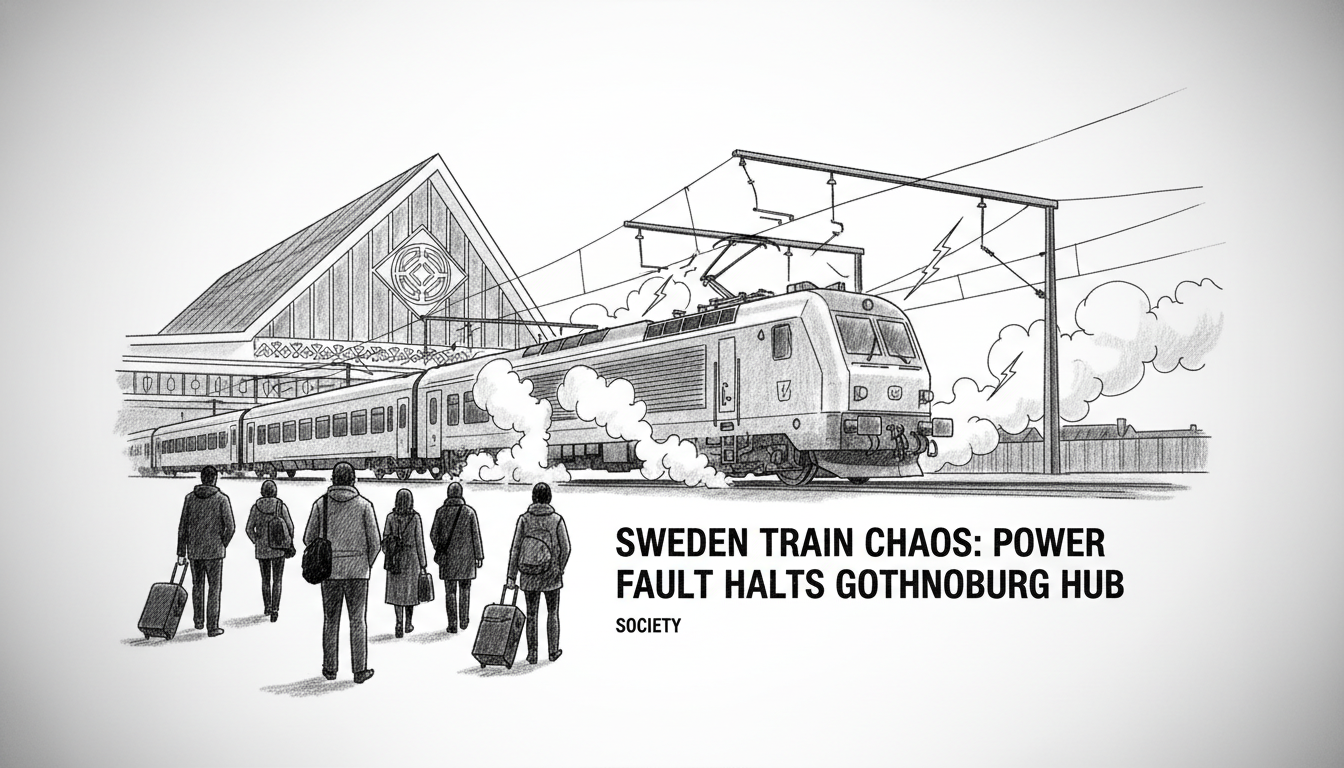
Sweden train delays caused major disruption at Gothenburg Central Station on Saturday. A sudden electrical fault brought all rail traffic to a standstill. The incident stranded thousands of passengers and highlighted the fragility of a critical national transport node. For over an hour, no trains could enter or leave Scandinavia's second-largest city. The silence on the platforms was broken only by frustrated sighs and the crackle of station announcements.
"We are bobbing the traffic around," said Göta Andersson, a duty officer at Västtrafik's disruption center. Her colloquial Swedish phrase, 'bollar om trafiken', described the frantic logistical shuffle. "Since it's a Saturday, there aren't as many trains running, so we are managing." The fault was eventually isolated to a limited number of tracks just after 12:30 PM, allowing a slow, cautious restart. The ripple effects, however, lasted for hours.
A Saturday Snarl in Sweden's Second City
Gothenburg Central, or Göteborg C, is more than just a station. It is the pulsing heart of western Sweden's rail network. The elegant, century-old building handles around 47,000 passengers on an average weekday. On Saturdays, the flow mixes commuters, weekend travelers, and families heading into the city for shopping or a fika. The power cut created instant gridlock. Passengers bound for Stockholm, Copenhagen, and local destinations like Kungsbacka and Alingsås found themselves stuck. The adjacent Nordstan shopping complex, usually buzzing with activity, saw an influx of confused travelers seeking information and coffee.
"I was supposed to meet my sister for lunch in Mölndal," said Erik Lundgren, a student checking his phone for bus alternatives. "Now I'm just hoping to get there before dinner. It's one of those classic Swedish moments where everything just... stops." His sentiment echoed through the concourse. The disruption exposed the heavy reliance on this single point of failure. Västtrafik, the public transport authority, scrambled to direct passengers to replacement bus services and its iconic blue trams, which run on a separate network.
The Recurring Ghost in Sweden's Rail Machine
Electrical faults are an unwelcome but familiar specter on Sweden's railways. While often linked to extreme weather—like the heavy snows that paralyzed parts of the network last winter—this Saturday's failure occurred under clear skies. Experts point to deeper, systemic issues. "Our infrastructure is aging, and the traffic volume has increased dramatically," explains Lars Pettersson, a retired rail engineer and industry commentator. "The system is operating at, and often beyond, its original capacity. Preventative maintenance is crucial, but it requires investment and planning windows that are hard to find when the network must run 24/7."
Göteborg C is the oldest station in the city. Its electrical systems, while upgraded over time, form a complex web beneath the platforms. A single fault can have a cascading effect. This incident follows a pattern seen from Malmö to Stockholm, where minor technical issues escalate into major travel chaos. For a country famed for its efficiency and punctuality, these disruptions strike a particular cultural nerve. They challenge the very Swedish concept of 'tillit'—trust in the system to function as promised.
The Human Cost of a Halted Hub
Beyond the statistics, the stoppage had a tangible human impact. For visitors unfamiliar with the city, the station is a daunting labyrinth even when functioning. Annika, a tourist from Germany who declined to give her last name, was trying to reach the archipelago ferries. "The signs said 'no trains,' but my Swedish is not good," she said. "A very kind woman helped me find the tram. Everyone seems calm, but also a bit resigned." This Swedish stoicism in the face of inconvenience is a cultural trait. There were few loud complaints, but rather a collective, weary acceptance.
Local businesses felt the pinch too. Cafés and kiosks inside the station saw a brief surge, but surrounding restaurants that rely on foot traffic from arriving trains reported a quiet afternoon. The disruption also affects freight, delaying goods moving through the port of Gothenburg, Europe's largest logistics hub. Each halted passenger train represents hundreds of individual plans derailed: missed connections, postponed family visits, and lost work hours.
Investing in the Tracks Ahead
The recurring nature of these faults puts pressure on both Västtrafik and the Swedish Transport Administration, Trafikverket, which owns the rail infrastructure. Major investment programs are underway nationally, but they are long-term projects. The West Coast Line (Västkustbanan) linking Gothenburg to Malmö and the Main Line (Stambanan) to Stockholm are both slated for upgrades. The question is whether investment can outpace wear and tear.
"Modernization is not just about high-speed rail," Pettersson notes. "It's about the unglamorous, essential work below our feet: signaling, power supplies, and switches. Saturday's fault is a reminder that resilience is built on these fundamentals." Västtrafik's communication during the incident was proactive, using its app and social media. Yet, for passengers on the ground, information often felt fragmented. The authority's challenge is balancing technical jargon with clear, actionable advice for the public.
More Than Just a Technical Glitch
As service slowly resumed, the station returned to its familiar rhythm. The delayed trains created a backlog that took the rest of the day to clear. For the people of Gothenburg, a city defined by its trams, its port, and its connectivity, the incident was a temporary rupture. It was a reminder of how tightly woven public transport is into the fabric of Swedish society and urban life. From the daily commute to the weekend getaway, the train represents freedom, sustainability, and connection.
A power fault is a technical diagnosis. But its meaning is cultural. It tests the social contract between the state and the citizen, where high taxes are supposed to fund flawless services. It interrupts the flow of modern life in a nation that prides itself on smooth operation. As the sun set over Göteborg Central on Saturday, the tracks hummed with electricity once more. The question lingering in the air, alongside the scent of coffee and pastries, was simple: How long until the next ghost in the machine appears? The answer depends on choices made today about the infrastructure we too often take for granted, until it suddenly, silently, stops.