
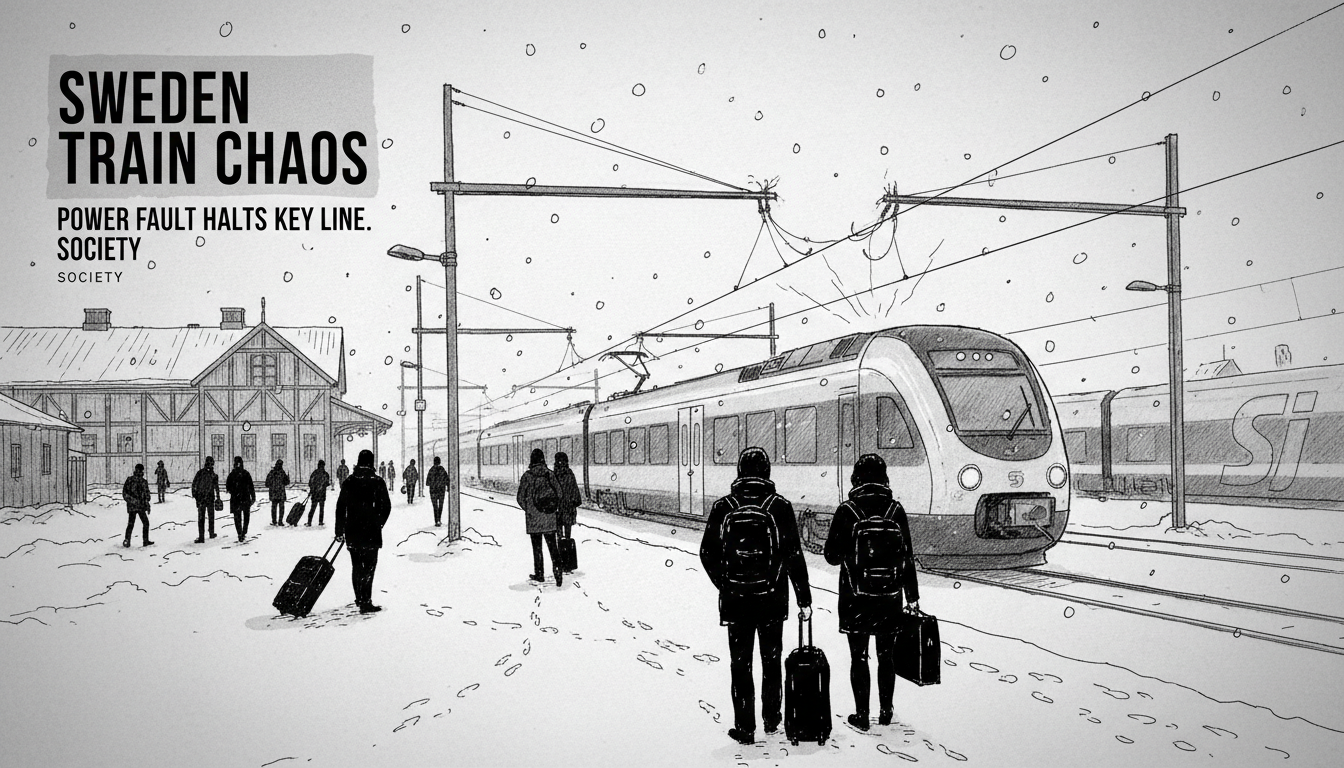
Sweden's key Stockholm-Gothenburg rail corridor ground to a standstill for thousands of commuters and travelers after a major power fault. An electrical failure between Pålsboda and Kilsmo in Örebro County halted all traffic just after lunch, with the Swedish Transport Administration, Trafikverket, estimating repairs would last until 17:00. The disruption stranded a train bound for Oslo, forcing an evacuation, and rippled across the network, affecting the Karlstad-Stockholm route and leading to a chaotic scramble for replacement buses and rerouted journeys.
For Sofia Lundqvist, a marketing manager trying to get from a meeting in Stockholm back home to Gothenburg, the news came via a crowded announcement at Centralstationen. 'It's the classic Swedish 'försening' – you sigh, you pull out your phone, and you try to figure out Plan B,' she said, waiting in a growing queue for bus services. Her evening plans were already cancelled. This scene of resigned adaptation played out across multiple stations, turning a routine three-hour commute into an unpredictable odyssey of connections and delays.
A Nation Grinds to a Halt
The Stockholm-Gothenburg line is the backbone of Sweden's domestic travel, with millions of passenger journeys each year relying on its efficiency. In 2022 alone, passenger rail transport in Sweden totaled approximately 7.9 billion passenger kilometers. When it falters, the economic and social ripple effects are immediate. Freight is delayed, business meetings are missed, and families are left waiting at platforms. The disruption highlights the fragile balance of an aging system supporting a modern, mobile society.
Trafikverket's contingency plan swung into action, deploying a fleet of replacement buses—'ersättningsbussar'—a term that brings a collective groan from seasoned travelers. These buses, often insufficient for the volume of passengers, create a bottleneck, moving people slower and without the comforts of the train. The administration's communication, primarily through its app and website, was clear on the 'what' but could do little to soothe the 'when' for individual travelers. 'You are at the mercy of the system,' said Erik Blom, a student traveling from Karlstad. 'One minute you're studying, the next you're calculating if you'll make it home tonight.'
The Wires Beneath the Welfare State
This incident is not an anomaly. Electrical faults are a persistent culprit behind Sweden's train delays, often stemming from overhead power line issues or faults within the trains themselves. Sweden's rail network, spanning about 13,000 km, was extensively electrified in the mid-20th century, a engineering marvel of its time. Yet, like much infrastructure across Europe, it is showing its age. The stretch between Pålsboda and Kilsmo is a critical link, and its failure is a stark reminder of systemic vulnerability.
'Investment has been high, but maintenance and modernization are continuous battles,' explains Lars Pettersson, a retired rail engineer I spoke to. 'We built a fantastic network, but the demand has soared, and the weather, especially winter, is relentless. A single point of failure can have massive consequences.' Experts consistently point to the need for sustained, strategic investment to improve resilience, not just expansion. The debate often centers on cost versus reliability, a difficult equation for public administrators.
A Culture of Patient (Im)patience
The Swedish response to such travel chaos is culturally telling. There is a notable absence of loud outrage; instead, a quiet, frustrated acceptance dominates. People scroll their phones, call loved ones, and settle in with a 'fika'—a coffee and pastry—to wait. The social contract, the trust in a well-functioning state apparatus, is momentarily strained but rarely broken. There's an unspoken understanding that these things happen, even as they disrupt the prized Swedish work-life balance.
Yet, beneath the calm surface, the disruption fuels a broader conversation about regional connectivity and the green transition. Trains are the sustainable alternative to domestic flights and long car journeys. When they fail, it undermines confidence in the climate-smart choice. For many living in smaller towns along the line, the train isn't just convenient; it's a lifeline to major urban centers for work, healthcare, and education. A reliable network is a question of equality.
The Road—and Rail—Ahead
As repair crews worked to fix the faulty section, the disruption served as a real-time stress test. The incident between Pålsboda and Kilsmo will be logged, analyzed, and added to the statistics that shape future infrastructure budgets. For Trafikverket, the challenge is dual: fixing the immediate physical fault and maintaining public trust in a system that remains, overall, one of Europe's better ones.
By late evening, services were slowly resuming, leaving behind a trail of rearranged schedules and personal stories of delay. The silent platforms at Stockholm Central returned to their normal rhythm, but the question lingers in the air like the echo of a departed train: In a nation committed to sustainability and efficiency, how can its most vital artery be made less vulnerable to a single spark? The journey toward an answer, much like today's affected commutes, promises to be long and full of unexpected stops.