
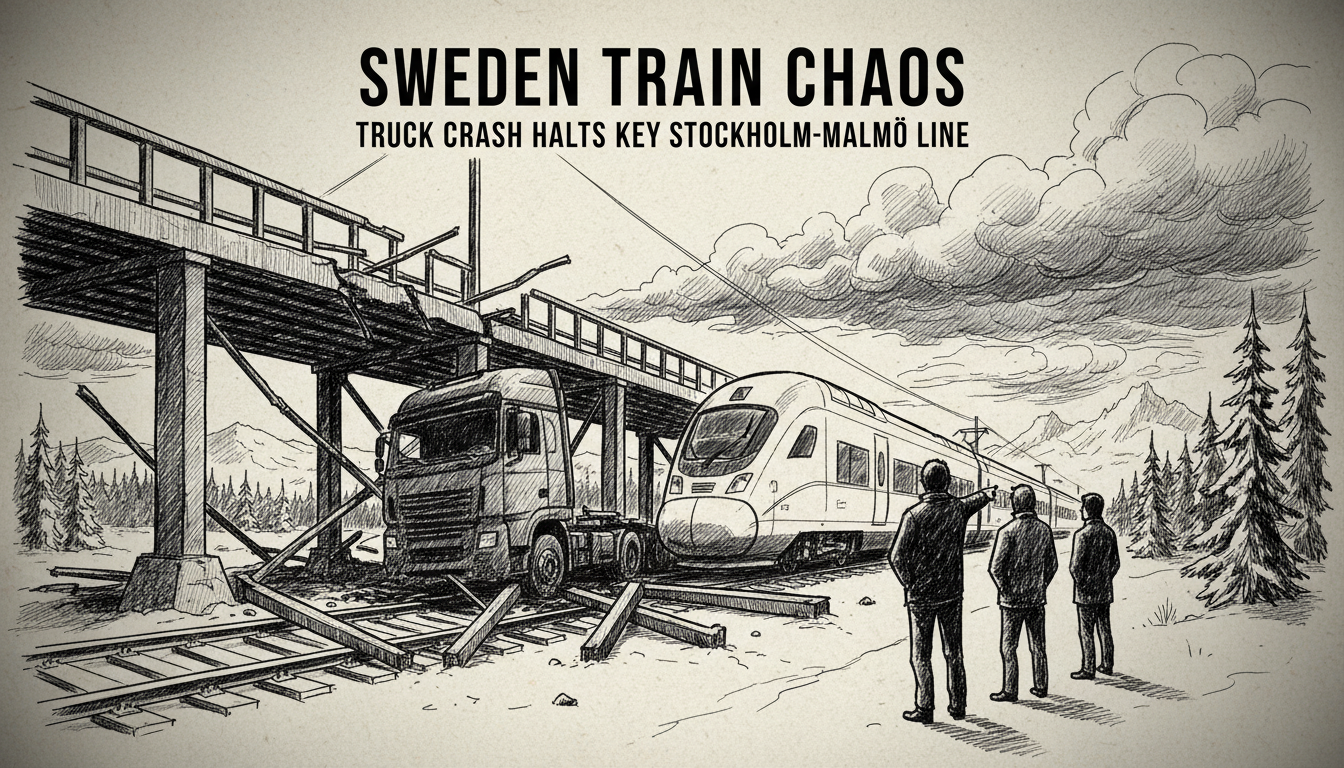
Sweden train delays cascaded across the southern rail network early this morning after a truck crashed into a railway bridge near Katrineholm. The accident brought all traffic on the critical Stockholm-Malmö line to a standstill, disrupting thousands of commuters and long-distance travelers. For a country that prides itself on efficient public transport, the sudden halt was a stark reminder of the system's fragility.
I was at Stockholm Central Station when the announcements began. The digital departure boards, usually a symphony of punctual green text, flickered with a wave of red 'Inställd' – cancelled. A collective groan rose from the platform. "There's been an accident near Katrineholm," a station attendant told a growing crowd. "All traffic is stopped. We have no estimated restart time." The hub of Sweden's rail network, a place normally buzzing with orderly movement, descended into a quiet chaos of confused passengers and ringing phones.
A Vital Artery Severed
Katrineholm is not just any town. Located about 120 kilometers southwest of Stockholm, it is a crucial railway junction. The lines connecting the capital to Malmö, Nyköping, and Sala to Linköping all converge here. When Katrineholm sneezes, Sweden's southern rail network catches a cold. The Stockholm-Malmö line is one of the nation's busiest, a backbone for business, tourism, and family connections. A stoppage here doesn't just delay one train; it creates a domino effect across the entire region.
"It's like cutting the main highway," said Lars Bengtsson, a transport analyst I spoke to by phone. "This corridor handles a massive volume of passenger and freight traffic. Every minute of stoppage has a significant economic impact, from lost productivity to disrupted supply chains. These incidents highlight our dependency on a few critical nodes." Sweden's Transport Administration, Trafikverket, manages over 14,200 kilometers of track. Yet, the failure of a single bridge near one town can paralyze a disproportionate share of it.
The Human Cost of Delays
Back at Central Station, the human stories unfolded. Emma, a student trying to get back to Lund after a weekend in Stockholm, stared at her phone in dismay. "My exam is tomorrow," she said, her voice tight with stress. "I have to get back today. Now I have to figure out if there are any buses, or if I can afford a last-minute flight. It's a mess." Nearby, a businessman in a suit was loudly explaining the situation to a colleague on a video call, the background of a café replacing the planned backdrop of a high-speed train.
For many, the train is more than transport; it's a reliable part of the Swedish social contract. With around 144 million train journeys taken in 2022, the system is woven into the fabric of daily life. This disruption breached that trust. At the information desks, staff handed out printed maps of alternative bus routes—a patchwork solution for a high-tech problem. The familiar Swedish principle of "lagom"—just the right amount—felt distant amidst the excess of inconvenience.
Recovery and Resilience
Trafikverket's crews worked through the morning to assess the damage to the bridge and clear the scene. By late morning, they provided a glimmer of hope: traffic was expected to resume by 10:30 AM. But the recovery from such a stoppage is slow. Restarting a railway network isn't like flipping a switch. Trains and crews are out of position, creating a ripple of delays that lasts for hours after the tracks reopen.
This incident raises quiet questions about infrastructure resilience. Sweden invests heavily in its railways, but as analyst Bengtsson notes, "We have a concentrated network. The focus is often on speed and efficiency, which is good. But concentration also brings vulnerability. Contingency planning and robust alternative routes are just as important as the main lines." Could bus replacement services be activated faster? Are there other rail routes that can absorb some capacity? For travelers stranded today, these are academic questions. Their immediate concern is simply getting to their destination.
The Ripple Through Swedish Society
The effects of this single accident stretch far beyond the tracks. Freight trains carrying goods between Sweden's major economic centers are also stalled, potentially disrupting deliveries and logistics. Tourists with tight itineraries are forced to change plans. The environmental calculation also shifts, as some travelers inevitably opt for carbon-intensive car travel instead of waiting for the greenest option to be restored.
There's a cultural dimension here too. Swedes generally have high expectations for public services. This trust is built on decades of relative reliability. A major, unexpected breakdown like this causes a particular kind of frustration. It's not just the delay; it's the breach of a silent agreement. Social media fills with real-time complaints and shared tips, a digital community forming around the shared plight.
Looking Down the Track
As the 10:30 restart time approached, a cautious optimism returned to Stockholm Central. The red 'Inställd' signs began to change, first to 'Försenad'—delayed—and then, slowly, to actual departure times. The system was grinding back to life. But for many, their carefully planned Tuesday was already undone.
This accident near Katrineholm is a snapshot of modern Sweden. It showcases a highly developed, widely used transport system. But it also reveals its pressure points. As the country continues to grow and urbanize, the strain on these key corridors will only increase. Investing in redundancy and resilience may not be as glamorous as building new high-speed lines, but as today's stranded commuters would attest, it is essential. The final question lingers in the air, as palpable as the station's announcement: In our interconnected world, can any system ever be truly fail-safe?