
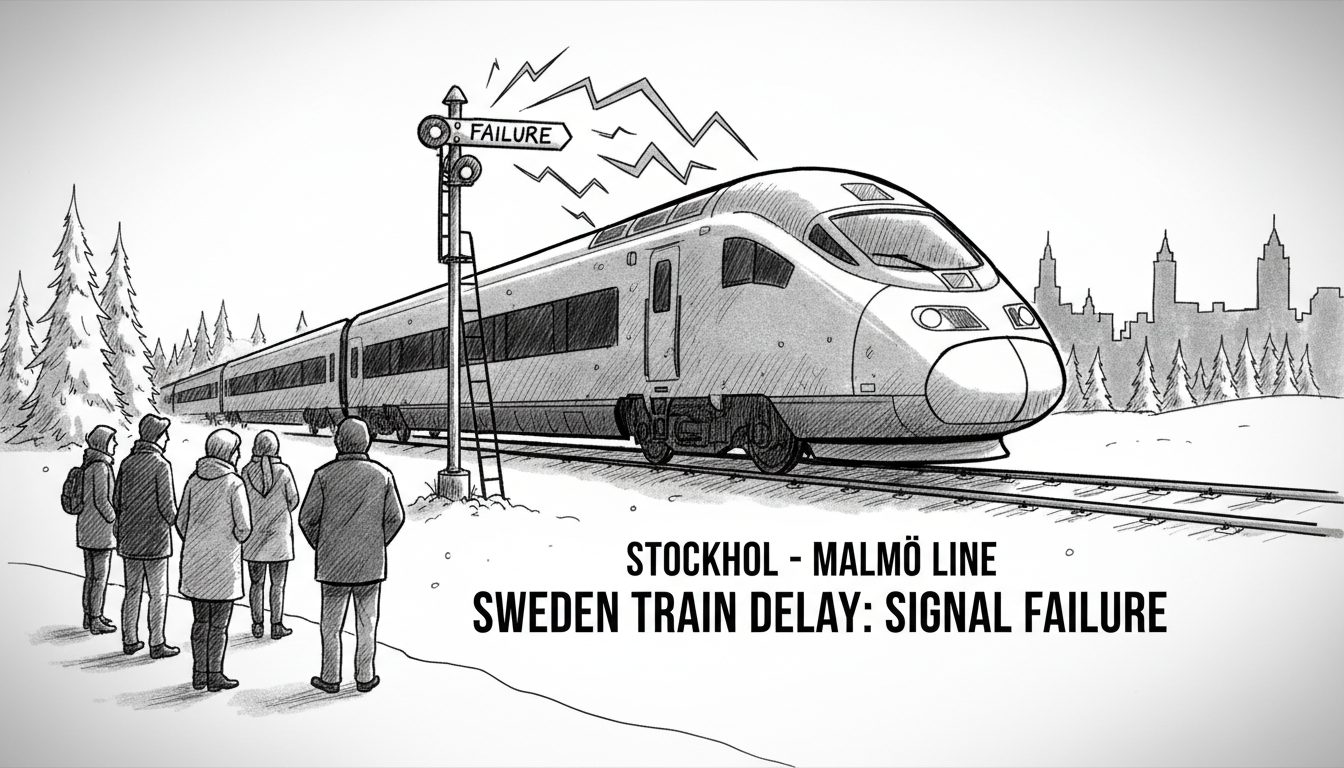
Sweden's vital Stockholm-Malmö rail corridor, handling thousands of daily passengers, is paralyzed by a signal failure this morning. The disruption on one of the nation's busiest lines spotlights the persistent vulnerability of the country's celebrated rail network to technical faults.
A signal system malfunction discovered at 5:19 AM near Katrineholm has brought all traffic to a standstill on the critical southern main line. Swedish Transport Administration (Trafikverket) controllers are scrambling to reroute some trains while arranging bus replacements for others. The stoppage between two major railway junctions, Katrineholm and Norrköping, effectively severs the primary link between the capital and Sweden’s third-largest city.
Commuters and long-distance travelers are facing major uncertainty. Morning rush hour plans are unraveling across the region. “I have a crucial meeting in Malmö at noon, and now I have no idea how I’ll get there,” said Elias Strömberg, a business consultant stranded at Stockholm Central Station. He checked his phone repeatedly for updates. “This is the second major delay for me this month. You start to lose faith.”
The Economic and Social Ripple Effect
This is not just an inconvenience for individual passengers. The Stockholm-Malmö line is an economic artery. It moves not only people but also a significant amount of freight. Delays here have a domino effect, disrupting connections to other cities like Gothenburg and Copenhagen. The 513-kilometer route is essential for business travel, tourism, and daily commuting in the broader Stockholm metropolitan region.
In 2022, punctuality for long-distance trains in Sweden was around 85%. This means 15% of trains arrived more than five minutes late. Signal failures are a leading contributor to these statistics. While Sweden invests heavily in its infrastructure, these incidents reveal the challenges of maintaining and modernizing a system under constant, heavy use.
“Our infrastructure is under strain from increased traffic and in some sections, its age,” explained Lena Forsberg, a transport analyst, in a recent industry report. She did not comment directly on today's incident. “Signal systems are complex. A single point of failure can halt an entire line. Continuous investment and proactive maintenance are non-negotiable for reliability.”
A Familiar Story for Swedish Commuters
For many Swedes, this morning's news brings a weary sense of déjà vu. Signal problems, often caused by technical glitches, extreme weather, or even vandalism, are a recurring headline. Each event reignites debate about the balance between high-speed ambitions and basic reliability.
At smaller stations along the affected route, the scene is one of frustrated patience. Travelers huddle around information screens showing columns of cancelled or delayed services. The promise of a ‘bussersättning’ or bus replacement is a cold comfort for a journey that should take just over four hours by high-speed train.
“I’m trying to get home to Norrköping after a conference,” said Sofia Karlsson, waiting at Stockholm Central. She sighed, looking at the crowded departure board. “It’s a common story. We’re told to take the train for the climate, which is right, but then the system fails us. It pushes people back toward their cars.”
How Trafikverket Manages the Crisis
The responsibility for managing this crisis falls to Trafikverket. Their traffic controllers are tasked with a complex logistical puzzle. They must determine which trains can be diverted onto alternative, often slower, routes. They must also coordinate with train operators like SJ and MTRX to source enough buses and drivers for the replacement services.
Communication is a critical challenge. Providing accurate, timely information to passengers is as important as fixing the physical signal fault. Trafikverket’s website and app, along with station announcements, become the primary lifelines for stranded travelers. The goal is to restore traffic flow while ensuring safety is never compromised.
The specific cause of today’s signal error will be investigated. Was it a component failure, a software issue, or external damage? Answers will come later. For now, the focus is on mitigation and restoration. Repair crews are on-site working to diagnose and fix the problem, but no estimated time for a full resumption of service has been given.
Looking Down the Track
This disruption serves as a stark reminder. Sweden’s vision for a fossil-free transportation future relies heavily on its railways. High-frequency, reliable train service is the cornerstone of this policy. Incidents like today’s signal failure in Katrineholm test public confidence in that transition.
Experts consistently point to the need for sustained funding to modernize signaling systems and increase network resilience. As passenger numbers grow, the system must not only expand but also become more dependable. The conversation often turns to projects like the future automated signaling system, which promises greater capacity and fewer faults, but is years from completion.
For the passenger on a cold platform today, the future is less abstract. It’s about whether they will make their meeting, get home to their family, or miss their flight. The true cost of the delay is measured in missed opportunities, stress, and eroded trust. As Sweden builds its green future, ensuring the trains run on time remains one of its most fundamental, and challenging, tasks. Will today's stoppage be a minor footnote or a catalyst for faster change?