
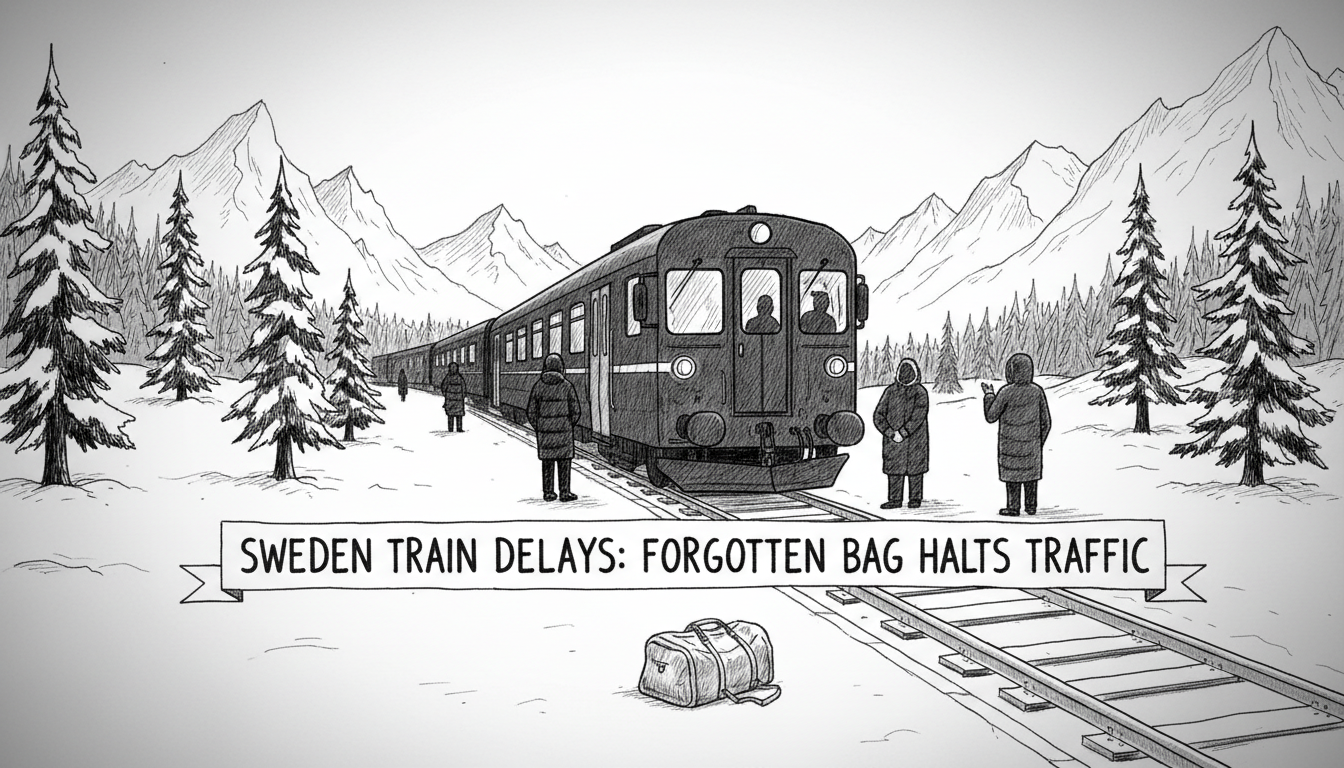
Sweden train delays cascaded across the southern network after a single forgotten bag brought a train to a standstill at Hässleholm station. The unattended suitcase, left on a commuter service, triggered a full-scale security alert. Police evacuated the train and blocked the track. The incident highlights a recurring tension in Swedish society between public safety and the smooth flow of daily life. For hours, the forgotten bag, or 'kvarglömd väska', was the most powerful object on the line.
"We have encountered a bag whose contents we do not know," said police spokesperson Leif Fransson. "No one on the train claimed it." This simple statement set in motion a familiar, disruptive protocol. Hässleholm is a critical railway junction. Delays rippled outwards, affecting connections to Malmö, Stockholm, and regional towns. Commuters sighed, checking their phones for updates. For them, it was another frustrating hiccup. For authorities, it was a necessary precaution.
The High Cost of Caution
Such incidents are not rare in Sweden. Unattended baggage is a common cause of temporary disruptions across the Swedish rail network, managed by Trafikverket. Each event forces a difficult calculation. The overwhelming majority of forgotten items are harmless—a student's backpack, a shopper's groceries left in a rush. But the potential consequence of ignoring the one dangerous bag is unthinkable. So the system defaults to caution. Trains stop. Stations partially evacuate. Police bomb technicians are called. The economic and social cost accumulates in missed meetings, delayed freight, and public irritation.
"Every unattended bag represents a risk assessment in real time," explains a railway security consultant who has worked with Swedish operators. "The procedure is clear, and for good reason. The challenge is executing it with maximum speed and minimum disruption, which requires excellent coordination between train staff, control centers, and police." On this day in Hässleholm, the coordination was methodical. Passengers were calmly moved away from the platform. The affected train sat empty, a silent vessel blocking a vital artery.
A Snapshot of Modern Swedish Stress
The scene at Hässleholm station became a brief tableau of modern Swedish stress. Business travelers tapped laptops, recalibrating their schedules. Parents wondered if they'd be late for after-school pickup. The communal sigh was almost audible. There's a particular Swedish ethos around punctuality and efficiency, a trust in the system to function smoothly. Events like this puncture that trust, however temporarily. They reveal the fragility of the infrastructure we take for granted.
Yet, alongside the frustration, there was compliance. No one argued about the evacuation. The social contract held. In a country with a deep-seated commitment to 'folkvett'—common sense and consideration for all—the collective understanding is that safety trumps schedule. This incident, like others before it, tested that balance. How long of a delay is acceptable for a bag that likely contains just gym clothes and a packed lunch? The authorities' answer is always: as long as it takes.
Beyond the Headline: A Systemic Challenge
For Trafikverket and the police, these incidents are a persistent operational headache. They tie up resources and generate negative headlines. The solution is not simple. Increased surveillance? More baggage checks? Such measures would fundamentally alter the open, accessible nature of Swedish public transport, which remains a point of pride. The current approach relies heavily on public vigilance: 'See something, say something.' But this also means the system is vulnerable to simple human forgetfulness.
Some transport analysts suggest smarter technology could help. Sensors or AI-driven video analysis might distinguish between a bag momentarily left by a seat and one truly abandoned. Others argue for clearer, more prominent public messaging. "We need to constantly remind people to keep their belongings with them," says the security consultant. "It sounds basic, but the frequency of these events shows it's a real problem. A moment's inattention by one person can disrupt thousands."
The Human Element in a Digital Age
As the afternoon wore on in Hässleholm, the mystery of the bag was solved. Police technicians conducted their controlled check. The contents were, as many suspected, innocuous. No threat was found. The all-clear was given. A collective reset button was pressed. Crews re-boarded the train. Signals turned green. The delayed services began, one by one, to creep back toward their timetables.
But the owner of the bag never came forward. It was taken to the police lost property office, another unclaimed item. This final detail is perhaps the most telling. In our digital age, we are traceable every second through our phones. Yet a physical object, detached from its owner, can still bring a piece of the modern world to a halt. It is a low-tech glitch with high-tech consequences.
The passengers dispersed, their routines slowly stitching back together. The incident will appear in Trafikverket's statistics—another unattended baggage delay. For the commuters, it becomes a story to tell over dinner: "You won't believe why I was late today." For Swedish society, it's a recurring rehearsal. A test of patience, procedure, and priority. It asks, quietly, what price we are willing to pay for safety, and how much trust we place in the strangers who share our train car, and sometimes, forget their luggage.
Will the next forgotten bag cause the same large-scale disruption? Almost certainly. Because in the delicate ecosystem of public transport, the greatest risks are often the most ordinary. And in Sweden, the response will continue to be thorough, cautious, and, for hundreds of waiting passengers, deeply inconvenient. The system, by choosing safety over speed, reaffirms a core value. Even when that value means staring at a delayed departure board, wondering about the contents of a lonely suitcase on a platform in Hässleholm.