
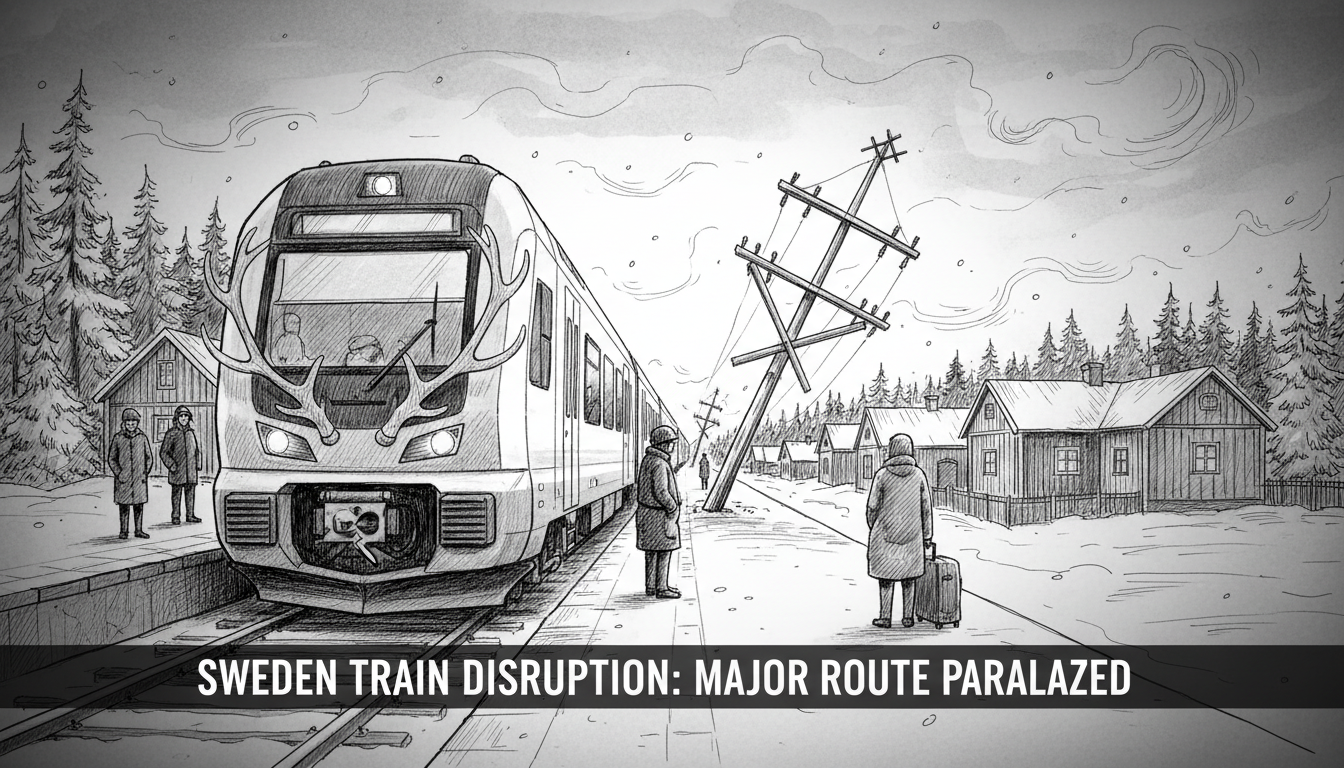
Sweden train delays cascaded across the country after a major incident near Floda paralyzed the crucial Gothenburg-Alingsås line. The stoppage, caused by an accident reported at 5:30 PM, halted all long-distance and regional trains, stranding thousands of evening commuters and travelers heading to cities like Stockholm, Hallsberg, and Skövde. For a nation that prides itself on functional public transport, the sudden silence on the tracks was a stark reminder of systemic fragility.
"I’ve been standing here for an hour, and all the boards just say 'cancelled'," said Elias Berg, a student trying to get back to his Stockholm apartment after visiting family. He stood amid a growing crowd inside Göteborg Central Station, one of Sweden’s busiest hubs handling millions of passengers yearly. The atmosphere shifted from routine irritation to palpable frustration as the scope of the disruption became clear. With no clear restart time announced by Trafikverket, the Swedish Transport Administration, alternative arrangements were scarce.
A Commuter Corridor Grinds to Halt
The affected line is a lifeline for western Sweden. Floda, the locality in Lerum Municipality where the accident occurred, sits just 25 kilometers northeast of Gothenburg. This isn't a minor branch line; it's a main artery. Every halted regional train meant hundreds of commuters from towns like Alingsås unable to return home. Every cancelled long-distance service disrupted travel plans across the country. The ripple effect was immediate and severe. Travelers bound for Stockholm faced a complete standstill, with connections in cities like Skövde and Hallsberg also thrown into chaos.
This single-point failure exposed a key vulnerability in the network. Railway analysts have long pointed to the risks associated with heavily used single-track sections and the need for greater infrastructure investment to withstand disruptions. "When a primary route like this goes down, the entire system's resilience is tested," explains transport analyst Lena Falk. "The focus immediately turns to communication and alternative transport, which are often the first points of public criticism."
The Human Cost of Standing Still
Beyond the network maps and delay statistics, the story unfolded in the packed waiting halls and frantic phone calls. For Malin, a nurse finishing a shift at Sahlgrenska University Hospital, the stoppage meant an uncertain wait and a likely expensive taxi ride home to Alingsås. "My shift ended at six. Now I’m just stuck," she said, glancing at her phone for ride-sharing prices. The economic impact of such disruptions is significant, from individual taxi fares to lost productivity, but the social cost—the stress and erosion of trust in a core public service—is harder to quantify.
In 2023, Swedish train punctuality already lagged behind national targets. Incidents like this amplify public perception of a system under strain. At the heart of the Swedish model is a social contract built on reliability and collective efficiency. When the trains stop without warning, that contract feels broken. Passengers I spoke to expressed less anger about the accident itself—these happen—and more about the opacity of information and the lack of swift contingency plans.
A National Ripple Effect
The impact was not contained to Västra Götaland County. A Gothenburg train accident doesn't just affect local commuters. The interconnectedness of Sweden's rail network means a blockage in the west sends shockwaves eastward. Long-distance services to the capital were severed. Business travel, freight logistics, and inter-city tourism faced immediate setbacks. This underscores how vital this corridor is for national mobility and the economy.
Trafikverket's initial brief statement, promising more information later, is a standard but often frustrating protocol. In the digital age, passengers expect real-time updates and clear guidance. The absence of that fuels anxiety. While replacement bus services are sometimes mobilized for regional traffic, they are rarely feasible for long-distance routes, leaving passengers to their own devices.
Infrastructure and the Swedish Promise
Sweden's identity is intertwined with functional infrastructure. The train system is more than transport; it's a symbol of egalitarian access and environmental progress. A major stoppage challenges that self-image. It prompts difficult questions about investment priorities and maintenance schedules. Is the system being stretched too thin? Are backup plans effective enough?
Experts argue that building redundancy into critical networks is essential. This could mean more parallel tracks or improved systems for managing traffic during disruptions. The goal is not just to fix problems, but to prevent a single incident from crippling an entire region. The conversation post-disruption often turns to these broader systemic needs, only to fade until the next crisis.
Looking Down the Track
As evening turned to night, the stations slowly emptied as people found costly alternatives or gave up their travel plans entirely. The true resolution time for the line remained uncertain. For the thousands affected, the incident was a personal inconvenience. For the system's managers, it is another data point in the ongoing challenge of maintaining an aging, heavily used network.
The question lingering in the cool evening air outside Göteborg Central was not just when the trains would run again, but how Sweden can future-proof the arteries that connect its society. Will this incident become a catalyst for discussing deeper infrastructure resilience, or merely another footnote in a year of delay statistics? The answer depends on whether the commitment to a reliable, sustainable transport system can move from principle to practice, even under pressure.