
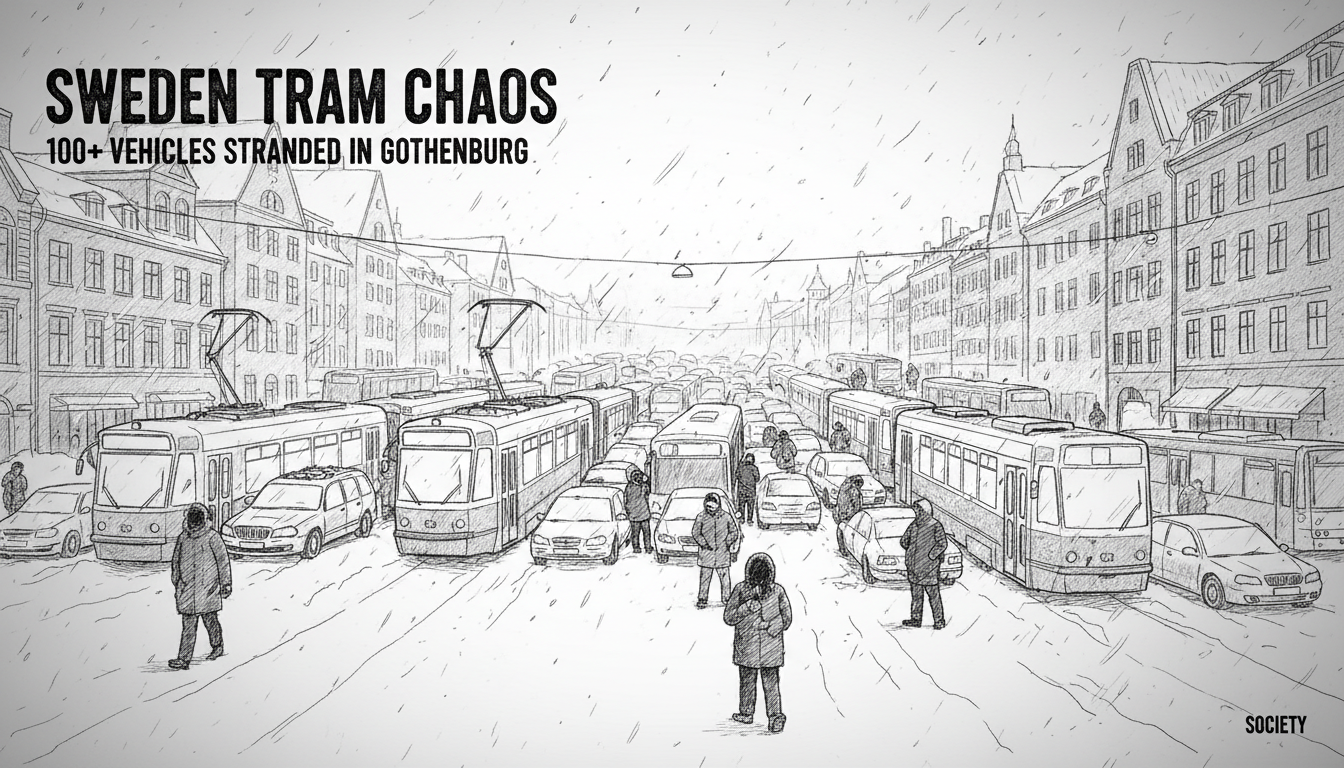
Sweden's Gothenburg ground to a standstill as over 100 trams and their drivers became trapped in their own tracks. Heavy snowfall and stalled plowing efforts brought the city's entire tram network, a system carrying nearly 300,000 daily passengers, to a complete halt. 'We have several trams stuck. We can't continue driving right now,' said Daniel Gaffby of Göteborgs Spårvägar, stating the simple, stark reality for a paralyzed city.
The scene on Wednesday morning was one of surreal stillness. Where the familiar green and blue trams should have glided past, there was only thick, uncompromising snow. The iconic lines—from the Number 11 circling the city center to the Number 5 heading out to Köpstadsö—were silent. Passengers bundled in winter coats waited at sheltered stops, their faces illuminated by phone screens displaying the same message across all travel apps: 'Ingen trafik.' No traffic.
A City Grinds to a Halt
For residents, the tram isn't just transport; it's the city's pulse. Students rely on it to reach Chalmers University. Workers need it to commute to industrial areas in Arendal. Shoppers use it to travel to Nordstan. Its failure created a cascade of disruption. Buses were overwhelmed. Taxi queues stretched for blocks. Cyclists, usually undeterred by Nordic weather, found even bike lanes impassable. The snow didn't just fall; it strategically defeated the system designed to handle it. 'The amount of snow and the plowing are the reasons,' Gaffby noted, pointing to a core municipal function that simply couldn't keep pace.
On Socialhögskolan's campus, sociology lecturer Erik Malm commented on the societal ripple. 'This exposes our hidden dependencies,' he said. 'We design compact, sustainable cities around these networks. One node fails, and the efficiency unravels. People miss healthcare appointments, children can't get home from daycare, and hourly workers lose pay. The social cost of a stalled tram is immense.'
Stranded in the Snow
The human stories emerged from the frozen tracks. One driver, Anna, who has been navigating Gothenburg's lines for a decade, described her experience from a stranded vehicle on Linnégatan. 'We started the route, but the snow just built up between the rails,' she explained via a brief phone call. 'The wheels lost grip. You have this powerful machine that is utterly useless. My main job became reassuring passengers and waiting for help that we knew would take hours.' She described sharing her emergency thermos of coffee with an elderly passenger.
Similar scenes played out across the city. In the Hising island district, a tram sat motionless near Lindholmen, its interior lights a warm capsule against the white blur outside. Commuters, initially frustrated, settled into a resigned camaraderie. Jens, a graphic designer who was aboard, recounted the moment. 'It was strangely peaceful after the initial annoyance. Someone started a crossword. We shared what snacks we had. For a few hours, we were just people in the same situation, not strangers ignoring each other on our phones.'
The Infrastructure Challenge
This incident is more than a bad weather day. It raises pointed questions about climate resilience in a country famous for managing winter. Gothenburg's tram network is one of Europe's most extensive, a point of pride for the environmentally conscious city. Yet, this event showed its vulnerability. Experts point to a combination of factors: the specific wet, heavy consistency of the snow, potential gaps in the plowing schedule during peak snowfall, and the inherent limitation of trams which cannot detour around an obstacle.
Urban planner Katarina Svensson, based in Stockholm but familiar with Gothenburg's system, offered analysis. 'This is a stress test. Our cities are built on reliable public transport. As weather patterns become more extreme, these systems need investment not just in maintenance, but in adaptation. That could mean different plowing tech, heated tracks in key areas, or better contingency protocols. The 'plogning'—the plowing—is a cultural institution here. When it fails, confidence wavers.'
The economic toll is still being calculated. Retailers in central business districts reported dramatically lower footfall. Restaurants saw lunch reservations vanish. Delivery services for everything from food to parcels faced major delays, creating a knock-on effect that will last days.
Cultural Patience Meets Modern Expectation
The Swedish concept of 'försiktighetsprincipen'—the precautionary principle—was on full display, with authorities choosing a full shutdown to prevent accidents. There’s a deep-seated cultural trust in official decisions here. Yet, this was challenged by modern expectations of constant mobility and real-time information. Social media filled with both understanding jokes—'Göteborg, the city that mastered snow, until today'—and genuine anger from those whose daily lives were fractured.
By late afternoon, a massive coordinated effort was underway. Heavy-duty tow trucks and specialized de-icing crews worked route by route. The priority was to free the immobilized vehicles and their drivers, a slow, meticulous process. Recovery, officials warned, would take the rest of the day and into the night. Bus replacement services were finally organized on major corridors, but coverage was patchy.
As dusk fell early over the snowy city, the questions remained. The trams will eventually run again. The snow will melt. But the memory of this standstill lingers. It serves as a stark reminder that even in a society renowned for order and function, nature can still write the agenda. The incident forces a conversation about what true resilience looks like for Sweden's second city as it faces future winters. How does a culture that takes pride in overcoming the dark and the cold adapt when its most trusted tools fail it? The answer will shape the future of every commute on every frozen morning to come.