
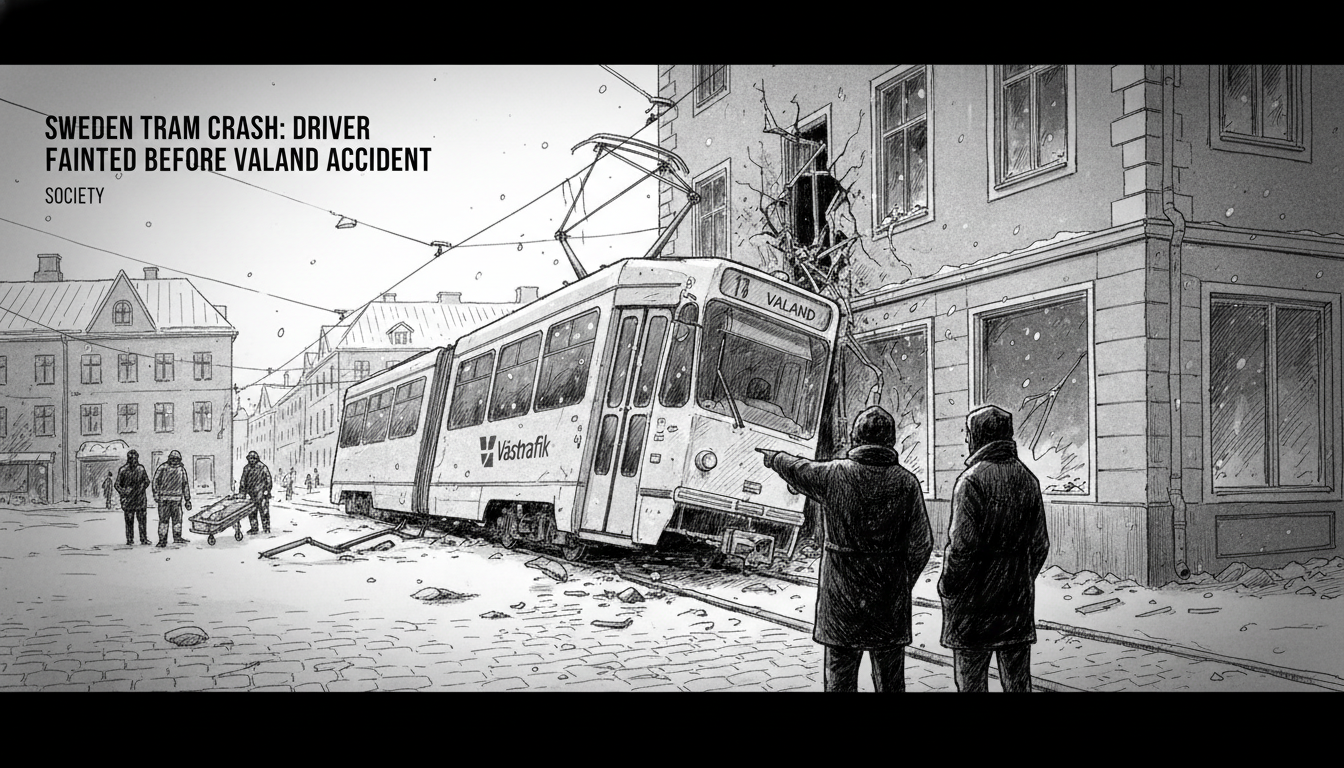
Sweden's Gothenburg tram crash investigation reveals the driver lost consciousness immediately before the collision. The operator Göteborgs Spårvägar has released its official report on the Valand incident, containing the driver's first-hand account. "I fainted immediately and I don't remember anything after that," the driver wrote in a personal description submitted to investigators. This admission places sudden medical incapacitation at the center of a major public transport safety review.
A Sudden Loss of Control at a Central Hub
The accident occurred at Valand, a critical junction in Gothenburg's city center where multiple tram lines converge. Valand serves as a major transit point, with high pedestrian traffic and frequent vehicle movements. A tram losing control here presents a worst-case scenario for city planners. Initial reports described a collision causing significant damage to the tram and surrounding infrastructure, though no serious injuries to passengers or the public were reported. The immediate aftermath saw service disruptions across several lines, highlighting the network's vulnerability to single-point failures.
Göteborgs Spårvägar, the municipal-owned public transport company, launched a technical and operational investigation. Their final report, now public, incorporates the driver's testimony alongside data from onboard systems. The driver's statement provides a clear, yet alarming, causal chain: sudden fainting, followed by a complete memory gap regarding the crash sequence. This direct account shifts the investigation's focus from mechanical failure or human error to occupational health and preventative medical screening.
The Investigation's Findings and Immediate Response
The investigation concluded the tram was mechanically sound and operating within all normal parameters prior to the incident. No signals were missed, and no external factors, like other vehicles or pedestrians, precipitated the event. Data recorders showed the tram proceeding normally before an abrupt cessation of control inputs, consistent with the driver's account of fainting. The vehicle's safety systems, designed to bring it to a stop if no driver activity is detected, were engaged but could not prevent the collision given the proximity to the Valand platform.
In response, Göteborgs Spårvägar has initiated a two-pronged strategy. First, they are reviewing medical check-up protocols for all operational staff, particularly drivers. Second, they are accelerating a pre-existing program to enhance automated safety features on the tram fleet. A company spokesperson stated, "The safety of our passengers and staff is paramount. This incident, while rare, forces us to scrutinize every layer of our safety regime." The driver involved is currently on paid administrative leave pending a full occupational health assessment.
Expert Analysis on Transport Safety Protocols
Transportation safety experts note that while rare, sudden medical events among operators represent a persistent risk in all modes of public transit. "This case in Gothenburg is a stark reminder that safety is not just about vehicles and tracks," says Dr. Lena Falk, a professor of transportation systems at Lund University. "It's about the human element. The protocols for monitoring driver health and the fail-safes for sudden incapacitation are now under the microscope. Many systems rely on a 'dead man's switch,' but the timeframe between incapacitation and system activation is critical."
Dr. Falk emphasizes that international best practice is evolving. "The discussion is moving towards more sophisticated driver monitoring systems, similar to those being tested in aviation and rail, that can detect micro-sleeps or loss of consciousness earlier. However, implementing these must balance safety with privacy concerns for employees." She also points out that Sweden's generally high standards for public transport safety mean any incident triggers a thorough review, which can set new benchmarks for other cities.
Systemic Implications for Swedish Public Transport
This incident reaches beyond Gothenburg's city limits, prompting questions at the national level. The Swedish Transport Administration (Trafikverket) monitors all major transit incidents and may issue new guidance. A key question is whether national regulations for medical examinations for professional drivers, which are already stringent, require tightening. The current framework mandates regular health checks, but the frequency and scope are partly determined by the employer.
Furthermore, the accident touches on broader investments in transport infrastructure. The Swedish government and the Riksdag have allocated substantial funds to modernize public transit, with a strong emphasis on safety and automation. Incidents like Valand provide concrete data points for parliamentary committees reviewing the effectiveness of these investments. They underscore the argument that modernization must encompass both rolling stock and human factors engineering.
The Path Forward: Technology and Policy
Göteborgs Spårvägar's next steps will be closely watched. The company has indicated it will evaluate advanced driver-assistance systems (ADAS) that could take corrective action faster than current protocols. These could include automated braking if an obstacle is detected and no driver input is present, or even systems that monitor a driver's alertness via cameras or sensors. However, such technology requires significant investment and union consultation.
From a policy perspective, the event may influence ongoing debates in the Riksdag about transport safety funding. It provides a real-world example of a risk that is often theoretical in policy discussions. Advocates for increased safety spending will likely reference Valand to argue for accelerated implementation of next-generation safety tech across Sweden's tram and bus networks. The challenge for policymakers will be to translate the lessons from a single, non-fatal incident into effective, proportionate, and funded national standards.
A City Reliant on Trams Reflects on Safety
Gothenburg's identity is intertwined with its iconic blue and white trams. For residents, they are a dependable and environmentally friendly backbone of daily life. An incident where the driver, the human element of this system, becomes unexpectedly incapacitated, resonates deeply. It challenges the perceived infallibility of a trusted system. The transparent handling of the investigation, including the release of the driver's own words, aims to maintain public trust.
The final measure of this incident's impact will be the tangible changes it produces. Will driver health monitoring become more rigorous and technologically assisted? Will new trams be ordered with more advanced autonomous safety overrides? The answers will determine whether Valand becomes a footnote or a turning point in the history of Swedish public transport safety. For now, the driver's simple statement—"I fainted directly"—echoes as a powerful catalyst for reflection and, potentially, reform across an entire industry.